Need help?
Do you have a question about the AutoCrib ROBOCRIB TX750 and is the answer not in the manual?
Description of warranty coverage for dispensing machines.
Details the standard warranty duration from the ship date.
Outlines software support terms and access to upgrades.
Defines the terms for an extended warranty contract.
Information on purchasing systems through authorized distributors.
Lists specific conditions not covered by the warranty.
AutoCrib's right to make changes to products.
Legal disclaimer on AutoCrib's responsibility and damages.
Main contact information for AutoCrib.
Contact details for regional representatives.
Lists items included with the RoboCrib TX750.
Technical details and dimensions of the RoboCrib TX750.
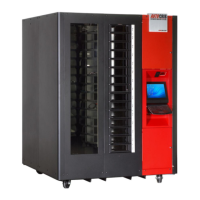
Overview of the machine's capabilities and design.
Lists key technical specifications and features.
Explains the basic step-by-step operation of the machine.
Lists part numbers and descriptions for repair purposes.
Continuation of the list of repair parts.
Essential safety and operational warnings for setup.
Explains wiring color conventions for safe installation.
Lists the necessary tools for setting up the machine.
Steps for unpacking and preparing the machine for setup.
Guidelines for safely moving the RoboCrib TX750.
Steps for positioning, accessing, and leveling the machine.
Instructions for connecting power and network cables.
Information on connecting the CAT5 network cable.
Steps to turn on and verify system power.
Locating and operating the controller power switch.
Procedures for testing machine motors.
Connecting peripherals and network to the management station.
Power connections, startup, and network configuration.
Identifies ports on the computer tower.
Steps to restore the system database.
Using SSMS to manage database restore settings.
Navigating to find the correct backup file.
Choosing the target database for restore.
Relocating database files for restore.
Overwriting database and completing restore process.
Launching the software after database restore.
Exiting SuperRobo, logging in, and verifying settings.
Setting up machine parameters and controllers within software.
Steps for preparing to stock items by creating POs and tags.
Receiving items and generating inventory reports.
Procedure for stocking using the tag system.
Steps to select and issue a single item.
Detailed process for selecting multiple items via search and cart.
Procedure for manually restocking items.
Steps to count items in individual bins.
Procedure for counting all bins.
Process for returning items to the machine.
Procedure to find item location within the system.
Process for configuring bins and assigning items.
Choosing a column in the layout diagram for configuration.
Setting floor position and bin height for new bins.
Specifying bin quantity and installing bin floors.
Linking items to specific bin locations.
Procedure to create larger bins by removing center walls.
Overview of category, family, type relationships for item search.
Steps to define item families.
Steps to define item types.
Associating families to their parent categories.
Associating types to their parent families.
Linking items to their specific types.
How to filter and display items by category.
Displaying items in grid or image formats.
Step-by-step guide for filtering and issuing items.
Steps to exit software and initiate auto-calibration.
Guidelines for correctly stocking items.
Using console mode for advanced operations and testing.
Using Putty for remote bin access and commands.
Commands for fetching bins and calibrating via Putty.
Detailed list of commands for machine control.
Further commands for version, status, and configuration.
Detailed explanation of stall settings for various moves.
Meanings and actions for calibration errors C0-C4.
Further details on calibration errors.
Description and action for S1 stall error.
Description and action for S2 stall error.
Description and action for S3 stall error.
Description and action for S5 stall error.
Description and action for S6 stall error.
Description and action for S7 and S8 stall errors.
Description and action for S9 stall error.
Procedures for repairs and cleaning components.
Conditions affecting safe machine operation.
Recommended tasks for system upkeep.
Specific cleaning steps for surfaces, windows, keyboard.
Tasks for the first month of operation.
Annual maintenance tasks.
Details on cabinet, base, and table brackets.
Specifications for table/stack motors, bearings, and chains.
Details on bin configurations, tambour, and front door.
Details on bin profiles, shelf inserts, and retainers.
Specifications for the front door and tambour subsystem.
Details on tambour motors and lead screws.
Specifications for LED array and calibration.
Description of safety sensor systems.
Details on accessory frame, peripherals, and UPS.
Details on controller board and related components.
Specifications for power supply and controller firmware.
 General
| Model | ROBOCRIB TX750 |
|---|---|
| Capacity | Up to 750 items |
| Dimensions | Varies based on configuration |
| Weight | Varies based on configuration |
| Power Supply | 110-240 VAC |
| Connectivity | Ethernet |
| Material | Steel |
| Access Method | RFID |
| Interface | Touchscreen |
| Power Requirements | Standard wall outlet |

 To Next Page