DL06 Micro PLC User Manual, 3rd Edition, Rev. E
5-135
Chapter 5: Standard RLL Instructions
1
2
3
4
5
6
7
8
9
10
11
12
13
14
A
B
C
D
This means a HEX table of two V-memory locations would require four V-memory locations
for the equivalent ASCII table. The function parameters are loaded into the accumulator stack
and the accumulator by two additional instructions. Listed below are the steps necessary to
program a HEX to ASCII table function. The example on the following page shows a program
for the HEX to ASCII table function.
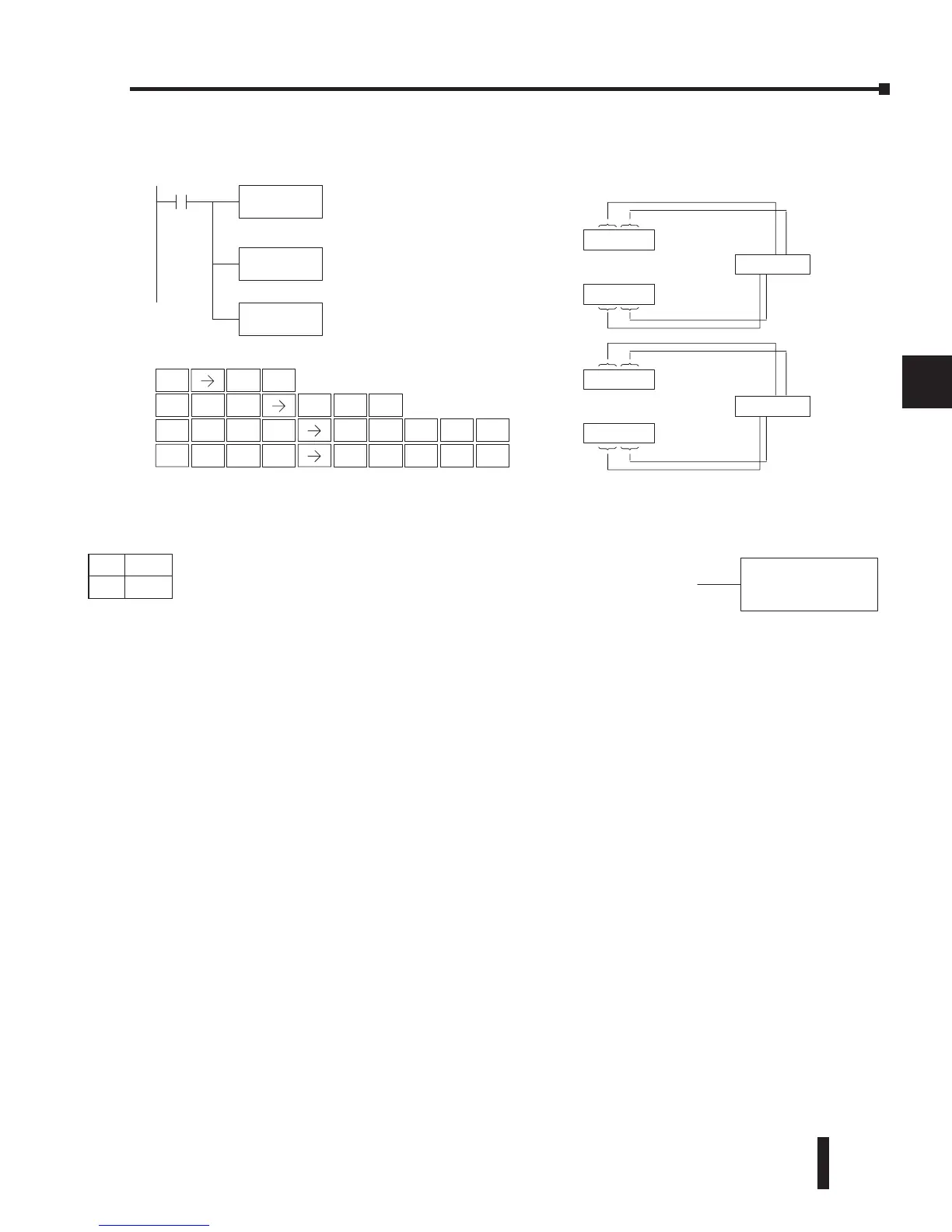
Step 1: Load the number of V-memory locations in the HEX table into the first level of
the accumulator stack.
Step 2: Load the starting V-memory location for the HEX table into the accumulator.
This parameter must be a HEX value.
Step 3: Specify the starting V-memory location (Vaaa) for the ASCII table in the HTA
instruction.
Helpful Hint: — For parameters that require HEX values when referencing memory locations,
the LDA instruction can be used to convert an octal address to the HEX equivalent and load
the value into the accumulator.
LD
K4
X1
Load the constant value
into the lower 16 bits of the
accumulator. This value
defines the number of V
memory location in the
ASCII table
LDA
O 1400
Convert octal 1400 to HEX
300 and load the value into
the accumulator
ATH
V1600
V1600 is the starting
location for the HEX table
ASCII T ABLE
Equivalents
1234
33 34
V1400
5678
31 32
V1401
37 38
V1402
35 36
V1403
V1600
V1601
STR
$
SHFT
ANDST
L
3
D
7
H
SHFT
MLR
T
SHFT
1
B
ENT
ENT
4
E
0
A
0
A
ENT
1
B
6
G
0
A
0
A
Handheld Programmer Keystrokes
PREV
ANDST
L
3
D
ENT
1
B
4
E
0
A
0
A
aaaV
HTA
DS Used
HPP
N/A
DirectSOFT
HEX to ASCII (HTA)
The HEX to ASCII instruction converts a table of HEX values to
a specified table of ASCII values. HEX values are one digit and
their ASCII equivalents are two digits.


 To Next Page