Technical Specification page 39
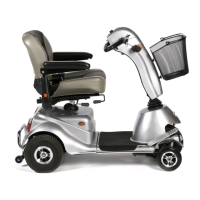
Quingo Plus Quingo Classic
(Differences only)
Class Type Class 3 Pavement 4mph – Road 8mph Class 2
Length/Width 122cm/48” x 64cm/25”
Height-seat at lowest setting 116cm/46” 90cm/36”
Wheelbase 84cm/33”
Seat width 48cm/19” 46cm/18”
Seat depth 30.5cm/12” measured to ISO 7176.7
Backrest height min/max 61cm/24” to 66cm/26” 41cm/16” to 41cm/16”
Seat height from floor min/max 45cm/18” to 55cm/22”
Seat height from ground min/max 60cm/24” to 70cm/28”
Legroom min/max 75cm/29.5” to 90cm/35.4” **
Foot room 20” to 23” – 51cm to 58” ****
Total unladen weight 107kg/236lb 100kg/220lb
Weight of each battery 14.4kg/32lb 11.2kg/25lb
Weight of heaviest component 34kg/74kg
Tyre type/Pressure F&R Pneumatic/pressure 30psi/2.1bar
Suspension Front Floating axle with independent outer wheels
Suspension Rear Twin coil spring (Adjustable)
Motor 400-watt constant load 250 watt constant load
Battery Capacity Quingo 12V 50Ah x 2 off 12V 35Ah x 2 off
Maximum Capacity 159kg/25st/350 lbs
Max. Speed 12.8 kph/8 mph 6.4 kph/4 mph
Range 48km/30miles (See notes regarding range) 37km/23miles (see notes)
Ground Clearance c/l of vehicle 127mm/5” *
Turning radius 107cm/43”
Safe climbing angle 12 Degrees
Kerb climbing 75mm/3” ***
* Measurement taken from the centre of the vehicle.
** From the hip joint area to the ball of the foot
*** Measured as a safe maximum kerb height
**** Measured from the rear cover to the end of the footplate
Note on Range:-
The above range figures are theoretical, produced in accordance with ISO 7176-4
ISO 7176-4 specifies a method for determining the theoretical distance range of electrically powered wheelchairs
and scooters by measuring energy consumed over a specified distance. It is applicable to electrically powered
wheelchairs and scooters with a maximum speed not greater than 15 km/h, intended to provide indoor and/or
outdoor mobility for one disabled person whose mass is within the range presented by ISO 7176-11.
The distance range of an electrically powered wheelchair is affected by energy consumption and battery
condition. Energy consumption is affected by a number of factors such as ambient temperature, total weight and
weight distribution of the user, topography, surface characteristics, and tyres. Battery condition is affected by
factors such as temperature, age, charging history and discharging history. Hence the result obtained from the
test specified in this part of ISO 7176-4 cannot be used to derive an accurate range estimate for a particular
wheelchair (or scooter) and user. However, it can be used to give a basis for comparison between different
wheelchairs or scooters under similar test conditions.
Factors can change the performance of the batteries such as:
Ambient temperature / weather
Age and use
Weight of the driver
Terrain it is driven on (Driving on grass / soft ground halves the range)
Incorrect tyre pressures
Note
Specifications are correct when going to press.
Advanced Vehicle Concepts Ltd retains the right to change specifications without prior notice.



 To Next Page