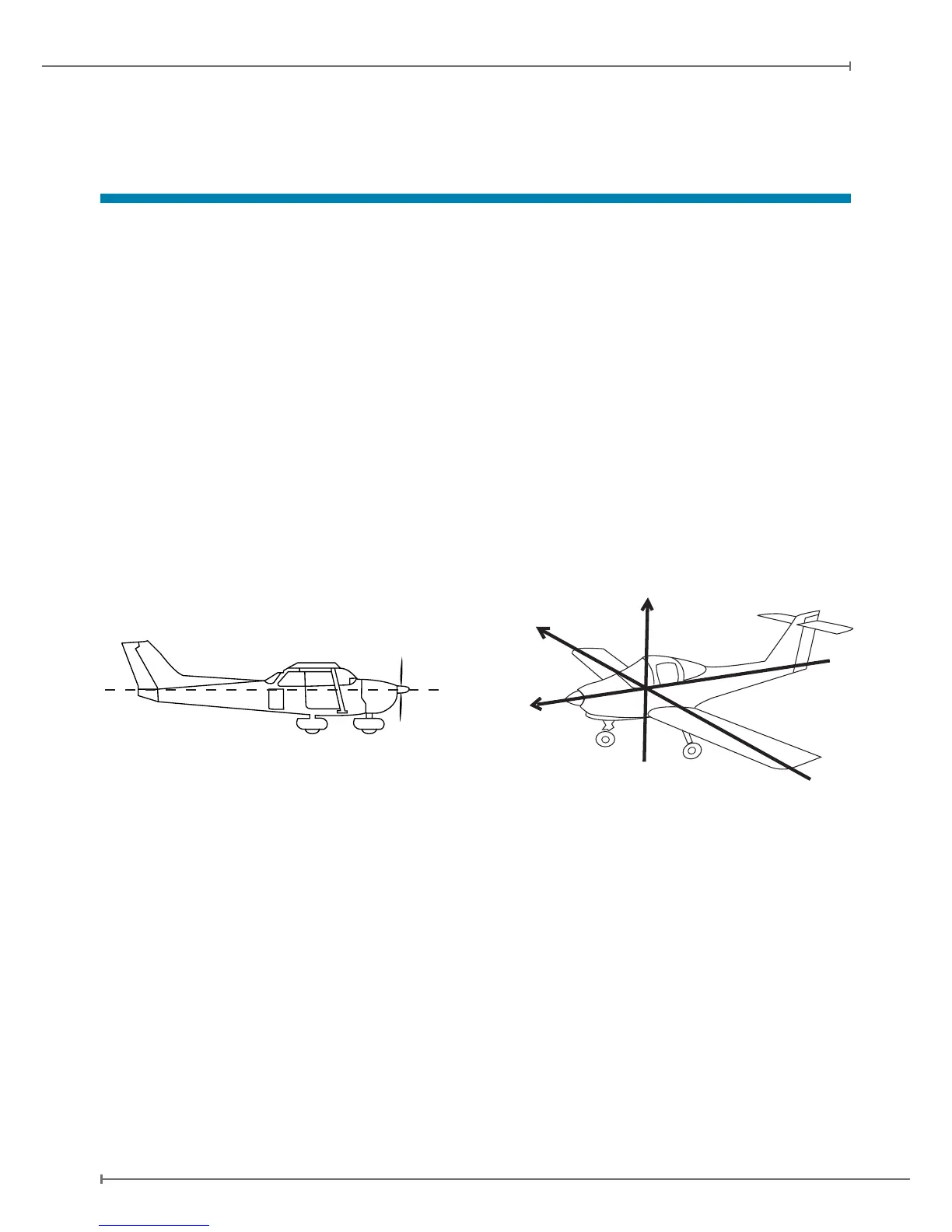
Lateral Axis
Normal or Vertical Axis
Longitude Axis
Figure 8
Level & Straight Flight Attitude
wire remains out of function and is to necessary to be connected to the external device.
Note: See paragraph 4.5 for NMEA-OUT settings.
3. System Calibration
There are three types of calibration procedures;
1. Horizon alignment calibration
2. Compass calibration
3. Altimeter calibration
3.1 Horizon alignment calibration (AHRS)
Scenario A – Horizon alignment calibration NOT required
It is assumed that the Ultra is installed in an instrument panel that is completely
perpendicular compared to the level & straight ight attitude and aligned with the lateral
axis of the airplane.
In this case no horizon alignment calibration is needed.
Scenario B - horizon alignment calibration required
In case the Ultra is installed in an instrument panel that is aligned with the aircraft lateral
axis, but not perpendicular to the straight & level ight attitude, the simple horizon alignment
calibration procedure must be executed.
Note: The horizon calibration corrects also a roll oset, if it is not perfectly alligned with the
aircraft laterall axis.
Horizon alignment calibration procedure
Execute this calibration procedure to align the horizon line of the Ultra with the aircrafts
straight & level ight attitude.
The procedure can be performed on the ground or in ight (with 2 people on board). The
Ultra must be powered since at least 2 minutes before processing the calibration. When
performing the calibration the ground, set the aircraft in level and straight ight attitude by
using jacks or blocks (or by asking a friend to push or lift the tail and hold). If its known that
the aircraft ies in “x” degrees ‘nose high’ straight and level ight, a digital level can be used
to orient the aircraft to normal ight attitude prior to the calibration. It is possible to perform


 To Next Page