check that there is enough clearance for the opening motion of the check damper closure on the fan outlet end (the check damper is sold separately);
It is recommended to connect the fan to the duct system using a exible pipe connection!
•
Place the fan body (8) and the xing plugs in the previously prepared holes.
•
Fasten the fan to the holes in the substructure by driving the wall bolts through the bolt holes (5) and into the wall plugs.
•
Remove the outer insulation from the power cable and remove the 4 mm of insulation from the wires.
•
Arrange the power cable and connect according to the electrical wiring diagram applicable to the model installed.
•
Verify that the power cable cores are held tight by the terminals.
•
Check the duct fan for the soundness of mounting and correct electrical installation.
•
Adjust the operating parameters as follows:
Part index sux T, H and M: Set the stop delay time and the humidity sensor sensitivity level with the key (3) using the potentiometer knobs on the electronic module (7).
•
Attach the housing panel (1) to the middle part of the fan housing (8) with the screws (6).
•
Attach the fan frame (2).
•
Check that the power cable is sealed properly in all grommets and glands.
- The connection cable must be protected in such a way that water cannot penetrate live parts along the cable in case of ooding.
•
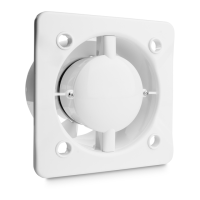
Install the front panel which acts as a guard against contact with moving parts (item sold separately).
ATTENTION! A rotating impeller can crush your ngers!
It is forbidden to start the fan without a protective mesh against touching the moving parts!
First start
Start the fan only with all safety precautions in place and all hazards eliminated. Check that it runs steadily and the air is handled eciently (out of the room and through
the air exhaust ductwork to the outside).
Check the operation of the fan (noise, vibration, the possibility to control the rotation speed).
Operate the fan only with the front bezel installed, as it is a direct touch guard on the suction side. Depending on the actual installation conditions, the fan may require a
protection against touching the moving parts on the delivery side. Suitable delivery-side direct guards can be provided on request. If the fan is guarded against direct
17
EN



 To Next Page