Need help?
Do you have a question about the Axis P1368-E and is the answer not in the manual?
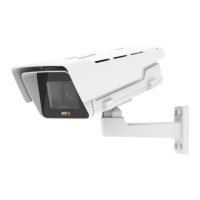
The AXIS P1368-E Network Camera is a robust surveillance device designed for various monitoring applications, offering a comprehensive set of features for video recording, image optimization, and event management.
The AXIS P1368-E is a network camera that captures video streams and can store them locally on an SD card or on network storage. It supports Power over Ethernet (PoE) for simplified installation, allowing both power and data to be transmitted over a single cable. The camera is equipped with various connectors for external devices, including I/O for alarm notifications and control, RS485/422 for auxiliary equipment like pan-tilt devices, and audio input/output for recording and public address systems. The device's core functionality revolves around providing high-quality video surveillance with advanced image processing capabilities.
The camera offers a wide array of usage features to optimize video quality and manage surveillance effectively. For image optimization, it includes settings to reduce noise in low-light conditions by adjusting the blur-noise trade-off, setting exposure mode to automatic, slowing down shutter speed, and opening the aperture. Users can select different exposure modes such as Automatic exposure, Flicker-free for artificial lighting, Flicker-reduced for mixed lighting conditions, and Hold current to lock settings. To maximize details in an image, the camera allows for fine-tuning, though this may increase bitrate and reduce frame rate.
The AXIS P1368-E supports Wide Dynamic Range (WDR) to handle scenes with strong backlight, making both dark and bright areas visible. This feature can be enabled and adjusted to cover areas of interest, though users should be aware that WDR can sometimes cause artifacts. The camera also allows for text overlays in the video stream, which can be triggered by events like motion detection, providing additional information during recordings.
For efficient bandwidth and storage management, the camera offers bitrate control with options for Variable Bitrate (VBR), Maximum Bitrate (MBR), and Average Bitrate (ABR). VBR adjusts bandwidth based on scene activity, guaranteeing constant image quality. MBR allows setting a target bitrate to manage limitations, prioritizing either image quality or frame rate. ABR automatically adjusts bitrate over time to meet specified targets and available storage, optimizing video quality. The camera supports different video compression formats, including Motion JPEG for high image quality and access to individual frames, and H.264 for significant reduction in file size and bandwidth without compromising image quality.
The camera facilitates monitoring long and narrow areas using corridor format, which better utilizes the full field of view for spaces like staircases, hallways, or roads. Users can rotate the view 90° or 270° to achieve this. To ensure sufficient detail for specific tasks, such as recognizing license plates, the pixel resolution can be verified using a pixel counter within the live view.
The AXIS P1368-E allows users to set up network storage by entering the host server's IP address and shared location, with options for login credentials. Audio can be added to recordings by enabling audio, selecting an audio source, and configuring the stream profile to include audio. Video recording can be initiated directly from the live view, and recorded videos can be watched from the storage section.
A powerful feature is the ability to set up rules and alerts based on various conditions and actions. For example, the camera can be configured to record video when motion is detected. This involves setting up AXIS Video Motion Detection, defining a rule with motion detection as a condition, and specifying actions like recording video to an SD card with prebuffer and postbuffer times. Applications from the AXIS Camera Application Platform (ACAP) can be installed to extend the camera's analytical capabilities and other functionalities.
The camera includes several maintenance features to ensure optimal performance and troubleshoot issues. Users can easily check the current firmware version through the product's webpage, which is crucial for identifying and resolving problems, as newer firmware often includes corrections. The device supports firmware upgrades, which can be performed via the web interface or AXIS Device Manager, preserving preconfigured settings where possible. It is important to maintain a continuous power source during upgrades.
For troubleshooting, the camera offers a reset to factory default settings option, which can be performed by disconnecting power, pressing and holding the control button while reconnecting power, and releasing it when the status LED flashes amber. This resets all settings, including the IP address, to their default values. The manual also provides guidance on technical issues, clues, and solutions, such as addressing firmware upgrade failures, problems with IP address assignment (e.g., device on a different subnet, IP address conflict), and issues with accessing the device from a browser (e.g., HTTPS protocol, lost root password).
The LED indicators provide visual cues for the camera's status, network activity, and power. A green status LED indicates normal operation, while amber signifies startup or settings restoration. Network LEDs show connection speed and activity, and the power LED indicates normal operation or firmware upgrade status. The Status LED behavior for focus assistant helps in adjusting the lens, with red indicating out of focus, amber for close to focus, and green for in focus.
The camera's microSD card slot allows for local storage, with warnings about potential damage from sharp tools or excessive force, and the risk of data loss if the card is removed while the product is running. Users are advised to unmount the SD card from the webpage before removal. The control button serves as a physical means to reset the product to factory default settings. The manual also outlines performance considerations, detailing how factors like image resolution, compression levels, rotating the image in the GUI, number of clients, event settings, HTTPS usage, network utilization, and client computer performance can affect frame rate and bandwidth.
 General
| Model | Axis P1368-E |
|---|---|
| Environment | Outdoor |
| Max. Resolution | 1920 x 1080 |
| Sensor Type | CMOS |
| Frame Rate | up to 30 fps |
| Day/Night | Yes |
| Wide Dynamic Range | Yes |
| Electronic Image Stabilization | Yes |
| Audio | Two-way audio |
| Power over Ethernet | Yes |
| IK Rating | IK10 |
| Image Sensor Size | 1/2.8" |
| Compression | H.264, Motion JPEG |
| Edge Storage | Yes |
| Ethernet | 10BaseT/100BaseTX |
| IP Rating | IP66 |
| Ingress Protection | IP66 |

 To Next Page