
 Need help?
Do you have a question about the Axis Q6054-E Mk III PTZ and is the answer not in the manual?
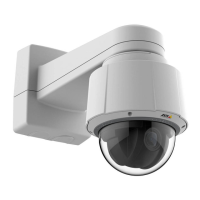
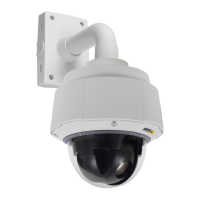
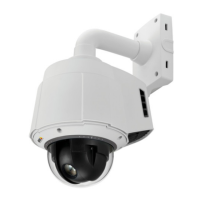
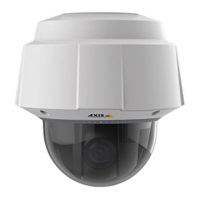
The AXIS Q6054-E Mk III PTZ Network Camera is a sophisticated surveillance device designed for comprehensive monitoring and recording. This user manual provides detailed instructions on its functionality, usage, and maintenance, ensuring optimal performance and security.
The AXIS Q6054-E Mk III is a Pan, Tilt, and Zoom (PTZ) network camera, meaning it can move horizontally (pan), vertically (tilt), and adjust its optical zoom to focus on specific areas. This flexibility allows for wide-area surveillance and detailed inspection of particular points of interest. The camera is designed to capture high-quality video, which can be streamed and stored for later review. It supports various video compression formats, including Motion JPEG and H.264, to balance image quality with bandwidth and storage requirements.
A key feature of this camera is its ability to operate effectively in diverse lighting conditions. During the day, it utilizes visible light to deliver color images. As light diminishes, the camera can automatically shift to night mode, employing both visible and near-infrared light to produce clear black-and-white images. This ensures continuous surveillance even in low-light environments. The camera also includes Electronic Image Stabilization (EIS) to counteract vibrations from external factors like wind or passing traffic, providing a smoother and steadier image with reduced blur and smaller file sizes.
The camera integrates event-based actions, allowing it to perform specific tasks when certain conditions are met. For instance, it can be configured to start recording, send email notifications, or display overlay text upon detecting motion or impact. This proactive approach enhances security by automating responses to critical events. The "gatekeeper" functionality further extends this by enabling the camera to automatically zoom in on a specific area, such as a license plate at a gate, when motion is detected, and then return to a home position.
To begin using the camera, it must first be located on the network and accessed via a web browser using its IP address or host name. For initial setup, a secure root password must be established. The user interface, accessible through a web browser, provides a live view of the camera's feed, along with various control and settings options. The webpage overview includes a live view control bar, product name display, user information, color theme options, a video control bar, and a settings toggle for easy navigation.
Image quality can be fine-tuned through several settings. The focus recall feature allows users to save focus settings for specific pan/tilt ranges, enabling faster focus adjustments when the camera moves into those areas. This is particularly useful in scenarios with frequent manual operation, changing focus settings, or low-light conditions. Users can create and delete focus recall areas as needed. Exposure modes, including automatic and manual, can be selected to optimize image quality for different surveillance scenes by adjusting aperture, shutter speed, and gain. The day-night shift priority can be configured to determine when the camera transitions between day and night modes based on light levels.
For enhanced image clarity in challenging conditions, the camera offers features to reduce noise in low-light environments and maximize image details. Users can adjust the blur-noise trade-off, set exposure mode to automatic, and fine-tune shutter speed and gain. The camera also supports Wide Dynamic Range (WDR) to handle scenes with strong backlighting, ensuring both dark and bright areas of an image are visible.
Overlays can be added to the video stream to provide additional information, such as timestamps or custom text. For example, the camera can display "Motion detected" when its AXIS Video Motion Detection application is triggered. The pan and tilt positions can also be shown as text overlays. The PTZ functionality allows users to pan, tilt, and zoom the camera, and even look above the default upper tilt limit by adjusting the PTZ limits in the settings.
Video streaming and storage are managed through various settings. Users can choose between Motion JPEG and H.264 compression formats, with H.264 offering significant bandwidth and storage savings. Bandwidth and storage can be further reduced by enabling dynamic GOP (Group of Pictures), increasing compression, and using dynamic FPS (Frames Per Second). Recordings can be stored on network storage or an SD card. Setting up network storage involves specifying the host server's IP address, shared location name, and login credentials if required. Video recording is initiated and stopped directly from the live view, and recorded videos can be played back from the storage section.
Event rules are central to the camera's automated functions. Users can create rules with specific triggers and actions. Triggers can include applications like AXIS Video Motion Detection, and actions can range from recording video to directing the camera to a preset position. For instance, the camera can be configured to record video to an SD card for a set duration before and after motion detection, or to move to a specific preset position when motion is detected.
The camera includes several maintenance features to ensure its longevity and proper functioning. Regular firmware upgrades are crucial for accessing the latest functionality and addressing potential issues. The manual provides instructions on how to check the current firmware version and upgrade it, emphasizing the importance of keeping the cover attached during upgrades and maintaining power throughout the process. Preconfigured and customized settings are generally preserved during firmware upgrades.
Troubleshooting guidance is provided for common issues such as firmware upgrade failures, problems with IP address settings (e.g., device on a different subnet, IP address in use, or conflicts), and login difficulties. For instance, if the IP address is in use, users are advised to disconnect the device and use the ping command to verify availability. If the root password is lost, the device can be reset to factory default settings.
The camera's LED indicators provide visual cues about its status:
The SD card slot supports SD/SDHC/SDXC cards for local storage. Users are cautioned against using sharp tools or excessive force when inserting or removing the card and are advised to unmount the SD card from the product's webpage before physical removal to prevent data loss or corruption.
The control button on the camera is used for resetting the product to factory default settings. This process involves pressing and holding both the control button and the power button for a specific duration until the status LED indicator changes color, followed by releasing the control button and then the power button. The power button itself can also be pressed and held to temporarily power the product when the dome cover is removed.
The network connector is an RJ45 Push-pull Connector (IP66) with High Power over Ethernet (High PoE) capability. Users are instructed to use the supplied midspan and to ensure the RJ45 IP66-rated connector or cable is used to maintain the camera's IP66 protection and not to remove the plastic network connector shield.
Performance considerations are also detailed, highlighting factors that can affect bandwidth and frame rate. High image resolution, lower compression levels, rotating the image in the GUI, accessing by many clients, simultaneous viewing of different streams, heavy usage of event settings, and using HTTPS can all impact performance. To maintain a high frame rate, using identical streams where possible is recommended.
 General
| Model | Q6054-E Mk III |
|---|---|
| Resolution | Up to 1920x1080 |
| Frame Rate | Up to 60 fps |
| Zoom | 30x optical zoom |
| Field of View | 2.9° to 85.6° (horizontal) |
| Day/Night Functionality | Yes |
| IP Rating | IP66 |
| Audio Support | Two-way audio |
| Digital zoom | 12x |
| Video compression | H.264, H.265, Motion JPEG |
| Audio compression | AAC, G.711, G.726 |
| Type | PTZ |
| Sensor Type | CMOS |
| Power Supply | PoE+ (IEEE 802.3at) |
| Resolutions | 1920x1080, 1280x720, 640x360 |
| Audio input/output | Line output |
| Security | HTTPS |
| Operating conditions | -40 °C to 50 °C |
| Power | PoE+ |
| Pan Range | 360° continuous |





 To Next Page