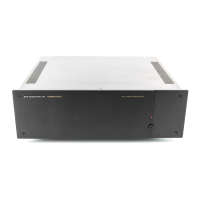
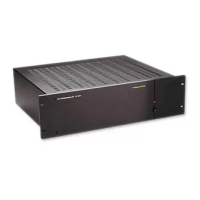
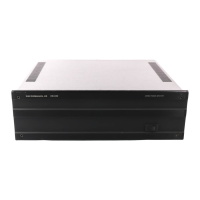
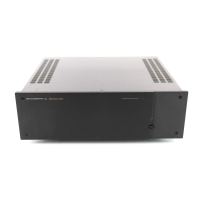
The B & K AV6000/654 and AV5000 are multi-channel A/V amplifiers designed for home entertainment systems, offering versatility and cost-effectiveness. This owner's manual provides detailed information on their design, setup, usage, and maintenance.
Function Description:
The AV6000/654 is primarily a 6-channel amplifier, while the AV5000 is a 5-channel amplifier. Both models are capable of delivering clean, musical audio amplification. A key feature is their "bridging" capability, which allows combining channels for more powerful output. The AV6000/654 can be configured for standard 6-channel mode, or 5, 4, or 3-channel modes. The AV5000 can operate in standard 5-channel mode, or 4 or 3-channel modes. This versatility makes them suitable for various surround sound or multi-room applications. The amplifiers are engineered to interact harmoniously with popular sources and line stages, with an ideal match being B & K preamplifiers.
Important Technical Specifications:
- Power Rating per Channel (r.m.s. into 8Ω):
- AV6000: Channels 1-6: 100 W
- AV654: Channels 1-6: 60 W
- AV5000: Channels 1-3: 100 W; Channels 4, 5: 60 W
- Bridged Power Output (r.m.s. into 8Ω):
- AV6000/654: 3 channels at 200/120 W
- AV5000: 2 channels at 200/120 W
- Frequency Response (Hz): 5-45k for all models.
- Input Sensitivity:
- AV6000: 1V
- AV654: 775 mV
- AV5000: 1V / 775 mV
- THD (%, S+N @ 1 kHz): 0.09 for all models.
- Input Impedance (Ω): 33.2 for all models.
- Damping Factor (@ 50 Hz):
- AV6000: 200
- AV654: 100
- AV5000: 100
- Current (Amps, peak-peak):
- AV6000: 28
- AV654: 14
- AV5000: 28/14
- Slew Rate (v/µsec): 14 for all models.
- Dynamic Headroom (dB): 1.4 for all models.
- S/N (dB, A-weighted): 95 for all models.
- Voltage Gain: 28 for all models.
- Line Power, Fuse: 120 VAC, 12A Slo Blo for all models.
- Dimensions (W x L x H"): 17 x 15-1/2 x 5-1/4 for all models.
- Weight (lbs./kg):
- AV6000: 40/18.1
- AV654: 35/15.9
- AV5000: 35/15.9
- Electronic Circuitry: High quality, utilizing 1% metal film resistors, computer grade electrolytic power supply capacitors, and a high capacity toroid transformer.
- Output Stages: Class AB, employing high current MOSFET power output stages, capable of reproducing demanding digital or analog recordings at full rated power levels.
Usage Features:
- Placement: Important for optimal performance. The amplifier should be physically located a safe distance from all source components to eliminate interference. Ideally, it should be near the speakers to minimize adverse effects of inductance, capacitance, and damping from speaker wire interaction. Raised feet ensure continuous ventilation and help minimize acoustic feedback.
- Inputs: 6 input signal connections (AV6000/654) or 5 (AV5000) through high-quality, gold-plated RCA connectors.
- Outputs: 6 sets of high-quality, 5-way binding posts (AV6000/654) or 5 sets (AV5000), designed to accept banana-type plugs or spade lug connectors.
- Level Controls: Each channel has a level control for adjusting relative volume to suit personal taste.
- System Installation Considerations: Pre-planning is essential. Users are advised to diagram component and cable layouts, number cables, and record lengths. Cable runs should be kept away from power radiation sources and traffic areas. Dealers can provide advice on cable types and custom lengths.
- Making Connections: Before connecting, ensure the amplifier's power switch is off. It is recommended to use a separate AC power outlet for the amplifier, not shared with other audio components, to prevent power line modulation interference. Connect audio cables from the preamplifier's output to the selected channel's input connectors, noting input numbers for correct speaker cable connection. Connect speaker cables to the appropriate CHANNEL output. Double-check all connections for tightness and correct polarity. With the preamplifier's volume at minimum or muted, plug the amplifier's power cord into the AC source and turn the amplifier's power switch on. All level controls on the amplifier should be set to maximum.
- Setup and Checkout: Initial listening will help identify unbalanced sound dispersion, which could be due to speaker relation, room acoustics, or signal distribution stages. The amplifier's level controls allow adjustment for personal taste.
- Burn-in Time: Approximately 40 hours of circuit forming ("burn-in") time are required for maximum fidelity. A suggested method is playing a CD into the system for about 24 hours straight at a low but listenable volume.
- Biwiring: The amplifier supports biwiring, which involves running two sets of speaker cables from the designated channel's speaker output to each speaker (one set to "HI" terminal, one to "LO" terminal), observing correct polarity. This can improve sound quality, especially bass tightness and clarity in mid-range and highs. Speaker manuals usually guide this process.
Maintenance Features:
- Safety & Care Considerations:
- Connecting/Disconnecting Cables: Always turn off the amplifier before plugging/unplugging preamplifier's power cord or interconnect cables to prevent damage to speakers and components. When plugging/unplugging interconnects from source to preamplifier, turn down the preamplifier's volume to minimum and mute it if available.
- Power Line Modulation Interference: Avoid connecting the preamplifier or source components to the same power source as the amplifier to prevent degraded audio signals.
- Ventilation: Do not remove cabinet feet; keep the amplifier well ventilated at all times.
- Speaker/Amplifier Damage Prevention: Observe polarity strictly; incorrect polarity can damage the amplifier. Ensure speaker drivers can handle the power delivered by the amplifier, especially during strong passages, to prevent speaker damage.
- Troubleshooting ("In Case of Difficulty"):
- No sound ('ON' LED not illuminated): Check if the power cord is plugged in, power is on at the AC source, or if the internal fuse is blown/faulty. Solutions include reconnecting the power cord, checking the AC source, and checking for shorts or overloading.
- No sound on some or all selected channels: Check for loose or faulty speaker leads, line stage-to-amplifier cables, or source-to-line stage cables. Also, ensure the line stage or source is correctly selected. Solutions involve tightening, repairing, or replacing cables and checking switch settings.
- Sound directionless, bass weak: Speakers connected out of phase. Solution: Check connections to ensure "+" is connected to "+" and "-" to "-".
- Loud hum or buzz on one or more channels: Poor ground connection in interconnect cabling. Solution: Check all connectors and repair as necessary.
- Fuse Replacement: If the unit continues to blow fuses, it should be serviced. Do not use a heavier fuse.
- Warranty: B & K Components Ltd. provides a three-year warranty from the date of purchase against defects in material and workmanship for the original purchaser, under normal residential use and service. Defective equipment must be returned to B & K, prepaid, for repair or replacement at their discretion. The warranty does not cover improper installation, incorrect fusing, misuse, abuse, harmful elements, non-compliance with instructions, or unauthorized modifications. The warranty does not extend beyond its term, and B & K is not liable for incidental or consequential damages.
- Returning Equipment: A RETURN AUTHORIZATION (RA) number is required before returning any equipment to B & K. To obtain an RA number, contact B & K by phone or FAX, providing your name, address, model and serial number of the equipment, and a description of the problem. Technical Service Representatives will assist in resolving the problem and issue an RA number if repair is necessary. Dedicated technical service hours are Monday through Thursday, 1:00 p.m. to 4:00 p.m. E.S.T.

 Need help?

 To Next Page
 General