19
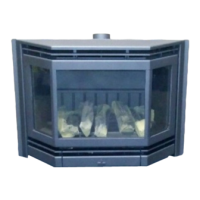
PANOLUX 65PANOLUX 52
7.2. OUTPUT
In practice, combustion is all about loss. This entails:
Ÿ Loss through excess heat leaving the chimney, rather than going into the room.
Ÿ Loss through insuf! cient combustion, such as CO (carbon monoxide) and soot
particles.
Ÿ Loss through excessive unburnt fuel in the ash.
The rate at which fuel can burn completely is called the output. A well-stoked
! re achieves output of 75% and thus falls into the category of high-output/low
emissions ! res. This means that you bene! t directly by using less wood to achieve
the same level of heat. The environment bene! ts as well: a well-stoked, high-
output appliance means less pollution and fewer odours.
Adverse effects on the output are:
Ÿ Burning the ! re with the door open. A warm chimney works in the same way as
an extractor. When the door is open, the chimney draws in much more air than
is necessary for combustion. This relatively cool air cools down the ! re.
Ÿ Excessive chimney draught. The combustion air does not reach the fuel, but
leaves the appliance via the chimney. The ! re cools and the combustion quality
decreases.
Ÿ Using too much wood. This is a problem if your ! tted ! re is too small. In that
case, it becomes overloaded and burns more wood than heat emitted. In this
case too the fuel cannot burn completely. More to the point, there is not enough
air to mix with the " ames. This has an extra impact on the environment.
Ÿ Admitting too much air under the fuel (primary air slides). Combustion is raised
to high intensity (like a blacksmith’s ! re). Combustion really needs time. If
combustion is too intense, there is insuf! cient time for the ! re to radiate all the
heat. The chimney will become excessively hot and the same will be true of the
escaping smoke. This heat is thus lost.


 To Next Page