3
• Some patients may be hypersensitive to heparin or suer from heparin induced thrombocytopenia (HIT) and these patients
must not have their catheter locked with heparin ush solution.
• As reported in literature, anaphylactic or anaphylactic-like reactions occur in a small percentage of the population during
placement
1
, positioning
1
, ushing
2
of central venous catheters or cleaning of catheter exit site
3
. These reactions are reported
in association with insertion, rapid ushing, or manipulation of the catheter and/or use of chlorhexidine gluconate (CHG) in
some patients. Be aware of the potential symptoms or signs of these reactions and take precautionary steps as dictated by
institution protocol for their prevention or treatment.
• If CHG allergy is suspected, conrmatory testing is recommended
4,5
.
Precautions Related to Device Placement Procedure
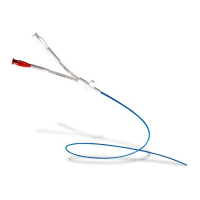
• The PowerPICCSOLO*
2
catheter features a reverse-taper catheter design. Placement of larger catheters at or below antecubital
fossa may result in an increased incidence of phlebitis. Placement of the PowerPICC SOLO
2
® catheter above antecubital fossa
is recommended.
• Avoid placement or securement of the catheter where kinking may occur, to minimize stress on the catheter, patency
problems or patient discomfort.
• Flush the catheter with sterile normal saline prior to use. Catheter stylet must be wetted prior to stylet repositioning or
withdrawal.
• Do not advance the guidewire past the axilla without uoroscopic guidance or other tip locating methods.
• If the guidewire must be withdrawn while the needle is inserted, remove both the needle and wire as a unit to prevent the
needle from damaging or shearing the guidewire.
• Never use force to remove the stylet. Resistance can damage the catheter. If resistance or bunching of the catheter is
observed, stop stylet withdrawal and allow the catheter to return to normal shape. Withdraw both the catheter and stylet
together approximately 2 cm and reattempt stylet removal. Repeat this procedure until the stylet is easily removed. Once the
stylet is out, advance the catheter into the desired position.
• Avoid accidental device contact with sharp instruments and mechanical damage to the catheter material. Use only smooth-
edged atraumatic clamps or forceps.
• Avoid perforating, tearing or fracturing the catheter when using a guidewire.
• Avoid sharp or acute angles during implantation which could compromise the patency of the catheter lumen.
• The PowerPICC SOLO
2
® catheter is designed for use with needleless injection caps or “direct-to-hub” connection technique.
Apply a sterile end cap on the catheter hub to prevent contamination when not in use. Use of a needle longer than 1.6 cm
may cause damage to the valve.
• Do not use scissors to remove dressing to minimize the risk of cutting catheter.
• Do not suture through or around any part of the catheter’s tubing (shaft or extension legs). If using sutures to secure catheter
USE THE SUTURE WINGS and make sure they do not occlude, puncture, or cut the catheter.
• The catheter must be secured in place to minimize risk of catheter breakage and embolization.
• To reduce potential for blood backow into the catheter tip, always remove needles or syringes slowly while injecting the last
0.5 mL of saline.
• Do not withdraw dilator from microintroducer sheath until sheath is within vessel to minimize the risk of damage to sheath
tip.
• Do not pull apart the portion of the sheath that remains in the vessel. To avoid vessel damage, pull back the sheath as far as
possible and tear the sheath only a few centimeters at a time.
• Do not cut guidewire to alter length.
• Do not insert sti end of guidewire into vessel as this may result in vessel damage.
• Keep sucient guidewire length exposed at hub to allow for proper handling. A non-controlled guidewire can lead to wire
embolism.
• Do not use excessive force when introducing guidewire or microintroducer as this can lead to vessel perforation and bleeding.
• Never leave stylet or stiening wire in place after catheter insertion; injury may occur. Remove stylet or stiening wire and
T-lock (as applicable) after insertion.
• The stylet or stiening wire needs to be well behind the point the catheter is to be cut. NEVER cut the stylet or stiening wire.
Possible Complications
The potential exists for serious complications including the following:
• Air Embolism
• Bleeding
• Brachial Plexus Injury
• Cardiac Arrhythmia
• Cardiac Tamponade
• Catheter Erosion Through the Skin
• Catheter Embolism
• Catheter Occlusion
• Catheter Related Sepsis
• Endocarditis
• Exit Site Infection
• Exit Site Necrosis
• Extravasation
• Fibrin Sheath Formation
• Hematoma
• Heparin Induced
Thrombocytopenia
• Hypersensitivity, anaphylactic or
anaphylactic-like reaction during
placement
1
, positioning
1
, ushing
2
of catheter or cleaning of catheter
exit site
3
• Intolerance Reaction to Implanted
Device
• Laceration of Vessels or Viscus
• Myocardial Erosion
• Perforation of Vessels or Viscus
• Phlebitis
• Spontaneous Catheter Tip
Malposition or Retraction
• Thromboembolism
• Venous Thrombosis
• Vessel Erosion
• Risks Normally Associated with
Local or General Anesthesia,
Surgery, and Post-Operative
Recovery


 To Next Page
 Loading...