This document provides installation instructions for the Barrette Outdoor Living Elevation™ Rail with Cable system, designed for both level and stair applications. The system is a railing solution that incorporates cables, offering a modern aesthetic for outdoor living spaces.
Function Description:
The Elevation™ Rail with Cable system serves as a safety barrier and aesthetic enhancement for decks, patios, and stairways. It utilizes a series of horizontal cables tensioned between posts to create a secure and visually open railing. The system is designed for DIY installation, with detailed steps provided for both deck/wood and concrete surfaces, as well as for level and stair configurations. Key components include top beams, top rails, cable guides, tensioners, and various post types (corner, line, end) with associated caps, trim rings, and shims. The installation process involves securing posts, installing cable guide assemblies, tensioning the cables, and attaching top rails and post caps.
Important Technical Specifications:
- Maximum Span (Level Section): 68 inches (172.7 cm) between posts (72 inches on center).
- Fasteners: Posts are designed to accept 3/8 inch (9.5 mm) fasteners.
- For deck/wood surfaces: 3/8 inch diameter galvanized bolts with nuts or #10x 3 1/2 inch deck screws.
- For concrete surfaces: 3/8 inch masonry anchors.
- Blocking (for deck/wood): Requires at least two 2x8 inch blocks, secured with at least three #10x3 1/2 inch deck screws penetrating joists by at least 1 1/2 inches.
- Drill Bit Sizes: 7/16 inch and 1/8 inch for drilling, 9/16 inch socket for tensioners.
- Cable Tensioning: Achieved through locker mechanisms and tensioner bolts, with visual cues (spring visibility) to confirm proper tension.
- Cable Excess: Approximately 12 inches (304.8 mm) of excess cable is left in the top beam channel after tensioning.
- Stair Installation: Maximum of 5 risers between posts. Base plates should be set back 2 inches (50 mm) from the nose of the stairs.
- Top Rail Cut: For level sections, subtract 1/2 inch (12 mm) from the measured distance between posts. For stair sections, subtract 1 1/4 inch (31.8 mm) from the measured length of the top beam.
Usage Features:
- Versatile Installation: Suitable for both level surfaces (decks, patios) and stairways.
- Surface Compatibility: Can be installed on deck/wood or concrete surfaces, with specific instructions and fasteners for each.
- Adjustable Posts: Leveling shims are included to plumb and level posts, ensuring proper alignment.
- Cable Management: Cable guide assemblies are designed to route and secure the cables, minimizing kinks and ensuring a clean appearance.
- Tensioning System: Features a robust tensioning system with locker mechanisms and bolts, allowing for precise cable tension adjustment. Visual indicators (spring visibility) guide the user during initial and final tensioning.
- Mid-Support Baluster: Included for longer spans to provide additional support and stability.
- Modular Design: Components are pre-fabricated and designed for assembly, simplifying the installation process.
- Aesthetic Finish: Base trims and post caps provide a finished look, concealing fasteners and post tops.
- Clear Instructions: The manual provides step-by-step instructions with accompanying figures, making it accessible for DIY installers.
- Product Registration: Users are encouraged to register their product online for warranty purposes.
Maintenance Features:
- Durable Materials: The system is designed for outdoor use, implying resistance to weather elements, though specific material details are not provided in this excerpt.
- Tension Adjustment: The tensioning system allows for re-tensioning if cables loosen over time, ensuring continued safety and performance.
- Component Replacement: The manual provides contact information for obtaining replacement parts, suggesting that individual components can be replaced if damaged or worn.
- Safety Guidelines: Emphasizes wearing safety goggles and referring to manufacturer's safety instructions for tools, promoting safe maintenance practices.
- Building Code Compliance: Advises consulting local building codes for installation requirements, which indirectly contributes to long-term maintenance by ensuring a structurally sound installation.

 Need help?
 General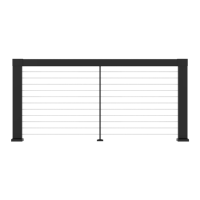

 To Next Page