Page 13<&(%$*4.8"4,7%H'*#$"&8#I%/7*,#*%4,77%JKLLLKLMMKNOPO1Item 64146
?@<6AQRS6;@ACRED@CEA6E@ET6 ?6AFS
A(&'+7*#.&&$"83
S(&+7*5 S&##"+7*%T,'#*# G"Z*7>%?&7'$"&8#
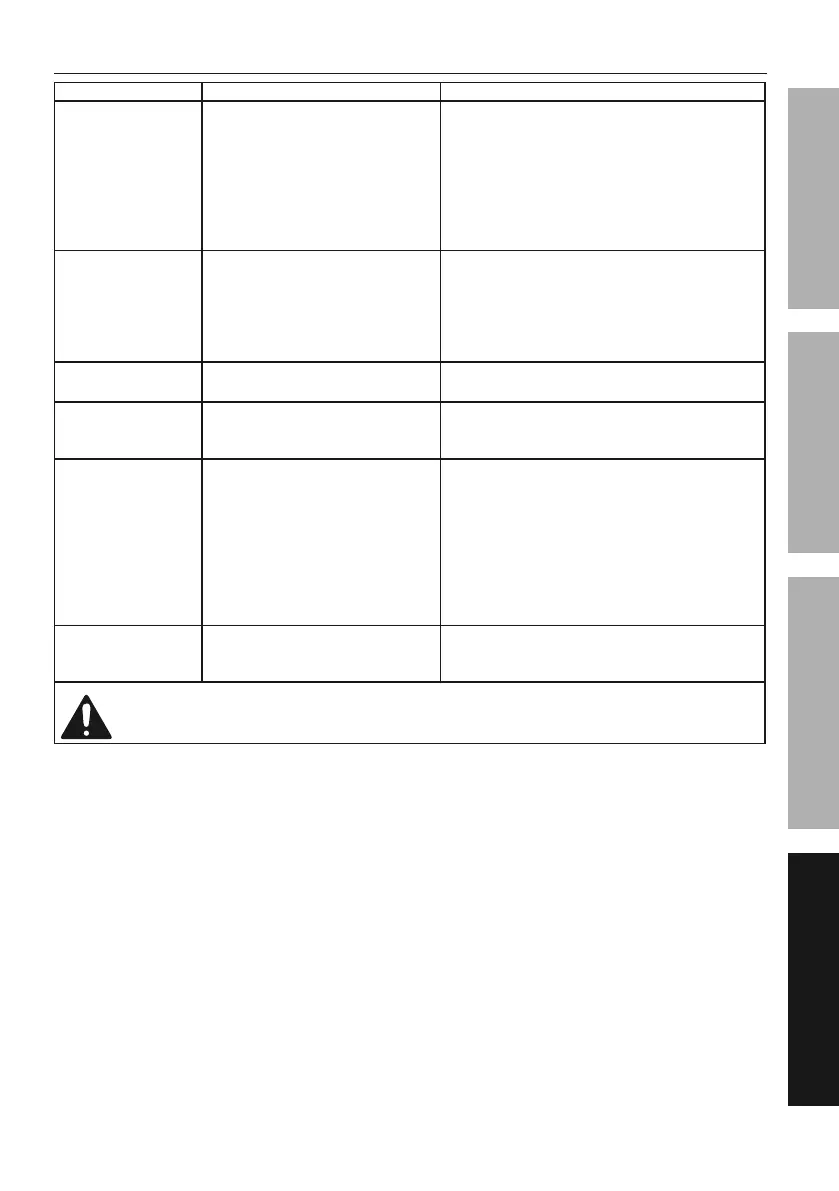
Tool will not start. 1. Cord not connected.
2. No power at outlet.
3. Internal damage or wear.
(Carbon brushes or
switch, for example.)
1. Check that cord is plugged in.
2. Check power at outlet. If outlet is unpowered,
turn off tool and check circuit breaker.
If breaker is tripped, make sure circuit is right
capacity for tool and circuit has no other loads.
3. Have technician service tool.
Tool operates slowly. 1. Excess pressure applied
to workpiece.
2. Power being reduced by long or
small diameter extension cord.
1. Decrease pressure, allow tool to do the work.
2. Eliminate use of extension cord.
If an extension cord is needed, use one with
the proper diameter for its length and load.
See Extension Cords in GROUNDING section.
Performance
decreases over time.
Carbon brushes worn or damaged. Have qualified technician replace brushes.
Excessive noise
or rattling.
Internal damage or wear.
(Carbon brushes or
bearings, for example.)
Have technician service tool.
Overheating. 1. Forcing tool to work too fast.
2. Blocked motor housing vents.
3. Motor being strained by long or
small diameter extension cord.
1. Allow tool to work at its own rate.
2. Wear ANSI-approved safety goggles
and NIOSH-approved dust mask/
respirator while blowing dust out of
motor using compressed air.
3. Eliminate use of extension cord.
If an extension cord is needed, use one with
the proper diameter for its length and load.
See Extension Cords in GROUNDING section.
Tool does not
grind, sand or
brush effectively.
Accessory damaged, worn or
wrong type for the material.
Check condition and type of disc accessory.
Use only proper type of disc
accessory in good condition.
% <&77&)%,77%#,2*$>%/(*4,'$"&8#%).*8*Y*(%9",38&#"83%&(%#*(Y"4"83%
$.*%$&&71%%X"#4&88*4$%/&)*(%#'//7>%+*2&(*%#*(Y"4*1


 To Previous Page
 Loading...