Need help?
Do you have a question about the Bauer 1913E-B and is the answer not in the manual?
Explains the safety alert symbol and its purpose for personal injury hazards.
General safety warnings and instructions for power tool operation, including electric shock, fire, and serious injury prevention.
Guidelines for maintaining a safe work environment, including cleanliness, avoiding explosive atmospheres, and keeping bystanders clear.
Ensures accessories are rated, sized, and undamaged for safe tool operation.
Mandates use of appropriate PPE like face shields, safety goggles, dust masks, and hearing protection.
Provides advice on managing vibration exposure, including medical checks, avoiding nicotine, and using proper grip.
Offers precautions to avoid kickback, such as maintaining grip, proper body positioning, and avoiding sharp edges.
Explains requirements for three-prong plugs and proper grounding for electrical safety.
Details the safety features of double insulated tools requiring no grounding.
Provides guidance on selecting appropriate gauge and type of extension cords based on tool requirements.
Instructions for securely attaching the auxiliary handle to the tool for proper operation.
Guidance on preparing the tool and work area, including accessory installation and safety measures.
Procedures for inspecting, cleaning, and maintaining the tool to ensure safe operation and longevity.
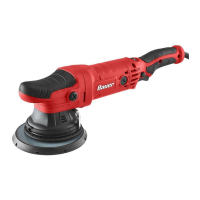
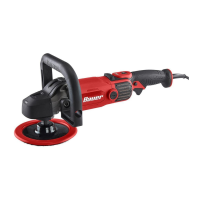
The Bauer 7" Variable Speed Rotary Polisher/Sander, model 1913E-B, is a versatile power tool designed for both sanding and polishing operations. This manual provides comprehensive instructions for its safe and effective use, emphasizing the importance of adhering to all safety warnings and guidelines to prevent serious injury, electric shock, fire, and other hazards.
The primary function of this tool is to act as either a sander or a polisher, depending on the accessory attached. It features a variable speed control, allowing the user to adjust the rotational speed (RPM) to suit the specific task, whether it's aggressive sanding or delicate polishing. The tool is equipped with a 5/8"-11 spindle, which is a common size for attaching various accessories like backing pads, sanding discs, and polishing bonnets. An auxiliary handle is provided to ensure a firm grip and better control during operation, which is crucial for resisting kickback forces and maintaining stability. The tool's design incorporates a spindle lock button to facilitate easy and secure accessory changes. An indicator light is also present, likely to signal power or operational status.
Before any operation, the manual stresses the importance of a thorough setup. This includes ensuring the trigger is in the off-position and the tool is unplugged when installing accessories. The auxiliary handle must be properly installed, and it can be positioned on either side of the gear housing for user comfort and control. The manual explicitly states that the tool should not be operated with one hand only or without the auxiliary handle.
For sanding operations, the user must select an appropriate grit sanding disc and attach it securely to the backing pad. The speed dial allows for adjustment of the rotational speed. When sanding, the tool should be held firmly with both hands, allowed to reach full speed before gently contacting the surface, and operated with light pressure, letting the tool do the work. A uniform pattern (up and down or side to side) is recommended for even sanding. Regular checks for disc wear are advised, with replacements made as needed.
For polishing operations, the process begins with preparing the work surface by cleaning it thoroughly. A clean foam pad is then securely placed onto the backing pad, and a small amount of wax is applied evenly to the foam pad. The manual cautions against applying wax directly to the vehicle surface and against using excessive wax, as this can saturate the foam pad and reduce its life. Slower speeds are recommended for polishing to prevent damage to the paint. The tool should be started and stopped while held firmly against the vehicle surface to prevent the foam pad or polishing bonnet from being thrown. The trigger can be locked in the ON position for continuous operation, and pressure should be kept light, allowing the foam pad to lightly contact the polishing surface. The wax is applied with broad, sweeping, crisscross strokes. After wax application, the tool is turned off and unplugged, and the foam pad is removed to apply wax to hard-to-reach areas. Once the wax has dried, a clean polishing bonnet is attached to the foam pad (ensuring any strings are secured) to buff off the dried wax. The tool should always be allowed to come to a complete stop before being set down.
The manual also highlights general power tool safety practices, such as keeping the work area clean and well-lit, avoiding explosive atmospheres, keeping children and bystanders away, and using appropriate personal protective equipment, including ANSI-approved eye protection and NIOSH-approved breathing protection. It emphasizes preventing unintentional starting, removing adjusting keys/wrenches before operation, maintaining proper footing and balance, dressing properly (avoiding loose clothing/jewelry), and ensuring dust extraction/collection facilities are properly connected.
Maintenance is crucial for the longevity and safe operation of the Bauer polisher/sander. The manual advises users to inspect the tool before each use for loose hardware, misalignment or binding of moving parts, damaged cord/electrical wiring, cracked or broken parts, and any other condition that might affect its safe operation. After use, the external surfaces of the tool should be wiped clean with a cloth.
Periodically, users are instructed to wear ANSI-approved safety goggles and NIOSH-approved breathing protection and use dry compressed air to blow dust and grit out of the motor vents. This helps prevent excessive accumulation of powdered metal, which could lead to electrical hazards. If the supply cord is damaged, it must be replaced only by a qualified service technician.
The manual also includes a troubleshooting section to address common issues such as the tool not starting, operating slowly, decreased performance over time, excessive noise or rattling, overheating, and ineffective sanding. This section provides possible causes and likely solutions, ranging from checking power connections and circuit breakers to allowing the tool to cool, reducing pressure on the workpiece, and ensuring proper extension cord usage. For internal damage or wear, or issues with carbon brushes, professional service by a qualified technician is recommended. The importance of using undamaged accessories and ensuring they are properly fitted is also stressed as a maintenance and safety measure.
 General
| Model | 1913E-B |
|---|---|
| Type | Random Orbit Sander |
| Power Source | Corded Electric |
| Voltage | 120V |
| No Load Speed | 12, 000 OPM |
| Dust Collection | Yes |
| Weight | 3.5 lbs |
| Pad Size | 5 inches |

 To Next Page