USER MANUAL / ENGLISH
the airbag.
The operation of the pressure relief valve is controlled 3x during each self-test and can be clearly heard from the characteristic ticking noise (like
a Swiss watch!)
7 AIRBAG INFLATION
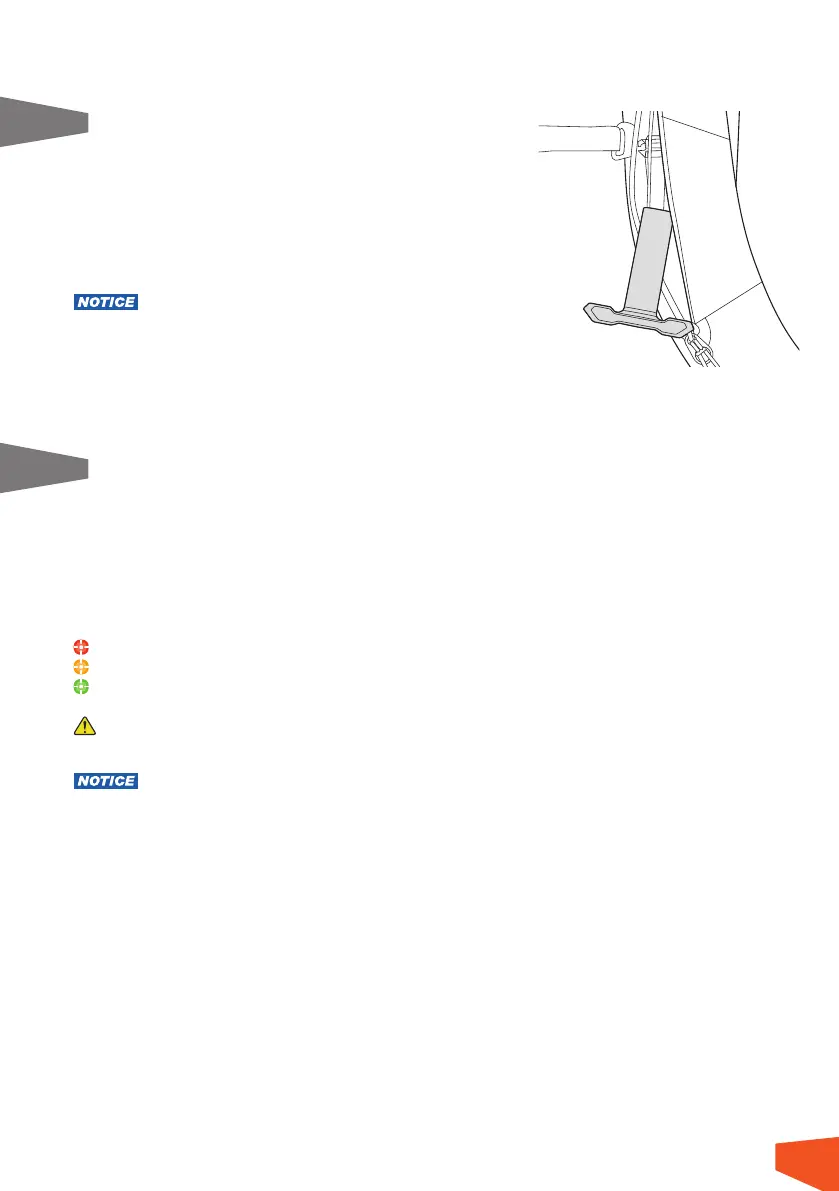
Before entering avalanche terrain, unzip the pocket where the trigger handle is stored (see
image on right).
In the event of an avalanche, pull hard (between 5 to 10 kg) on the activation trigger. The airbag
will inflate in 3-4 seconds.
The compressor will operate for 5 seconds and then stop.
The airbag will remain inflated for a minimum of three minutes, then the pressure relief valve
will be activated, and a passive and partial deflation of the airbag will take place.
Once inflation is complete, the supercapacitors will automatically recharge thanks to the two
AA batteries if installed (see section 3)
In compliance with the EN 16716 standard “Certification of Avalanche airbags,”
the airbag must remain inflated for a minimum of three minutes. An avalanche airbag is not a
life vest; therefore, it is normal that it does not remain inflated at full pressure for more than
three minutes.
HANDLING DURING AVALANCHE INCIDENT
In the event of an avalanche, always try to reach a place of safety or escape from the path of the avalanche. If on them, try also to remove your skis
or snowboard, as these have an anchoring effect in an avalanche. Once the avalanche appears to be losing momentum, close your mouth and hold
your arms in front of your face to create a life-saving air pocket. Once the avalanche has stopped moving and you can extract yourself, do not remove
the airbag when you help others. Only remove when you are confident there is no more risk of a second avalanche.
8 CHARGE AND STATUS OF THE SYSTEM
RECHARGING THE SUPERCAPACITORS
There are two ways to recharge the supercapacitors:
1- Insert the two AA batteries (not included). The supercapacitors will be automatically recharged once the batteries are in place. Depending on the
type of batteries and the temperature, charging takes 40-80 minutes.
2- Use the USB-C port and the standard micro-USB-C cable (provided). The USB-C port can be connected to a standard charger (not included),
like those used for cell phones, or to a standard power bank. Depending on the type of charger or power bank, charging takes 20-40 minutes.
The charging status is indicated by the rapid blinking of the LEDs (4 x per second).
The level of charge is indicated by the LED colour.
Red: low charge – the charge level cannot guarantee 100% inflation and must be charged before use.
Orange: medium charge – the charge level guarantees 100 % inflation of the airbag but with less than six hours of autonomy.
Green: charging is complete – the LED blinks slowly (1 x every 10 seconds).
WARNING: Do not leave the USB-C cable connected while using the E2 System in the terrain. After charging is complete, remove the USB-C
cable.
• Before the first use, charge the system with the USB-C port. After prolonged storage without batteries (e.g., over the summer or a new system),
charging the supercapacitors will take longer than after inflation. After inflation there is still energy in the supercapacitors, but after prolonged
storage without batteries, the supercapacitors will be completely empty.
• Charging with the USB-C cable takes priority over the batteries. If the batteries are in place and the cable is connected, charging will be carried
out via the cable without draining the batteries.
• Charging is also possible without batteries using the USB-C cable.
• If the system is charging in OFF mode, The LED will blink but the system will remain in OFF.
• The system recharges automatically. If the airbag is inflated, the system will begin to recharge on the batteries or the USB-C port immediately.
• 2 AA batteries allow for 1-2 recharging cycles of the supercapacitors (depending on the quality of the batteries used and the charging temperature).
7


 To Next Page