• Application Note:
1. PXE Boot:
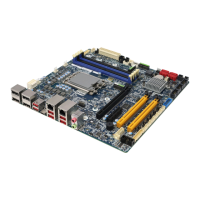
a. Connect ethernet cable with desired LAN1 or LAN2 port at rear I/O of MX680RD board.
NOTE:
Where “LAN1” is located right next to the rear I/O audio port. “LAN2” is located next to
the rear I/O USB-C port (USB-P7).
b. Enter BIOS menu.
c. Under “Advanced”->”Network Stack Configuration”; enable “Network Stack”, and then
enable the desired “IPv4 PXE Support” or “IPv6 PXE Support” (choose only one).
d. under “Chipset”->”PCH-IO Configuration”; enable the desired “LAN1 PXE OpROM” or
“LAN2 PXE OpROM” (choose only one).
e. Under “Boot”; change “Boot Option #1” to “Network”.
f. Under “Save & Exit”, click on “Save Changes and Exit”.
g. Under the system reboot, the screen shall prompted with message “Checking Meia
Presence….”, “Media Present…..”, “Start PXE over IPv# (# is either 4 or 6, depending on
what you had chosen at step C) on MAC (showing the MAC address of
chosen LAN port).
2. TPM Support (Infineon TPM (IFX), or Intel PTT (INTC)):
a. Enter BIOS menu.
b. Under “Advanced”->”Trusted Computing”;
i. Under “TPM Device Selection”; choose the desired TPM device “dTPM” for
Infineon TPM (IFX), or “PTT” for Intel PTT (INTC).
ii. Under “Security Device Support”, change it to “Enable”.
c. Under “Save & Exit” option, choose “Save Changes and Exit”.
d. The system shall reboot once. Enter BIOS menu again.
e. Enter “Advanced”->”Trusted Computing”.
i. If you selected “TPM Device Selection” as “dTPM”, make sure “Vendor” section is
shown as “IFX”.
ii. if you chose “TPM Device Selection” as “PTT”, make sure “Vendor” section is
shown as “INTC”.
f. Let the system reboot into Windows environment, under “Search”, type “Device Manager”.
And make sure the Device Manager displays the option “Security devices”->”Trusted
Platform Module 2.0” and there is no any exclamation mark or question mark associated with
it.
g. Under “Search”, type “Manage Bitlocker”; the menu “BitLocker Drive Encryption” shall be
prompted. Click on “TPM Administration” at lower left-hand corner of its screen.
h. The next screen shall prompt with the status of TPM;
i. Make sure “Status” section is indicating “The TPM is ready to use”.
ii. Under “TPM Manufacturer Information” section, the “Manufacturer Name” is shown
as “IFX” if you chose “dTPM” under step“2b” above.
Or
“INTC” if you selected “PTT” under step “2b” above.
i. If the information at “2f”, “2g”, & “2h” were verified to be corrected, you may click on “Turn
on BitLocker” option under “BitLocker Drive Encryption” screen to start BitLocker
execution process.
3. Clear CMOS when a different model of CPU is installed:
If a different model of CPU is being installed with the same MX680RD board, it is recommended to
clear the CMOS once in order to be sure previous CPU information stored at NVRAM is cleared.


 To Next Page
 Loading...