Need help?
Do you have a question about the Beko BCFD373 and is the answer not in the manual?
Emphasizes the mandatory earthing of the appliance for safety.
Instructions on how to safely fit an alternative plug, including wiring details.
Specifies required clearances around the appliance for optimal ventilation and performance.
Details how to set and adjust the thermostat for optimal fridge and freezer temperatures.
Explains the automatic defrosting process for the fridge compartment and troubleshooting drain issues.
Guides users through common operational problems and checks before seeking service.
Step-by-step instructions for reversing the hinge orientation of the top door.
Step-by-step instructions for reversing the hinge orientation of the lower door.
Provides contact numbers and advice for service requests and product support.
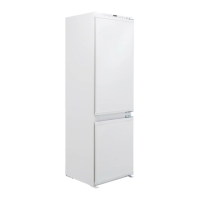
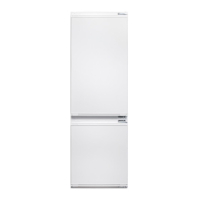
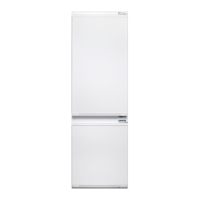
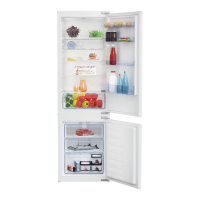
This document provides installation and user instructions for a Beko Frost Free Combi Built-In Fridge / Freezer, model BCFD373. It serves as a comprehensive guide for safe operation, maintenance, and troubleshooting of the appliance.
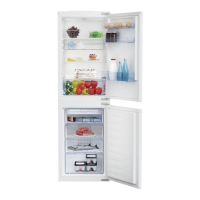
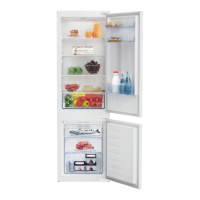
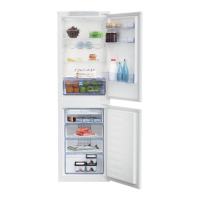
The Beko Frost Free Combi Built-In Fridge / Freezer is designed for the storage and freezing of edible foodstuff. It features a fridge compartment for short-term storage of fresh food and drinks, and a **** rated freezer compartment suitable for freezing and storing pre-frozen food. The appliance incorporates Frost Free technology, meaning both the fridge and freezer compartments defrost automatically, eliminating the need for manual defrosting. The freezer compartment is equipped with a fan that circulates cold air to ensure efficient freezing. The appliance also features Freezer Guard technology, which allows it to operate effectively in ambient temperatures as low as -15°C, preventing frozen food from thawing even in unheated environments like a garage. However, at very low ambient temperatures (below 0°C), the fridge compartment contents may freeze, so it's recommended not to use the fridge compartment under such conditions.
The appliance's operating temperatures are controlled by a thermostat knob located on the ceiling of the fridge compartment, with settings ranging from MIN to MAX, where MAX is the coldest position. For initial setup, it's recommended to set the thermostat halfway between MIN and MAX and monitor the temperature to achieve the desired level. The normal storage temperature for the freezer should be -18°C (0°F), with colder temperatures achievable by adjusting the knob towards MAX. In cases of temporary ice build-up in the fridge, the thermostat setting should be reduced to 1 until the ice disappears and automatic defrosting resumes. For ambient temperatures between 0°C and -15°C, a setting of 4 is recommended for the freezer compartment.
For storing food, cooked dishes should be kept in airtight containers, while fresh wrapped produce can be placed on shelves. Fresh fruit and vegetables should be cleaned and stored in the crisper bins. Bottles can be placed in the door section. Raw meat should be wrapped in polythene bags and placed on the lowest shelf, ensuring it doesn't contact cooked food to avoid contamination. Hot food and beverages should be cooled before being placed in the fridge. High-proof alcohol should be stored upright in sealed containers. Certain fruits and vegetables, like pineapples, melons, cucumbers, and tomatoes, should be wrapped in polythene bags if kept near 0°C to prevent damage.
When freezing fresh food, it's important not to freeze too large a quantity at once to ensure rapid freezing and preserve food quality. The maximum freezing capacity is 4 kg (8.8 lb) per 24 hours. Fresh food can be placed in any part of the freezer, but care should be taken not to mix it with already frozen food. For making ice cubes, the ice-cube tray should be filled 3/4 full with water.
The appliance is designed for domestic household use. It's important to ensure the door(s) are not left open longer than necessary and are properly closed after each opening to maintain internal temperatures and save energy. Defrosting frozen food in the fridge compartment can help assist cooling in the fridge.
Regular cleaning and care are essential for optimal performance and hygiene. Before cleaning, the appliance should be switched off at the socket outlet and the mains plug pulled out. Abrasive instruments, soap, household cleaners, detergents, and wax polish should not be used. The cabinet can be cleaned with lukewarm water and wiped dry. The interior should be cleaned with a damp cloth wrung out in a solution of one teaspoon of bicarbonate of soda to one pint of water, then wiped dry. Care must be taken to prevent water from entering the lamp housing.
Excess ice deposits should be removed regularly with a spoon handle, as large accumulations can impair performance. If the appliance will not be used for an extended period, it should be unplugged, all food removed, cleaned, and the door left open. Door seals should be checked regularly to ensure they are clean and free from food particles. Door racks can be removed by pushing them upwards from the base after emptying their contents. Freezer drawers can be removed by pulling them out as far as possible, tilting them upwards, and then pulling them out completely.
The fridge compartment defrosts automatically, with defrost water draining into a collection container at the back of the appliance. If the drain tube becomes blocked by food particles, it can be cleared by pushing the special plastic plunger provided. If a frost layer of about 1/4" (7 mm) forms, reducing the thermostat setting will restart automatic defrosting. The freezer compartment also defrosts automatically, and its internal fan circulates cold air. It's crucial not to insert any objects through the fan guard or obstruct it to ensure proper air circulation and performance.
For replacing the interior light bulb, an Authorised Service should be contacted. The lamp(s) used are specifically designed for the appliance's internal conditions and are not suitable for household room illumination.
When transporting the appliance, it should be kept in a vertical upright position with the packing intact. If transported horizontally, it must be left to stand upright for at least 4 hours before switching on to allow compressor oil to settle. The mains cable should be protected from damage during and after transportation. The special receptacle provided at the back of the cabinet should be used to store the mains plug during transit to prevent damage.
The appliance should be installed in a well-ventilated area, with minimum side clearances from heat sources like cookers, radiators, or other freezers. The back wall of the wooden cabinet where the appliance is built-in must be left completely open to the kitchen wall to allow sufficient air circulation for the condenser unit, contributing to energy efficiency. The legs of the refrigerator can be adjusted to balance the appliance if it is unbalanced.
 General
| Star rating | 4* |
|---|---|
| Freezer position | Bottom-placed |
| Freezing capacity | 3.2 kg/24h |
| Freezer net capacity | 69 L |
| Automatic defrost (freezer) | Yes |
| Freezer temperature rise (max) | 13 °C/h |
| Freezer number of shelves/baskets | 3 |
| Storage time during power failure | 13 h |
| Minimum operating temperature (freezer) | -15 °C |
| Lamp type | LED |
| Fridge net capacity | 193 L |
| Number of vegetable drawers | 1 |
| Multi-Airflow system (fridge) | - |
| Fridge number of shelves/baskets | 4 |
| Icemaker | No |
| Noise level | 38 dB |
| Climate class | SN-ST |
| Total net capacity | 262 L |
| Minimum operating temperature | 5 °C |
| Door hinge | Right |
| Product color | White |
| Door hinge note | Sliding hinges |
| Shelves material | Glass |
| Appliance placement | Built-in |
| Connected load | - W |
| Energy efficiency scale | A to G |
| Annual energy consumption | 280 kWh |
| Package depth | 600 mm |
| Package width | 575 mm |
| Package height | 1870 mm |
| Package weight | 62300 g |
| Package tare weight | 4726.4 g |
| Metal packaging weight | 13.9 g |
| Paper packaging weight | 3642.1 g |
| Plastic packaging weight | 187.4 g |
| Expanded Polystyrene (EPS) packaging weight | 883 g |
 Weight and Dimensions
| Depth | 545 mm |
|---|---|
| Width | 540 mm |
| Height | 1775 mm |
| Weight | 57500 g |

 To Next Page