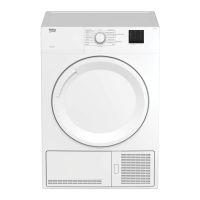
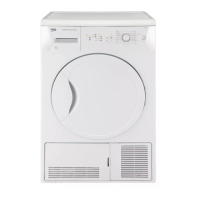
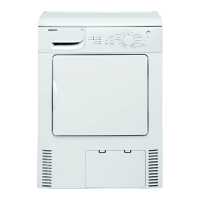
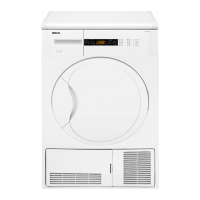
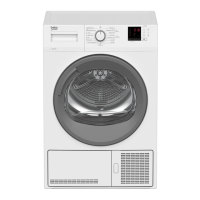
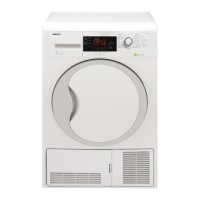
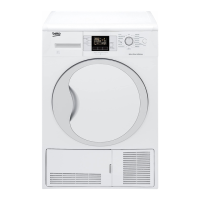
This document is a user manual for a Beko Dryer, model DC7211. It provides comprehensive information on the dryer's function, technical specifications, usage, and maintenance.
Function Description:
The Beko Dryer is designed for domestic use, specifically for drying laundry that is marked as suitable for tumble drying. It is not intended for commercial use. The dryer operates by tumbling laundry in a heated drum, removing moisture, which is then condensed and collected in a water tank or drained directly. The device offers various drying programs tailored to different fabric types and desired dryness levels, including options for cotton, synthetics, delicates, and specific items like shirts or jeans. Some models may include steam functions for wrinkle removal and odor reduction. The dryer incorporates safety features such as a child lock and warnings against improper use to ensure safe operation.
Important Technical Specifications:
- Height (Min. / Max.): 84.6 cm / 86.6 cm* (adjustable feet)
- Width: 59.7 cm
- Depth: 56.8 cm
- Capacity (max.): 7 kg** (dry laundry weight before washing)
- Net weight (± %10): 34.5 kg
- Rated power input: See type label*** (located behind the loading door)
- Model code: DC7211
- Voltage: Not specified in the provided excerpt, but typically standard household voltage.
- Energy Consumption Values (for 7kg capacity):
- Cottons Eco: 4.21 kWh (1000 rpm spin, 60% remaining humidity)
- Cottons Iron dry: 3.25 kWh (1000 rpm spin, 60% remaining humidity)
- Synthetics cupboard dry: 1.42 kWh (800 rpm spin, 40% remaining humidity)
- Note: All values are determined according to EN 61121 standard and may vary based on laundry type, wringing speed, ambient conditions, and voltage levels.
Usage Features:
The dryer features a control panel with an On/Off/Program selection button, Start/Stand-by button, End Time button, Drying Level button, and Buzzer volume / Time programs selection button.
- Program Selection: Users can select from a variety of programs, including:
- Cottons Iron Dry, Cottons Eco, Cottons Cupboard Dry, Cottons Extra Dry
- Synthetics Iron Dry, Synthetics Cupboard Dry
- Drying Rack/TimeDry (for specific items or timed drying)
- Refresh (Wool Refresh), Gentle Care / Shirts, Jeans, Outdoor/Sports (Goretex)
- Mix(Daily), Hygiene (BabyProtect+), Delicates, Express
- End Time Function: Allows delaying the program start by up to 24 hours.
- Drying Level: Adjustable to achieve desired dryness (e.g., iron dry, cupboard dry).
- Buzzer/Time: Adjusts the audible warning at program completion or sets program duration for Rack/Time programs.
- Child Lock: Prevents accidental program interruption by deactivating all buttons except the On/Off/Program selection knob. Activated by pressing Drying Level and Buzzer buttons simultaneously for 3 seconds.
- Loading: Laundry should be placed in the drum without jamming, and the loading door must be securely closed.
- Preparation: Laundry should be spun at the highest possible speed in the washing machine to reduce drying time and energy consumption. Items should be sorted by type and thickness, and metal accessories should be turned inside out. Zippers, hooks, buckles, and buttons should be fastened.
- Energy Saving Tips: Avoid opening the loading door unnecessarily, do not add wet laundry during operation, and ensure the room is well-ventilated.
- Water Tank: The dryer collects condensed water in a tank, which needs to be emptied after each drying cycle. If the tank fills during a program, the machine will pause, and a warning indicator will flash. Direct water drain connection is an optional feature that eliminates the need to empty the tank.
- Illumination Lamp: Some models include an illumination lamp inside the drum to assist with loading.
Maintenance Features:
Regular maintenance is crucial for extending the product's service life and preventing common problems.
- Lint Filter: Must be cleaned before or after each drying cycle. A clogged filter can prolong drying time and reduce efficiency. The filter can be cleaned by hand, with a soft cloth, or with a vacuum cleaner. Periodically, the filter should be washed with warm water to remove any accumulated layer that clogs its pores, then dried completely before reinstallation.
- Loading Door Inner Surface: The entire inner surface of the loading door and its gasket should be cleaned with a soft damp cloth after each drying process to prevent lint and fibers from accumulating.
- Dampness Sensors: Metal surfaces of the sensors, located inside the drum, should be cleaned with a soft cloth dampened with vinegar and then dried, approximately four times a year. Metal tools should not be used for cleaning these sensors.
- Condenser (for condenser models): Should be cleaned once a month or after every 30 drying cycles. This involves opening the kick plate, unlocking and pulling out the condenser, cleaning it with pressurized water (e.g., a shower armature) until the water drains, and then securely placing it back in its housing.
- Filter Drawer / Heat Exchanger (for heat pump models): The sponge and filter cloth in the filter drawer should be cleaned regularly.
- Transportation: Before transporting, all water remaining in the dryer must be drained. The dryer should ideally be carried in an upright position; if not possible, it should be tilted towards the right side when viewed from the front.
- Troubleshooting: The manual provides a detailed troubleshooting guide for common issues such as long drying times, damp clothes, machine not starting, premature program termination, and warning indicator lights. It advises contacting authorized service for persistent problems and warns against self-repair.

 Need help?

 To Next Page
 General