
 Need help?
Do you have a question about the Beko RDNT233 Series and is the answer not in the manual?
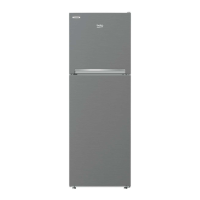
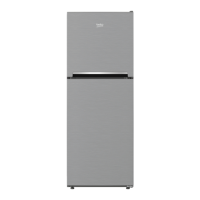
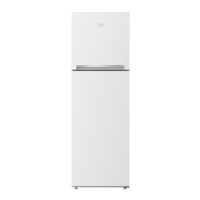
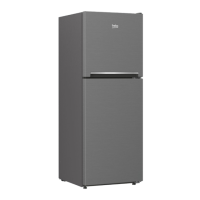
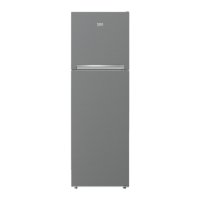
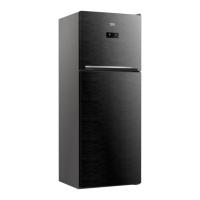
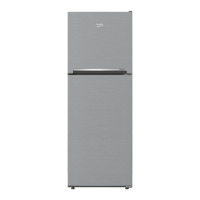
This document is a user manual for Beko Refrigerator-Freezer models, including RDNT200*, RDNT201*, RDNT202*, RDNT203*, RDNT231*, RDNT232*, RDNT233*, RDNT251*, RDNT252*, RDNT253*, RDNT271*, RDNT272*, and RDNT273*. It provides essential information for safe and efficient operation, installation, maintenance, and troubleshooting.
The Beko Refrigerator-Freezer is designed for indoor use in homes, closed working environments (stores, offices), and accommodation areas (farmhouses, hotels, pensions). It is not intended for outdoor use. The appliance features a refrigerator compartment and a freezer compartment, with specific models offering additional features such as a convertible chiller compartment, key lock, and adjustable door shelves. The fan system ensures homogeneous distribution and circulation of cold air, with its operation time varying based on product properties and cooling requirements.
The refrigerator-freefreezer models listed have varying capacities: 184L, 210L, 230L, and 255L. Power consumption ranges from 90W to 95W. All models operate on a voltage of 220-240V at 50Hz and use R600a as the refrigerant. The defrost type is automatic. The product is manufactured by Beko Thai Co., Ltd. in Rayong, Thailand. The service life of the product is 10 years, with original spare parts available during this period. The appliance is designed to function at ambient temperatures up to 43°C (90°F). For models with advanced electronic temperature control, frozen food in the freezer will not thaw even if the ambient temperature falls to -15°C.
The refrigerator-freezer includes an indicator panel (optional) for temperature settings and error status. Users can set the freezer compartment temperature to -16, -18, -20, or -24°C, and the fridge compartment temperature to 2, 4, 6, or 8°C. "Quick Freeze" and "Quick Cool" buttons allow for rapid temperature adjustments. Some models feature a "Vacation function indicator."
For freezing fresh food, it is recommended to wrap or cover food, cool hot food to room temperature before placing it in the refrigerator, and divide food into portions. Packaging materials should be airtight, resistant to cold and humidity, and of sufficient thickness. Frozen food should be used immediately after thawing and never refrozen. The manual advises activating the quick freeze function when freezing large quantities of food and avoiding mixing already frozen food with fresh food.
For preservation of frozen food, prepacked commercially frozen food should be stored according to manufacturer's instructions for a 4-star freezer compartment. Packages should be placed in the freezer as quickly as possible after purchase, labeled, dated, and not exceed "Use By" or "Best Before" dates.
The appliance may include an optional Twist Ice-matic or a standard ice container for making ice. The Twist Ice-matic allows users to easily drop ice cubes into a drawer by turning a knob, while the ice container requires manual twisting to release ice.
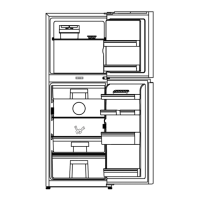
The manual provides guidance on placing food in different compartments:
Some models feature a "Chiller compartment" for storing delicatessen or meat products at lower temperatures for short-term consumption. The "Crisper" is designed to keep vegetables fresh by intensifying cool air circulation.
For models with "Blue light" or "HarvestFresh" technology, fruits and vegetables stored in the crispers benefit from enhanced preservation of vitamin C content. HarvestFresh simulates a day cycle with blue, green, red, and dark lights, and automatically adjusts illumination when the door is opened during the dark period.
Regular maintenance and cleaning are crucial for the appliance's longevity. The manual advises unplugging the refrigerator before cleaning. Users should clean the interior with lukewarm water and a soft cloth, using a solution of one teaspoon of bicarbonate of soda to one pint of water. It is important to ensure no water enters the lamp housing or other electrical items.
For external cleaning, users should avoid gasoline, benzene, abrasive tools, soap, household cleaners, detergents, kerosene, fuel oil, varnish, or chlorine-containing agents, as these can damage plastic surfaces or cause corrosion on metal parts. Lukewarm water and a soft cloth are recommended.
To protect plastic surfaces, liquid oils or oil-cooked meals should not be placed in unsealed containers. Spills should be cleaned immediately with warm water. Door seals should be checked regularly for cleanliness and absence of food particles. If the refrigerator is not used for a long time, it should be unplugged, emptied, cleaned, and the door left ajar. To remove door racks, all contents should be removed, and the rack pushed upwards from the base.
The manual also includes troubleshooting tips for common issues such as the refrigerator not operating, condensation, compressor not running, increased operation noise, bad odor, and crispers getting stuck. These tips help users identify and resolve minor problems before contacting service.
 General
| Brand | Beko |
|---|---|
| Model | RDNT233 Series |
| Category | Refrigerator |
| Language | English |



 To Next Page