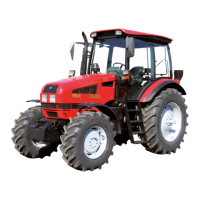
The provided document is an Operator's Manual for the BELARUS 922.6 tractor, published in 2016. This manual details the tractor's structure, operation rules, and maintenance procedures.
Function Description
The BELARUS 922.6 is a general-purpose wheeled tractor of traction class 1.4, featuring a 4x4 wheel arrangement. It is designed for various agricultural operations, including those with mounted, semi-mounted, and trailed machines and implements, as well as for loading-unloading and transportation work.
The tractor's framework is semi-frame, with a low-profile, single-seated cab equipped with protective rigid framework, thermal, noise, and vibration insulation. The cab includes a sprung seat adjustable for operator's height and weight, rear-view mirrors, a sun visor, electrical wipers and washers for front and rear screens, a roof lamp, and a place for a radio set. It also features a system for heating and ventilation (with an optional air conditioning system). The cab doors have locks, with keys for the left door, and the right door serves as an emergency exit. The cab complies with category 2 under EN 15695-1:2009 and Level I of Falling-Object Protective Structures (FOPS) under GOST R ISO 3449-2009.
The tractor is powered by a 4-stroke piston six-cylinder inner combustion engine with in-line vertical cylinder arrangement, direct diesel fuel injection, and compression ignition, meeting Stage 4 environmental requirements. The engine lubrication system is combined, with some parts pressure-lubricated and others spattered. The fuel supply system includes a Common RAIL accumulator system with a high-pressure fuel pump, injectors, fuel accumulator, sensors, electromagnetic actuating mechanisms, and electronic control unit. Engine start-up is electric, facilitated by heating plugs for low temperatures. The air delivery system comprises a turbocharger, air pipeline, and inlet air cooling system, with a Donaldson dry air cleaner. The cooling system is closed-type with compulsory coolant circulation. Two selective catalytic reduction (SCR1, SCR2) systems are installed in the exhaust system to meet Stage 4 exhaust gas composition requirements.
The coupling clutch is frictional, dry, two-disk, and spring-loaded, with a hydrostatic control drive and hydraulic booster. The basic configuration gearbox is a synchromesh type with double-lever control and a synchronized reduction gear unit (14F + 4R). An optional transmission with a synchromesh GB with double-lever control and reverse gear (7F + 6R) is available. The rear axle features a main drive, differential with electrohydraulic locking mechanism, and final drives. Brakes are multi-disk, oil-lubricated, and located on drive pinion shafts of the hub drive, with an option for dry-friction brakes. The service brake control drive is hydraulic, and the parking brake is independent and manually controlled. A double-line pneumatic drive for trailer brakes is interlocked with the tractor's operating brakes, with an option not to install it. The rear power takeoff shaft (PTO) is continuous, dual-speed (540 and 1000 min-1), and synchronous, rotating clockwise when viewed from the shaft end face. PTO shaft end extensions are available in various spline configurations.
Steering is hydrostatic, with a gear-type feed pump and a gerotor-type dosing pump with an open center and no steering response. The rotation mechanism uses one hydraulic cylinder (TS63x200) for bidirectional operation and a steering linkage. The front driving axle (FDA) has a main gear, a self-locked differential, and planetary gear groups for final drives. The FDA drive is a transfer gearbox with automatic FDA engagement, two cardan shafts, and an intermediate bearing with an overload clutch, with mechanical control.
The hydraulic system is a remote cylinder type with hydraulic lift, providing draft control, position control, and mixed control for agricultural implements, with left and right side outputs and a pair of rear outputs. The rear lift linkage (RLL) is a three-point linkage of category 2 (ISO 730 and GOST 10677), with outer or inner lock of lower links, and two TS80x220 cylinders. Various draw hitches are available, including non-rotatable towing yokes, rotatable towing yokes, "Python" drawbar hitches, towing bars, and crossbars.
Important Technical Specifications
- Traction Class: 1.4 (according to GOST 27021)
- Rated Traction Force: 14 kN
- Engine Model: D-245.5S4, turbocharged with intercooling of inlet air, four in-line vertical cylinders, 4.75 L displacement.
- Engine Power: Rated 70 kW, operating 66.7 ± 2.0 kW.
- Crankshaft Rated Speed: 2200 rpm
- Specific Fuel Consumption: 240.0 ± 5 g/(kW·h)
- Rated Factor of Torque Backup: At least 45%
- Max Torque: 464.0 N·m
- Number of Gears: 14 for forward travel, 4 for reverse travel (basic configuration with reduction gear).
- Tractor Travel Speed (Design): Forward 2.5-35.2 km/h, Backward 5.2-11.6 km/h.
- Tractor Weight: Tare 4440 ± 100 kg, operating with ballast 5240 ± 100 kg, operating without ballast 4635 ± 100 kg, max operating 7000 kg, ex-works 4540 ± 100 kg.
- Weight Distribution on Axles (operating): Front 2320 ± 50 kg, Rear 2920 ± 50 kg (with ballast weights mounted).
- Permissible Load on Axles: Front 37 kN, Rear 53 kN.
- Max Trailer Weight: Without brakes 2100 kg, with independent brake 3500 kg, with overrunning brake 3500 kg, with brake system (trailer brakes interconnected with tractor brakes) 18000 kg.
- Road Clearance: At least 520 mm (on 360/70R24 tires).
- Track Dimensions (on 360/70R24 tires): Front 1415-2000 mm (short FDA beam), 1535-2120 mm (long FDA beam); Rear 1500-2100 mm.
- Least Turning Radius: 4.5 m (with braking).
- Tractor Base: 2440 ± 20 mm.
- Maximum Fordable Depth: 0.85 m.
- Service Life: 12 years.
- Overall Dimensions: Length 4440 ± 50 mm (with loads and RLL in transport position), 4060 ± 50 mm (without loads and RLL in transport position); Width 1970 ± 20 mm (along rear wheel semi-axles); Cab height 2560 ± 30 mm.
- Tires (basic configuration): Front 360/70R24, Rear 18.4R34.
- Electrical Equipment: Rated supply voltage 12V, rated ignition voltage 12V.
- Hydraulic System: Pump displacement 46 l/min (at crankshaft rated speed), safety valve operation pressure 20-2 MPa, conventional volume factor at least 0.65.
- Rear PTO Shaft: Rated speed with ground-speed drive on: Position I (2080 rpm engine) 540 rpm, Position II (2200 rpm engine) 955 rpm. Rated speed with continuous drive on: 3.36 rev/meter of travel (on 18.4R34 rear tires).
- Rear Lift Linkage: Loading capacity on suspension axis 4200 kg. Time for raising RLL from lowermost to uppermost position with test load: not more than 3 sec.
- Noise Level: Operator's workplace does not exceed 86 dB (A). External noise level does not exceed 89 dB (A).
- Vibration Level: Operator's seat complies with Council Directive 78/764/ЕEС.
Usage Features
The BELARUS 922.6 tractor is designed for ease of operation and maintenance.
- Controls and Instruments: The cab features a well-organized instrument board with gauges for air pressure, voltage, fuel volume, engine coolant temperature, and engine oil pressure, along with pilot lamps for various indicators (air filter clogged, emergency oil pressure, differential lock, heating plugs, brake fluid level). An integrated indicator and information display provide operational parameters and fault messages.
- Starting the Engine: Before starting, the parking brake must be engaged, fuel filled (if needed), fuel supply control handle set to minimum, clutch pedal not pressed, PTO drive control handle set to "PTO off," rear PTO drive switch handle in neutral, hydraulic system valve group handles in neutral, RLL control handles in middle position, rear axle DL switch in "off" position, GB levers in neutral, accumulator battery switch on, and starter/instruments switch turned to "I." The heating plugs operate automatically based on engine temperature.
- Movement and Gear Shifting: Tractor movement is initiated by reducing engine speed, fully depressing the clutch, setting the desired GB range and gear, disengaging the parking brake, and slowly releasing the clutch while increasing fuel feed. Gear and range shifting should generally occur when the tractor is stopped and the clutch pedal fully depressed, except for certain transport operations where shifting between specific gears is allowed while moving.
- PTO Use: The rear PTO can be engaged in ground-speed or continuous drive modes. Engagement requires setting the handle to the desired position, pressing the lower part of the key switch, and briefly pressing the button switch. Disengagement is achieved by pressing the top part of the key switch. The PTO frequency can be changed by adjusting a bolt on the PTO arm.
- FDA Drive Control: The FDA drive has "FDA off," "FDA engages and disengages automatically," and "FDA positive activation" positions. "FDA off" is for hard surfaces, "automatic" for field operations, and "positive activation" for repeated rear wheel skidding or backward travel.
- Rear Lift Linkage (RLL) Control: RLL is controlled by position and draft control handles. Position control sets implement height, while draft control adjusts cultivation depth based on soil reaction. Combined control limits maximum depth by position control.
- Tire Pressure: Optimal tire pressure depends on operational conditions and load. It's crucial to adjust pressure to avoid premature tire wear, turning on rims, or increased skidding.
- Drawbar Hitches: Various drawbar hitches are available for coupling different implements. It's important to use the correct hitch type and observe load limits.
- Front Loader Installation: When installing a front loader, specific guidelines regarding tire pressure, wheel track, axle loads, and ballasting must be followed to maintain stability and prevent damage.
- Safety: Strict adherence to safety measures is emphasized throughout the manual, including proper training, pre-operation checks, safe operating practices, and emergency procedures. Operating the tractor in closed rooms without ventilation, with an empty AdBlue tank, or with faulty safety systems is strictly forbidden.
Maintenance Features
The manual outlines a comprehensive maintenance schedule to ensure the tractor's reliability and longevity.
- Scheduled Maintenance Services: These include Shift-Time Maintenance Service (STMS) every 8-10 hours, First Maintenance Service (MS-1) every 125 hours, Additional Maintenance Service (2MS-1) every 250 hours, Second Maintenance Service (MS-2) every 500 hours, Third Maintenance Service (MS-3) every 1000 hours, and Special Maintenance Service every 2000 hours. General and seasonal maintenance services are also specified.
- Run-in Period: A 30-hour run-in period is mandatory, during which the tractor should be loaded up to 80% of its rated power. Regular checks of gauges, lubrication, cooling, and power supply systems are required, along with tightening outer fastening links.
- Daily Checks (STMS): Includes checking oil levels in the engine crankcase, transmission, HLL tank, HSC tank, and engine cooling system; AdBlue level in the SCR system liquid tank; visual inspection of exhaust gases; tire condition; air conditioner hose fixtures; hydraulic system elements; air conditioner drainage pipes; engine water radiator and CAC-radiator; RLL gripper tools; brakes, engine, steering, and lighting operability; draining condensate from the pneumatic system balloon; and checking wiring and wire bundles.
- 125-Hour Checks (MS-1): In addition to STMS, this includes checking threaded joint torqueing of wheel mounting, washing the tractor and cleaning the cab, checking CAC air duct clamp bolts, checking pneumatic tire pressure, draining sediment from the fuel tank and coarse fuel filter, cleaning ventilation and air heating system filter cartridges, and checking/adjusting air conditioner compressor drive belt tension.
- 250-Hour Checks (2MS-1): Includes checking oil level in FDA cardan drive intermediate bearing, clutch control adjustment, AB maintenance, lubricating HSC hydraulic cylinders hinge joints, checking/adjusting clearances in steering link hinge joints, checking/adjusting front wheels toe-in, lubricating clutch release yoke bearing and pivot axis bearings of FDA, changing engine oil filter and oil in engine crankcase, checking/tightening drawbar hitch bolt joints, and providing maintenance for generator and starter.
- 500-Hour Checks (MS-2): Includes cleaning air pressure regulating filter, checking/adjusting service and parking brake control, checking pneumatic system lines hermiticity, checking/adjusting brake valve actuators, checking air cleaner and inlet duct joints, checking oil level in oil sump brakes, checking/adjusting engine valve and rocking arm clearances, and checking PTO shaft brake band pads.
- 1000-Hour Checks (MS-3): Includes checking oil level in main gear housing and FDA wheel-hub drive housings, and oil level in transmission.
- 2000-Hour Checks (Special Maintenance): Includes changing HLL and HSC tank changeable filter cartridges, changing oil in HLL tank, HSC tank, transmission line, main gear housing, FDA cardan drive intermediate bearing, and FDA wheel-hub drive housings; changing oil in oil sump brakes; changing brake fluid in clutch and brake control drives; lubricating FLL lever pin sleeves and steering joints elements; checking/adjusting pneumatic system pressure regulator; checking/tightening cylinder head tension bolts and tractor external threaded joints; rinsing engine cooling system and replacing cooling liquid; and changing cab ventilation and heating system filter cartridges.
- Seasonal Maintenance: Involves changing oil grades in the engine crankcase according to seasonal temperatures.
- Storage: Detailed instructions for inter-shift, short-term, and long-term storage are provided, including cleaning, preservation of components, sealing openings, and accumulator battery maintenance.
- Troubleshooting: The manual includes sections on troubleshooting possible failures in the clutch, gearbox, electronic control systems (for DL, PTO, FDA), rear axle, rear PTO shaft, brakes, pneumatic system, hydrostatic steering control, hydraulic lift linkage, electrical equipment, and air-conditioning/heating systems. It emphasizes contacting a dealer for complex repairs and adjustments.

 Need help?

 To Next Page
 General