5
• If the pressure indicator (g1.3) shows not only the blue level, but also the red level, immediately reduce the power since
the inner pressure reaches or even exceeds its maximum pressure level.
• Don’t store salt, soy sauce, alkali, sugar, vinegar, or steam water inside the cooker for a long time. Clean and dry it every
time after using.
• Do not tinker with any of the safety systems. Please refer to the chapter “Getting started and how to cook”.
• Only use manufacturer’s spare parts in accordance with the relevant model. Always use body and cover from the same
manufacturer, indicated as being compatible.
• KEEP THESE INSTRUCTIONS close at hand. When someone else is to use your pressure cooker, make sure that person
knows how to use it. Always hand over this manual with the pressure cooker.
3 PRINCIPLES OF COOKING WITH A PRESSURE COOKER
In a pressure cooker, food is cooked by means of steam. The steam is produced by heating a little amount of liquid –
mostly water – in a closed container. Due to the extremely heated steam that is created the ingredients are ready fast.
Cooking times with a pressure cooker are much shorter than when other methods are used. The principle of using steam
also explains why always a liquid is used.
The pressure limiting valve (g1.7) indicates when the right amount of steam, thus the right amount of pressure is
reached. That’s the signal to immediately lower the heat so that the correct pressure can be maintained. It’s also the
moment that you have to start timing. Since you have to adjust the heat, never leave the pressure cooker unattended.
When cooking time has passed, you can’t directly open the lid. There’s more on this topic in section 4.5
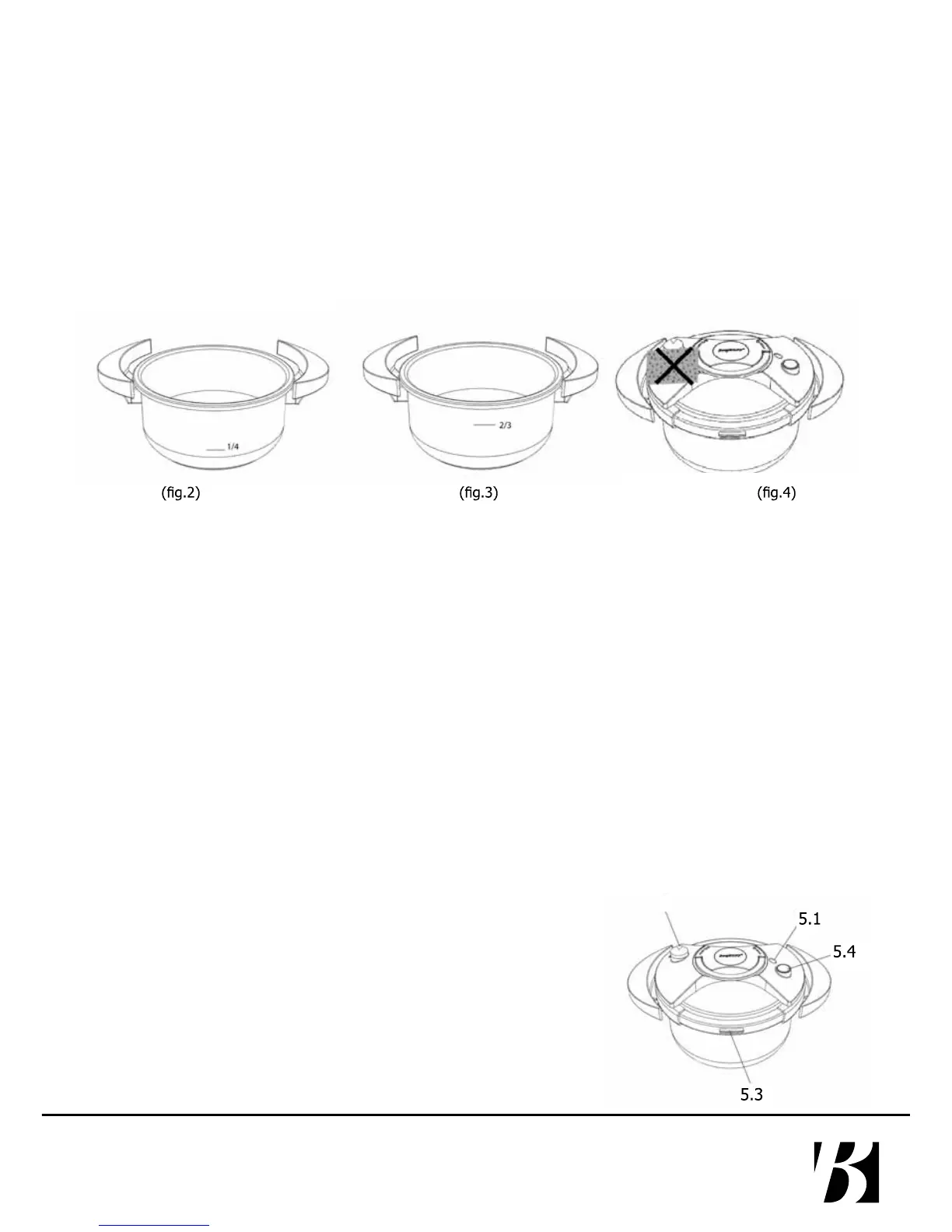
To feel safe and at ease we designed and equipped this pressure cookers with several safety-devices. (Fig.5)
The 5 independent safety systems:
Safely open-preventing valve (g.5.1): Will raise when the pressure inside
reaches 4Kpa. From that moment on, the lid can not be opened anymore, until
the pressure has dropped under 4Kpa again. (The safely open-preventing valve
has to be down again).
5.2
(Fig.5)



 To Next Page