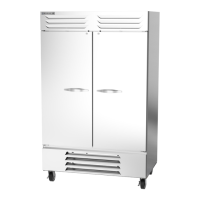
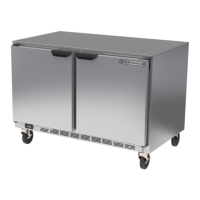
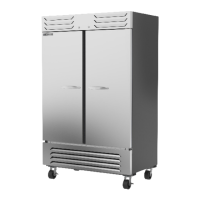
This document serves as the User Manual for MMF Freezer Models manufactured by Beverage-Air. It provides comprehensive instructions for installation, operation, and maintenance of these commercial freezer units.
Function Description
The Beverage-Air MMF Freezer models are designed for commercial use in controlled indoor environments, such as bars and restaurants, to maintain a set internal temperature of 0°F (-17.8°C) or below. They are not intended for rapid pull-down of warm products but rather for storage. The units are equipped with a refrigeration system that includes a compressor, condenser fan, evaporator fan, and defrost heaters to ensure consistent internal temperatures and prevent ice buildup. The operation is controlled by a Danfoss controller, which displays the current internal temperature and manages the various refrigeration components based on air temperature measured by a return air probe.
Important Technical Specifications
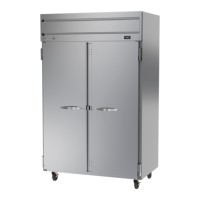
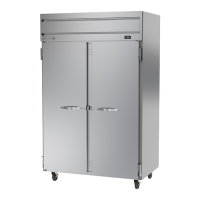
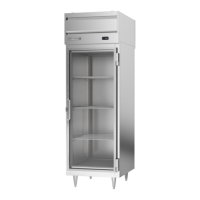
The manual provides a table of product information including various MMF Freezer models with their respective cabinet dimensions (width x depth x height in inches), door configurations (Half or Full), door material (Glass or Solid), Full Load Amps, Power Cord Plug (NEMA type), and Refrigerant Type/Charge (g/oz).
For example:
- MMF12HC-1: 24 1/8 x 25 3/4 x 62 inches, 5 Full Load Amps, R-290/50/1.69 refrigerant.
- MMF19HC-1: 27 1/4 x 27 1/2 x 78 1/8 inches, 1 Full door, Glass, 7.5 Full Load Amps, 5-15P plug, R-290/150/5.08 refrigerant.
- MMF72HC-5: 75 x 33 1/2 x 78 inches, 3 Full doors, Glass, 14 Full Load Amps, L14-20P plug, R-290/301/10.17 x 2 refrigerant (indicating two systems per cabinet).
All listed heights include casters. The units operate on 115 volts and require a dedicated power supply. They are designed for use within a room air temperature range of 60°F (15.6°C) to 100°F (37.8°C) and a voltage range of 103.5V (minimum) to 126.5V (maximum). The refrigerant used is R-290, which is flammable, requiring specific safety precautions for service.
Usage Features
- Installation: The manual details uncrating and setup, including instructions for removing the skid and attaching casters or legs. It emphasizes the importance of leveling the cabinet to ensure proper door sealing and water drainage. Clearance requirements are specified: 6 inches at the top, 3 inches at the rear, and 0 inches on the left, right, and bottom sides.
- Shelf Installation: Step-by-step instructions are provided for installing shelf clips and shelves, ensuring they are securely placed and not overloaded.
- Electrical Connection: Units are cord-connected and must be plugged into a dedicated power supply. The use of extension cords is prohibited, and the unit must be grounded. Connection to GFI/GFCI outlets is not recommended due to potential product loss from unsafe cabinet temperatures if the device trips.
- Danfoss Controller: The unit features a Danfoss controller that displays the internal temperature. The factory set point is 0°F, which can be adjusted by the user. The controller includes buttons for Defrost (ESC), Select (OK), Up, Down, and Set (ENTER). It also has indicator LEDs for Defrost, Fan, Alarm, and Compressor status.
- Manual Defrost: A manual defrost can be initiated by pushing and immediately releasing the "melting" or defrost button.
- Cabinet Light: For models with glass doors, holding the SC button turns the cabinet light on or off.
- Alarm System: The controller signals alarm conditions with an icon and specific codes (e.g., "Hi" for high temperature, "dor" for door open, "E01" for sensor error). Alarms can be silenced by pressing any button, though the icon will continue flashing until the condition is resolved.
- Door Reversal: Detailed instructions are provided for reversing the door swing, including removing hinge covers, brackets, and hole plugs, and re-mounting components.
Maintenance Features
- Cleaning Schedule:
- Cabinet: Daily wipe down, weekly interior cleaning.
- Condenser Coil: Quarterly cleaning.
- Gaskets: Daily inspection for tightness to the cabinet.
- Routine Maintenance: Annually.
- Daily Exterior Cleaning: Involves washing with a mild, chlorine-free detergent, rinsing, drying with a soft cloth, and polishing with stainless steel cleaner weekly.
- Weekly Interior Cleaning: Requires removing food and shelves, disconnecting power, cleaning loose food particles, scrubbing surfaces and door gaskets with a warm detergent solution and soft brush, rinsing, air drying, and then restoring power and food.
- Condenser Cleaning: Critical for efficient operation. Instructions include unplugging the unit, removing the front panel (secured by a Phillips head screw), brushing and vacuuming dust and lint from the coil. Caution is advised due to the rotating fan blade. If the coil is greasy, professional cleaning with coil cleaner is recommended. Air filters are not recommended as they restrict airflow.
- Stainless Steel Cleaning: A detailed table provides various cleaning agents and methods of application for different types of stains and discolorations on stainless steel, along with their effect on the finish.
- Troubleshooting Guide: The manual includes sections for user and technician troubleshooting, addressing common issues like no cooling, unit running continuously, high/low space temperature, compressor issues, fan problems, and excessive noise.
- R290 Service Information: For service technicians, critical information regarding R290 systems is provided, emphasizing that service should only be attempted by trained professionals. Key points include avoiding wire nuts, using only exact replacement switches, using process tubes for service access, cutting (not un-brazing) refrigeration components, venting R290 in a flame/spark-free area, attaching a service sign, and using a combustible gas leak detector. It also covers evacuation procedures and symptoms of overcharge and undercharge.
- Warranty: Beverage-Air offers a three-year parts and labor warranty and an additional four-year compressor part-only warranty for units shipped after 03/01/2020, with specific exceptions for certain models and residential applications. Warranty registration can be completed online or by mail.

 Need help?
 General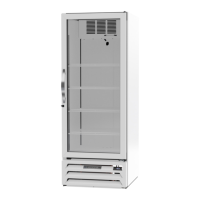

 To Next Page