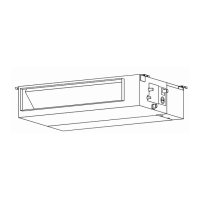
This document is a user and installation manual for BGH Eco Smart indoor units, specifically models BMPE36CTL, BMPE60CTL, and BMPE72CTL. These units are high-efficiency indoor units designed to work with R410-A refrigerant, with capacities ranging from 1.5 to 6 TR.
Function Description
The BGH Eco Smart indoor units are designed for use in air conditioning systems, providing either vertical upflow or vertical downflow air distribution, and can also be configured for horizontal airflow. They are intended to be part of a complete HVAC system, working in conjunction with an outdoor unit. The units are designed for high-efficiency operation, ensuring optimal comfort and energy savings.
Important Technical Specifications
Models and Dimensions:
The manual covers models BMPE36CTL, BMPE60CTL, and BMPE72CTL.
Dimensions vary by model, as detailed in the "Dimension data" table:
| MODEL SIZE |
FILTER SIZE IN [mm] |
"W" IN [mm] |
"D" IN [mm] |
"H" IN [mm] |
Return width "A" IN |
Return length MODEL "B" IN |
| 24 |
16x20[406x508] |
16.8[426] |
20.4[518] |
1[25.4] |
19.6 |
14.8 |
| 36 |
18x20[457x508] |
18.3[466] |
21.6[548] |
1[25.4] |
20.8 |
16.3 |
| 60/72 |
20x22[508x559] |
20.7[526] |
23.9[608] |
1[25.4] |
23 |
18.8 |
Refrigerant: The units use R410-A refrigerant.
Maximum Pressure: The maximum resistant pressure of the evaporator is up to 16MPa (2320PSI).
Electrical Wiring:
- Power Wiring: Requires a branch circuit disconnect of adequate size, located within sight of, and readily accessible to the unit. Supply circuit power wiring must be 75°C minimum copper conductors only. Supply circuit protective devices may be either fuses or "HACR" type circuit breakers. Power wiring may be connected to either the right, left side or top. Three 7/8", 1-3/8", 1-3/4" dia. concentric knockouts are provided for connection of power wiring to unit. Power wiring is connected to the power terminal block in unit electric cabinet.
- Control Wiring: Class 2 low voltage control wiring should not be run in conduit with main power wiring and must be separated from power wiring, unless Class 1 wire of proper voltage rating is used. Low voltage control wiring should be 18 Awg. color-coded. For lengths longer than 100 ft., 16 Awg. wire should be used.
- Grounding: The unit must be permanently grounded. Grounding may be accomplished by grounding metal conduit when installed in accordance with electrical codes to the unit cabinet. Grounding may also be accomplished by attaching ground wire(s) to ground lug(s) provided in the unit wiring compartment. Ground lug(s) are located close to wire entrance on left side of unit (up-flow). Lug(s) may be moved to marked locations near wire entrance on right side of unit (upflow). If alternate location is more convenient. Use of multiple supply circuits require grounding of each circuit to lug(s) provided in unit.
Electrical Data (Cooling & Heating):
| NOMINAL COOLING & HEATING |
VOLTAGE |
HERTZ |
HP |
RPM |
SPEEDS |
CIRCUIT AMPS |
MIN. CIRCUIT AMPACITY |
MAX. CIRCUIT VOLTAGE HERTZ |
| 2 |
220-240 |
50 |
1/5 |
701 |
3 |
0.6 |
1.0 |
15(A) |
| 3 |
220-240 |
50 |
1/2 |
794 |
3 |
1.4 |
1.8 |
15(A) |
| 5 |
220-240 |
50 |
3/4 |
845 |
3 |
3.3 |
4.1 |
15(A) |
| 6 |
220-240 |
50 |
3/4 |
963 |
3 |
4.3 |
5.4 |
15(A) |
Airflow Performance (CFM - Watts):
The manual includes detailed tables for External Static Pressure (Inches W.C.) versus CFM and Watts for different models (24, 36, 60, 72) and motor speeds (LOW, MIDDLE, HIGH). These tables provide crucial data for selecting the appropriate unit and fan speed based on the required airflow and static pressure for a given application.
Ductwork:
- Duct system must be designed within the range of external static pressure the unit is designed to operate against.
- Supply and return ductwork, grills, special filters, accessories, etc. are accounted for in total resistance.
- The duct system incorporates flexible air duct, be sure pressure drop information (straight length plus all turns) shown in "ACCA" Manual "D" is accounted for in system.
- Supply plenum is attached to the 3/4" duct flanges supplied with the unit. Attach flanges around the blower outlet.
Usage Features
Installation Flexibility:
- The unit can be positioned for bottom return air in the upflow position, left and right return in the horizontal position, top return in the downflow position.
- The Air Handler provides the flexibility for installation in any upflow or downflow horizontal application.
- The direct drive motors provide a selection of air volume to match any application. 3-Speed motors provide selections of air flow to meet desired applications.
- Top and side power and control wiring, accessible screw terminals for control wiring all combine to make the installation easy, and minimize installation cost.
- For horizontal applications, a vertical upflow unit may be converted to horizontal right by removing indoor coil assembly and reinstalling coil as shown for right hand air supply. And reinstall coil in unit as shown for right hand air supply.
- Horizontal left isn't the default factory configuration for the units.
- Conversion to Horizontal: A vertical upflow unit may be converted to horizontal right by removing indoor coil assembly and reinstalling coil as shown for right hand air supply. And reinstall coil in unit as shown for right hand air supply.
Airflow Configuration:
- Vertical Upflow: Configuration is factory set. If a side return air opening is required, field fabricate a return air plenum with an opening large enough to supply unit and strong enough to support unit weight. If return air is to be ducted, install duct flush with floor. Use fireproof resilient gasket 1/8 to 1/4 in. thick between the ducts, unit and floor. Set unit on floor over opening.
- Vertical Downflow: Conversion to Vertical Downflow: A vertical upflow unit may be converted to the vertical downflow on it. Remove the door and indoor coil and reinstall 180° from original position.
- Horizontal: Horizontal right is the default factory configuration for the units. Horizontal left isn't the default factory configuration for the units. Conversion to Horizontal: A vertical upflow unit may be converted to horizontal right by removing indoor coil assembly and reinstalling coil as shown for right hand air supply. And reinstall coil in unit as shown for right hand air supply.
Electrical Heater Integration:
- The unit is equipped with a breaker switch for the electric heater only.
- The main power plug in the air conditioner has been joined with the ground wiring, please don't change it freely.
- The power socket is used as the air conditioner specially.
- Don't pull the power wiring hard.
- When connecting the air conditioner with the ground, observe the local codes.
- If necessary, use the power fuse or the circuit, breaker or the corresponding scale ampere.
Maintenance Features
Filter Installation and Removal:
- The unit is supplied with a filter rack.
- Remove bolts manually, remove air filter recover, see in Fig 6.
- Hold the edge of the air filter and extract out.
- Clean the air filter (Vacuum cleaner or pure water may be used to clean the air filter. If the dust accumulation is too heavy, use soft brush and mild detergent to clean it and dry out in cool place).
- External filter or other means of filtration is required. Units should be sized for a maximum of 300 feet/min. air velocity or what is recommended for the type filter installed.
- Filter application and placement are critical to airflow, which may affect the heating and cooling system performance. Reduced airflow can shorten the life of the system's major components, such as motor, limits, elements, heat relays, evaporator coil or compressor.
- The return air duct system must have only one filter location. For systems with a return air filter grill or multiple filter grills, can have a filter installed at each of the return air openings.
- If adding high efficiency filters or electronic air filtration systems, it is very important that the air flow is not reduced. If air flow is reduced the overall performance and efficiency of the unit will be reduced. It is strongly recommended that a professional installation technician is contacted to ensure installation of these such filtration systems are installed correctly.
- DO NOT DOUBLE FILTER THE RETURN AIR DUCT SYSTEM. DO NOT FILTER THE SUPPLY AIR DUCT SYSTEM.THIS WILL CHANGE THE PERFORMANCE OF THE UNIT AND REDUCE AIRFLOW.
Condensate Drain Trap:
- The condensate drain trap is designed to prevent sweating and damage due to condensate forming on the outside surface of the line.
- Make provisions for disconnecting and cleaning of the primary drain line should it become necessary. Install a 3 inch trap in the primary drain line as close to the unit as possible. Make sure that the top of the trap is below connection to the drain pan to allow complete drainage of pan.
- Auxiliary drain line should be run to a place where it will be noticeable if it becomes operational. Homeowner should be warned that a problem exists if water should begin running from the auxiliary drain line.
- Plug the unused drain connection with the plugs provided in the parts bag, using a thin layer of teflon paste, silicone or teflon tape to form a water tight seal.
- Test condensate drain pan and drain line after installation is complete. Pour water into drain pan, enough to fill drain trap and line. Check to make sure drain pan is draining completely, no leaks are found in drain line fittings, and water is draining from the termination of the primary drain line.
- Install drain lines so they do not block service access to front of the unit. Minimum clearance of 24 inches is required for filter, coil or blower removal and service access.
- Make sure unit is level or pitched slightly toward primary drain connection so that water will drain completely from the pan.
- Do not reduce drain line size less than connection size provided on condensate drain pan.
- All drain lines must be pitched downward away from the unit a minimum of 1/8" per foot of line to ensure proper drainage.
- Do not connect condensate drain line to a closed or open sewer pipe. Run condensate to an open drain or run line to a safe outdoor area.
Refrigerant Connections:
- Keep the coil connections sealed until refrigerant connections are made.
- See the installation Instructions for the outdoor unit for details on line sizing, tubing installation, and charging information.
- Coil is shipped with "No charge". Evacuate the system before charging with refrigerant. Install refrigerant tubing so that it does not block service access to the front of the unit.
- Nitrogen should flow through the refrigerant line while brazing.
- Use a brazing shield to protect the cabinet's paint and a wet rag to protect the rubber grommet from being damaged by torch flames. After the refrigerant connections are made, seal the gap around the connections with pressure sensitive gasket.
General Maintenance:
- Ensure enough space required for installation and maintenance.
- Regularly check and clean the filter.
- Periodically inspect electrical wiring and connections.
- Ensure proper grounding of the unit.
- Check for any unusual noises or vibrations during operation.
- Ensure proper condensate drainage to prevent water damage.

 Need help?
 General

 To Next Page