Need help?
Do you have a question about the BIGTREETECH TMC2209 V1.2 and is the answer not in the manual?
Overview of the TMC2209 IC, its continuous and peak drive current, and comparison with TMC2208.
Specifies the operating voltage range and lists key patent technologies like SpreadCycle, StealthChop2, and CoolStep.
Details flexible microPlyer, StallGuard4, CoolStep, and compatibility with 3D printing devices.
Details the physical dimensions, power voltage, peak/RMS current, microstep settings, and operating modes.
Highlights advantages like step loss prevention, quiet operation, cooling, anti-shaking, and support for specific tests/modes.
Illustrates the physical dimensions of the drive module and the cooling pad size for heat dissipation.
Details the designation and functional purpose of each pin on the TMC2209 module.
Explains the mode settings for each pin, detailing the function of J1 and J2 interfaces.
Details the microstep resolution configuration based on MS1/MS2 pin settings.
Provides the formula for calculating drive current and instructions for potentiometer adjustment.
Explains the pin configuration for enabling UART mode by connecting the PDN_UART pin.
Illustrates the wiring diagrams for connecting the module to an MCU in UART mode.
Details how to select between mute (StealthChop) and anti-shake (SpreadCycle) modes using jumper settings.
Provides essential guidelines for safe installation, wiring, handling static electricity, and heat dissipation.
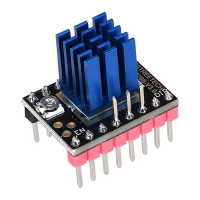
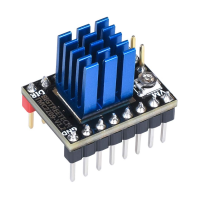
The TMC2209-V1.2 is a stepper motor drive module designed for two-phase stepper motors, offering a blend of advanced features for precise and quiet operation. It is an ultra-silent motor driver IC that aims to enhance the performance and user experience in various applications, particularly in 3D printing.
At its core, the TMC2209-V1.2 serves as a sophisticated controller for stepper motors, enabling them to move with high precision and minimal noise. It integrates several patented technologies to achieve its operational goals.
One of the primary functions is SpreadCycle™, a highly dynamic motor control chopper. This technology ensures smooth and efficient motor operation across a wide range of speeds, contributing to the overall performance and responsiveness of the system.
Another key function is StealthChop2™, which is responsible for the module's ultra-quiet operation. This technology is particularly beneficial in noise-sensitive environments, such as 3D printers, where reducing operational sound is a significant advantage. By minimizing motor noise, StealthChop2™ enhances the user experience and allows for more comfortable use of the device.
The module also incorporates MicroPlyer™, a microstep control unit. This feature allows for the interpolation of microsteps, providing a finer resolution of motor movement. The flexible microPlyer interpolation unit can provide up to 256 microsteps, which means that even if the input signal has a lower resolution, the motor can still achieve very smooth and precise movements. This is crucial for applications requiring high accuracy and smooth motion, preventing visible stepping artifacts.
A notable enhancement in this version is the inclusion of StallGuard4™, a locked-motor test function. This technology can detect when a motor stalls or encounters an obstruction, providing an abnormal signal. This feature is vital for preventing damage to the motor or the system by allowing for immediate detection and potential intervention when the motor is not rotating as expected. It adds a layer of safety and reliability to the system.
Furthermore, the TMC2209-V1.2 includes CoolStep™, a current dynamic control feature. This function intelligently adjusts the motor current based on the load, which can lead to significant energy savings. By optimizing the current, CoolStep™ can save up to 75% energy, making the module more efficient and reducing power consumption. This also helps in managing heat generation, contributing to the longevity of the motor and the driver.
The module is designed to achieve perfect sinusoidal control, even in systems with limited pulse frequency. This ensures that the motor's movement is as smooth and continuous as possible, avoiding jerky motions that can compromise precision or quality in applications like 3D printing.
The TMC2209-V1.2 operates with a standard step/dir interface, making it easy to integrate into existing electronic devices, particularly those used in 3D printing. This compatibility eliminates the need for expensive redesigns, allowing users to upgrade their systems with minimal effort and cost. The module supports both STEP/DIR and UART operating modes, offering flexibility in how it communicates with the main controller.
The TMC2209-V1.2 offers several features that enhance its usability and performance in practical applications.
One of the most significant advantages is that the motor is difficult to lose steps. This is critical for applications requiring high accuracy and reliability, as lost steps can lead to inaccuracies in positioning and overall performance degradation. The advanced control algorithms within the module help maintain precise motor positioning, even under varying loads.
The ultra-quiet mode is a standout feature, particularly for consumer-oriented devices like 3D printers that are often used in home or office environments. The StealthChop2™ technology ensures that the motor operates with minimal audible noise, creating a more pleasant and less disruptive user experience. This feature makes the TMC2209-V1.2 an excellent choice for applications where noise reduction is a priority.
The module is designed to prevent the motor from shaking. This stability is crucial for achieving smooth and consistent motion, which is essential for high-quality output in applications such as 3D printing, where even minor vibrations can affect the final product. The advanced control mechanisms contribute to a stable and controlled motor movement.
The locked-motor test support (StallGuard4™) is a valuable usage feature. It provides real-time feedback on the motor's status, allowing the system to detect and respond to potential issues such as obstructions or stalls. This proactive detection can prevent damage to the motor and the driven mechanism, improving the overall reliability and safety of the system. It can also be used for sensorless homing, simplifying the mechanical design of the system.
The flexibility of supporting both STEP/DIR and UART modes provides users with options for integration. The standard STEP/DIR interface is straightforward to implement, while the UART mode offers more advanced control and feedback capabilities, allowing for more sophisticated system designs and diagnostics. This dual-mode support caters to a wider range of application requirements and user preferences.
The module also includes a microstep setting capability, allowing users to configure the microstep resolution. While the flexible microPlyer interpolation unit can provide up to 256 microsteps, the module can be configured for 2, 4, 8, or 16 microsteps directly, which can then be interpolated further. This flexibility allows users to balance between precision and processing overhead based on their specific application needs.
While the TMC2209-V1.2 is designed for robust operation, certain features and recommendations contribute to its longevity and reliable performance.
The module features a large-area cooling pad, which is a significant design choice for thermal management. This cooling pad helps to dissipate heat generated during operation, effectively lowering the temperature of the drive. Maintaining a lower operating temperature is crucial for the long-term reliability and performance of electronic components, preventing overheating that could lead to premature failure or reduced efficiency. This integrated cooling solution simplifies maintenance by reducing the need for complex external cooling setups in many applications.
The potentiometer regulation instructions provide a clear method for adjusting the drive current. Users can rotate the potentiometer to reduce or increase the Vref voltage, which in turn adjusts the drive current. This allows for fine-tuning the motor's performance to match specific requirements, ensuring optimal operation and potentially extending the life of the motor by preventing overcurrent situations. This adjustability is a key maintenance feature, allowing for on-the-fly calibration without complex software changes.
The diagnostic and StallGuard output (DIAG pin) provides valuable information for troubleshooting and system monitoring. This pin outputs a high level upon stall detection or driver error, allowing the system to identify and respond to issues. The error condition can be reset by setting ENN to high. This diagnostic capability simplifies the process of identifying and resolving operational problems, reducing downtime and maintenance effort.
The VREF pin, which provides an analog reference voltage for current scaling, also contributes to maintenance by allowing for precise control over the motor current. This ensures that the motor operates within its optimal parameters, preventing unnecessary wear and tear.
The design of the module, being compatible with existing 3D printer electronic devices, also implies a certain ease of replacement and upgrade. If a module needs to be replaced, its standard interface and form factor make the process straightforward, minimizing maintenance complexity.
Overall, the TMC2209-V1.2 is engineered to be a reliable and user-friendly stepper motor drive module, with integrated features that not only enhance performance but also contribute to its ease of use and long-term maintainability.
 General
| Microstepping | Up to 1/256 |
|---|---|
| Interface | UART |
| Logic Voltage | 3.3V / 5V |
| Version | V1.2 |
| Features | StealthChop2, SpreadCycle, StallGuard4, CoolStep |
| Protection | Short circuit |
| Dimensions | 20mm x 15mm |

 To Next Page