Need help?
Do you have a question about the BIGTREETECH TMC2208 V3.0 and is the answer not in the manual?
Highlights stealthChop2, spreadCycle, interpolation, and microstepping capabilities.
Details drive current, voltage range, low RDSon, and peak current.
Explains Single Wire UART and Integrated Pulse Generator functions.
Setup and operation for the STEP/DIR interface.
Using MS1 and MS2 pins to select driver operating modes.
Guidance on adjusting the current reference for motor control.
Steps for activating UART mode and necessary wiring adjustments.
Benefits of using UART for firmware-based configuration and control.
Detailed steps for adjusting the potentiometer for drive current.
Information on measuring Vref voltage and its operational limits.
Precautions for preventing damage during potentiometer adjustment.
Configuring Marlin firmware with the TMC2208 driver.
Explains the difference between TMC2208 and TMC2208_STANDALONE modes.
Essential safety and wiring advice for UART mode.
Guidelines for correct installation and effective heat management.
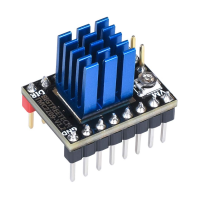
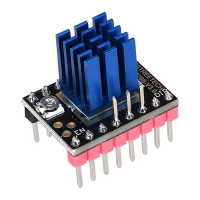
The BIGTREETECH TMC2208-V3.0 is a stepper motor driver designed for various applications, particularly in 3D printing and other motion control systems. Its primary function is to control stepper motors, offering a range of features aimed at improving performance, quietness, and dynamic operation.
The driver is equipped with a built-in power tube that delivers a continuous drive current of 1.2A, with a peak current of 2A. This capability allows it to handle a variety of stepper motors, providing sufficient power for most common applications. A key feature of this driver is its ability to achieve 256 microsteps per full step. This high microstepping resolution is crucial for smooth and precise motor movements, which is particularly beneficial in applications requiring fine control, such as 3D printers where layer accuracy is paramount. The driver also supports interpolation from lower input resolutions, meaning it can take a lower resolution input signal and internally interpolate it to achieve higher microstepping, thus enhancing smoothness even with simpler control signals.
One of the standout usage features of the TMC2208-V3.0 is its "stealthChop2" mode. This mode is specifically designed for quiet positioning, significantly reducing motor noise during operation. This is a highly desirable feature in environments where noise reduction is important, such as home 3D printers or other consumer-level devices. In contrast, the "spreadCycle" mode is available for applications requiring high speed and dynamic performance. This mode optimizes the current control for faster acceleration and deceleration, making it suitable for tasks where rapid movements are more critical than absolute quietness. The ability to switch between these two modes, either through firmware or configuration, provides flexibility to adapt the driver's behavior to specific application needs.
The driver operates within a voltage range of 12V to 24V DC, making it compatible with common power supplies used in many electronic projects. Its low RDSon (on-resistance) values for both the low-side (LS 280mΩ) and high-side (HS 290mΩ) MOSFETs, typical at 25°C, contribute to its efficiency by minimizing power loss as heat. This efficiency is important for maintaining stable operation and prolonging the lifespan of the driver.
For advanced configuration and control, the TMC2208-V3.0 supports a Single Wire UART interface. This allows for sophisticated communication with a microcontroller, enabling dynamic adjustments to various parameters. This is a significant usage feature, as it allows users to fine-tune the driver's performance without needing to physically adjust jumpers or potentiometers for every change. The driver also includes an integrated Pulse Generator, which is useful for standalone motion applications where a dedicated external pulse source might not be available or desired.
The driver offers two primary working modes: STEP/DIR mode and UART mode. In STEP/DIR mode, the driver is controlled by traditional step and direction signals from a microcontroller. This mode is simpler to implement for basic motion control. The choice of microsteps (8, 2, 4, or 16) and chopper mode (stealthChop2) can be set by configuring the MS1 and MS2 pins. To access all other modes, such as spreadCycle, the UART interface must be used.
The UART mode unlocks a wealth of advanced usage features. When operating in UART mode, the motor current can be set arbitrarily by the firmware, providing precise control over the motor's torque and heat generation. Similarly, microsteps can be set arbitrarily by firmware, up to 256 actual microsteps, allowing for extremely smooth motion. This mode also enables the combination of actual and interpolated microsteps to achieve maximum torque, optimizing the balance between smoothness and power. A crucial advantage of UART mode is the ability for firmware to dynamically switch between stealthChop2 and spreadCycle modes, adapting the driver's behavior on-the-fly based on the current operational requirements. Furthermore, in UART mode, the standby current of the motor can be dynamically reduced when the motor is not moving, which helps to minimize heat generation and save power.
Maintenance features primarily revolve around proper installation and configuration. When using the UART working mode, caution is advised during soldering to prevent scalding and to ensure no residual tin slag remains on the module, which could cause short circuits. Correct wiring is essential; paying attention to the line sequence and IO port connections is critical, as incorrect connections will prevent the drive from functioning. When inserting the driver into the main board, it is important to observe the correct orientation to prevent damage from backward insertion.
Effective heat dissipation is a key maintenance consideration for the TMC2208-V3.0. It is crucial to ensure good heat dissipation, typically by using a heat sink and a heat dissipation fan, to prevent abnormal operation or damage to the driver due to overheating. The potentiometer on the driver allows for manual adjustment of the reference voltage (Vref), which in turn controls the driving current. Rotating the potentiometer clockwise reduces Vref and the driving current, while counter-clockwise rotation increases Vref and the driving current. The accurate Vref voltage can only be measured when the main board is supplied with 12V or 24V. Care must be taken not to apply excessive force when rotating the potentiometer to avoid irreversible damage. The potentiometer has a range where continuous rotation beyond the maximum or minimum point will cause it to cycle back to the opposite extreme.
For users who wish to modify the firmware, the manual provides instructions for Marlin-bugfix-2.0, using BIGTREETECH SKR V1.3 as an example. This involves configuring Configuration.h and Pins_BIGTREE_SKR_V1.3.h files to enable TMC2208 drivers and set up UART communication pins. The TMC2208 setting in the firmware indicates control via UART, while TMC2208_STANDALONE signifies STEP/DIR control. After firmware changes, burning the firmware to the microcontroller and verifying correct driver installation are necessary steps. The Configuration_adv.h file also allows for enabling STEALTHCHOP_XY, STEALTHCHOP_Z, and STEALTHCHOP_E for quiet stepping, and configuring chopper timing parameters. Monitoring driver status and setting current step-down values are also possible through firmware adjustments.
In summary, the BIGTREETECH TMC2208-V3.0 stepper motor driver is a versatile and feature-rich component, offering precise control, quiet operation, and dynamic performance suitable for a wide array of motion control applications. Its advanced UART capabilities provide extensive customization and real-time adjustment options, while its robust design and clear configuration guidelines ensure reliable operation with proper installation and thermal management.
 General
| Type | Stepper Motor Driver |
|---|---|
| Driver Chip | TMC2208 |
| Version | V3.0 |
| Operating Voltage | 4.75V-36V |
| Microstepping | up to 1/256 |
| Interface | UART |
| Operating Modes | StealthChop, SpreadCycle |
| Max Current | 2A |
| Features | CoolStep |
| Configuration | UART |
| Dimensions | 20mm |

 To Next Page