22
FI
SV
EN
DE
NO
ET
LV
LT
RU
FR
PL
CS
(EN) INSTRUCTIONS FOR USE
1. COMPOSTING PERMITS AND
REGULATIONS
The permits and regulations applicable to composting vary from
country to country and municipality to municipality. Consult your
local municipal environmental authority for the regulations valid
in your area.
2. CHOOSING CORRECT COMPOSTER
LOCATION
Place Quick Composter 550 in a place where you can easily take
your waste and unload the composter all year round. Set the
composter up on a firm surface at a location with good drainage.
Make sure that the composter is level or slightly tilted back-
wards by elevating the front end a bit. Quick Composter 550 is
equipped with a seep liquid opening near the bottom at the back
of the bin to drain any excess liquid. Place the composter directly
onto the ground so that the soil will absorb any seep liquid. Alter-
natively, you can collect the seep liquid (see Chapter 3.1). If the
compost mass is exceptionally wet, some seep liquid may also
seep from under the compost unloading hatch (part 3) and from
the adjustment valve at the front of the composter (parts 9 and
10). If you wish to place the Quick Composter in, for example, an
outdoor storage shed, connect the hose connector supplied with
the composter to the seep liquid opening. You can then connect
a hose with a diameter of 19 mm to the connector to drain the
seep liquid into a floor drain or a canister.
3. PRIOR TO USE
3.1 Attaching the seep liquid hose and
draining liquid
Quick Composter 550 includes a seep liquid opening near the
bottom in the back of the bin to drain any excess liquid out of the
bin and absorb it into the soil. You can collect the seep liquid in a
container if you like, but this is not mandatory. Attach the hose
connector (supplied) to the seep liquid opening and then connect
a hose with a diameter of 19 mm to the connector. Place the oth-
er end of the hose in a container located in such a place that the
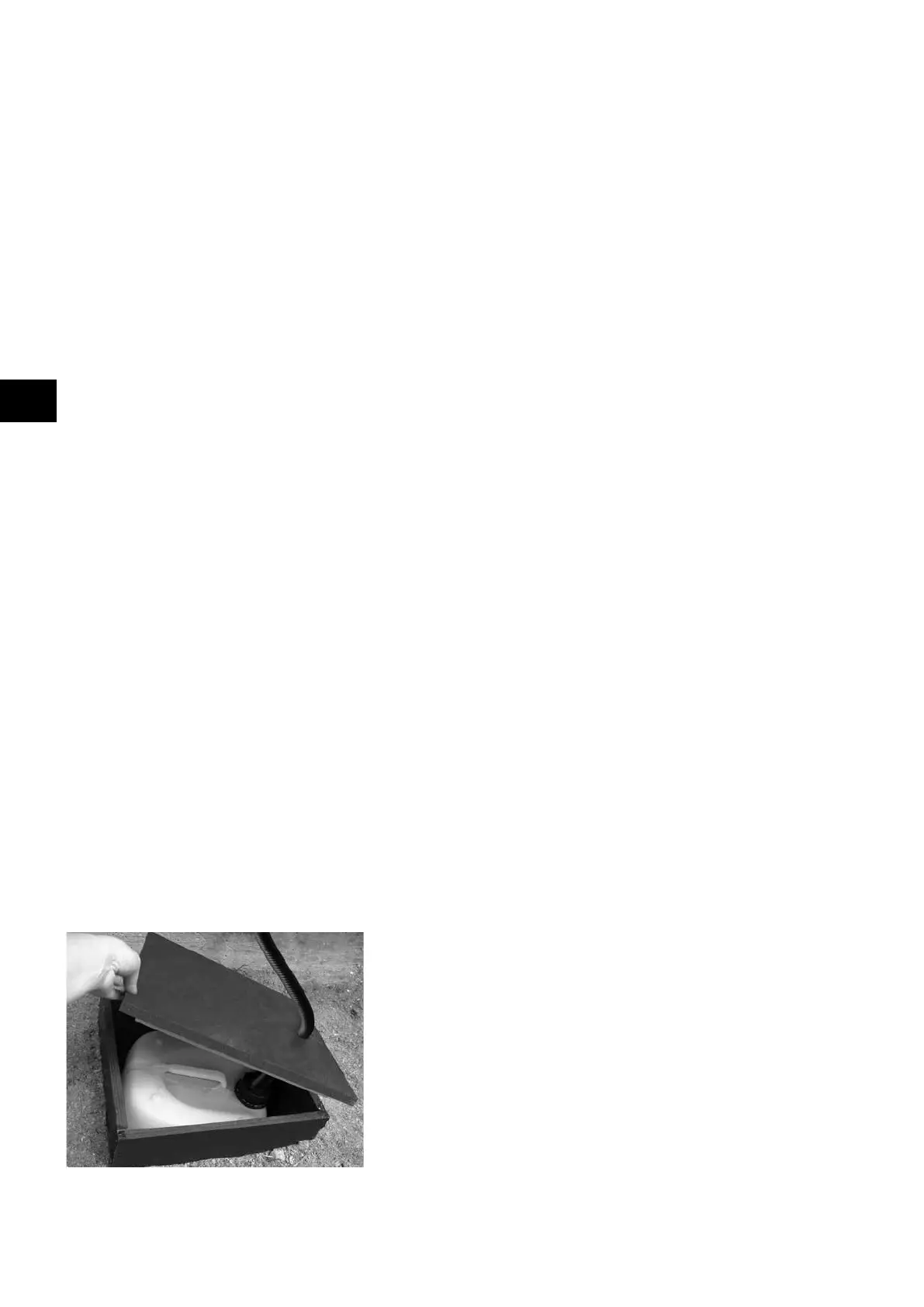
liquid will flow downhill. If you want, you can use film-faced ply-
wood to make a covered pit for the canister and insulate it on the
outside (as shown in Figure 1). You can use any canister made of
frost-proof plastic. You can purchase the canister from a retailer
or from the Biolan webstore.
4. COMMISSIONING
Spread a layer of 5 cm (about 20 litres) of Biolan Compost and
Dry toilet Bulking Material at the bottom. Start using the com-
poster in the manner described in Chapter 5. When you are put-
ting waste into the composter for the first time, use more bulking
material than recommended – you can reduce the amount later on.
4.1 Starting the composting process
The composting process starts when there is a sufficient amount
of waste in the bin; normally this happens when the mass starts
to cover the air ducts. The micro-organism population that will
develop inside the composter increases and maintains the
temperature in the bin, provided that waste is regularly added.
The composter’s thermal insulation keeps the heat in and pre-
vents the outdoor air from cooling the compost mass. In Quick
Composter 550, the temperature of the mass varies between
+10–70 degrees centigrade. A very common thermometer read-
ing is +30–40 degrees. Note that the temperature gauge (part
8) measures the temperature at the upper air ducts. The tem-
perature gauge provides indicative information on the phases
of composting and the temperatures of the high-temperature
phase. Waste will compost as long as there is enough oxygen and
the temperature stays above 0 °C. The quality of the compost
mass emptied from the bin is the best indicator of the function-
ing of the composter. If the composter is working properly, the
waste will have decomposed, except for citrus fruit peels or egg-
shells, which may still be clearly identifiable. Once the process
has started, the waste will turn into cover soil in approximately
five to eight weeks. The start of the process may be slower if the
outdoor temperature is less than 0°C.
5. USING QUICK COMPOSTER 550
The composter is intended for biodegradable materials only. Do
not place anything in the composter that could impede the com-
posting process or will not turn into compost, such as:
• Plastic, rubber, glass, leather
• Chemicals, wood preservatives and disinfectants, paints, sol-
vents, petrol
• Detergents, washing water
• Lime
• Ash, cigarette butts, matches
• Hoover bags
• Coloured advertisement paper
• Large quantities of paper
5.1 Loading
• Empty the biowaste container into the composter. Please
note that the larger the pieces of waste you put into the com-
poster, the longer it will take for them to decompose.
• If you use biodegradable rubbish bags, empty the content of
the bag into the composter and put the bag in separately. Bio-
degradable bags may create oxygen-free layers in the com-
post mass, which may interfere with the composting process.
• Always cover the waste with Compost and Dry toilet Bulking
Material (accessories p. 26). Usually the proper amount is
approximately one-third to half of the amount of new waste
deposited in the composter. If the waste is wet, use more of
the bulking material.
• You can also place bulking agent at the bottom of the bio-
waste container to help keep the container cleaner.
• Continue filling the composter as bio-waste is generated. Try
to add more waste to the composter several times a week.
This is especially important during the cold season.
• Stir in the most recent portion of the added waste down to
some 20–30 cm from the surface. You do not need to mix the
compost after every loading. The more bulking material you
use, the less mixing the mass requires.
• Do not mix the entire compost mass all the way down to the
bottom to prevent the already cooled lowermost layers from
cooling down the compost mass that is in the high-tempera-
ture phase.
Figure 1. Seep liquid collection container



 To Next Page
 Loading...