Epoch™ User Guide Page 16 of 23
10166_Rev08 WWW.BIOPAC.COM 9.9.2019
Surgical Implantation of the Sensor
Surgical manuals can be provided by contacting BIOPAC. Manuals are available for the following animal implants:
• Adult mouse
• Adult rat
• Rat pup - post-natal day 18.
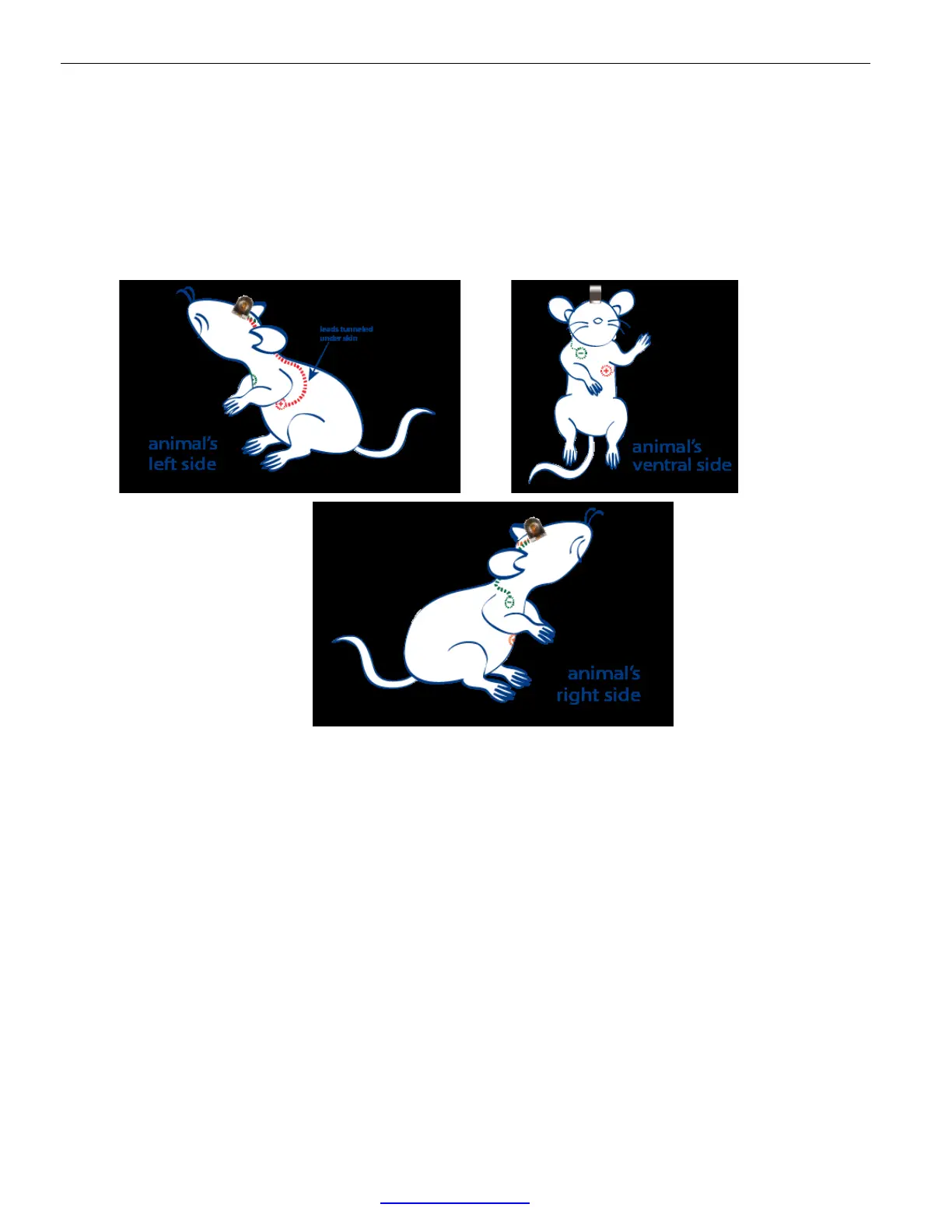
For ECG sensors, the surgical procedures are similar to EEG except for placement of the electrodes, which
should be done following the diagram below.
Figure 19: Wiring diagram for single-channel ECG sensor
Experimental Setup Requirements
There are a few requirements necessary to ensure reliable transmission between the animal’s sensor and the
receiver tray:
SIGNAL RANGE: The sensor needs to remain vertically within 6 inches of the receiver tray. If an animal were to
climb out of this range, the signal reliability may be compromised. Note that connecting the metal feeding trough to
the receiver tray throught the 3.5 mm stero jack “Antenna extension” eliminates this issue for most animal housing
systems.
ELECTRICAL NOISE INTERFERENCE: In the event that the room contains high environmental noise (e.g., RF
interference, power strips, fluorescent lights, other 50/60 Hz noise sources, etc.) it is recommended to use the
supplied Faraday Shield around the receiver tray and animal housing. If the signal transmission indicator is
illuminated when no sensor is present, the environmental noise is too strong and the shielded housing is necessary.
HOUSING COMPATIBILITY: Each receiver tray can accommodate a number of different animal housing
systems, such as commercially-available rodent housing. The limitations on the housing size are that 1) the housing
must fit within the Faraday Shield (see shielding specifications for sizing on page 15) and 2) the animal must have at
least one foot within the footprint of the Epoch receiver tray at all times. BIOPAC recommends using the smallest
housing that is suitable for the species according to your institutional guidelines. It is also recommended that the
housing be centered on the receiver.


 To Next Page