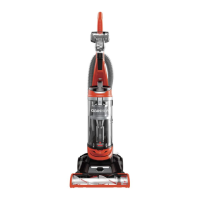
This document outlines troubleshooting steps for a Cleanview Turbo 1994U vacuum cleaner that is "Blowing Dust," indicating a potential issue with its filtration or airflow system. The instructions provided guide the user through a series of checks and cleaning procedures to resolve this problem, focusing on the vacuum's filtration components and potential clogs.
The primary function of this device is to clean surfaces by suction, collecting dust and debris into a dirt tank. When the vacuum is "blowing dust," it suggests that the collected particles are not being properly contained within the system, either due to a clogged filter, a compromised seal, or an obstruction in the airflow path. The troubleshooting steps are designed to address these common causes.
Maintenance Features:
The maintenance features described in the document primarily revolve around cleaning and inspecting the vacuum's filters and hoses.
-
Post-Motor Filter Inspection and Cleaning:
- The first step involves locating the post-motor filter, which is situated on the back of the vacuum. This filter plays a crucial role in trapping fine dust particles before the air is expelled from the machine, preventing them from being blown back into the room.
- Users are instructed to press down on the filter door tab to remove the door, allowing access to the filter.
- Once accessible, any debris buildup on and around the filter should be cleared. This step is essential because a clogged post-motor filter can restrict airflow, reduce suction efficiency, and potentially cause dust to be expelled from other parts of the vacuum.
- After cleaning, the filter door must be reattached securely to ensure proper sealing and filtration.
-
Dirt Tank Removal and Emptying:
- The dirt tank is the primary receptacle for collected dust and debris. Its proper functioning is critical for effective cleaning and preventing dust from escaping.
- Users are guided to remove the dirt tank by pressing a release button and lifting the tank away from the machine. This action allows for access to the tank's contents and internal components.
- To empty the tank, it should be held over a trash bin, and the empty latch on the back of the tank should be pressed. This opens the bottom lid, allowing the collected debris to fall out.
- After emptying, the bottom lid must be snapped shut securely to maintain the tank's integrity and prevent leaks during operation.
-
Filter Assembly Disassembly, Cleaning, and Reassembly:
- The document provides detailed instructions for disassembling, cleaning, and reassembling the filter assembly within the dirt tank. This is a multi-step process designed to ensure thorough cleaning of all filter components.
- Separating Top Handle from Bottom Tank: The user needs to grasp the carry handle and the base of the dirt tank and twist the carry handle counterclockwise to separate these two main sections. This action provides access to the internal filter components.
- Removing the Filter Handle: The filter handle, which is part of the filter assembly, should be grasped and lifted out of the dirt tank.
- Separating Filter Pieces (Outer Cyclone): To further clean the filter, the filter handle needs to be twisted counterclockwise while grasping the base of the outer cyclone. This separates the outer cyclone from the rest of the assembly, allowing for individual cleaning.
- Separating Filter Pieces (Inner Cyclone): Following the separation of the outer cyclone, the filter handle should again be twisted counterclockwise while grasping the base of the inner cyclone. This separates the inner cyclone, providing access to all internal filter components.
- Clearing Debris and Washing: Users are instructed to clear away any debris buildup from these separated pieces. Washing the pieces is recommended if necessary, but a crucial note specifies: "NOTE: DO NOT wash filter. To clean, tap on side of trash bin." This distinction is important, as some filter types can be damaged by water. The instruction to tap the filter on the side of a trash bin suggests it is a dry-cleanable filter, likely designed to dislodge trapped dust without water.
- Reassembly: The reassembly process is the reverse of disassembly, with specific alignment instructions.
- First, the tabs on the filter piece must be aligned with their mating slots on the inner cyclone, and then twisted clockwise to secure them.
- Next, the same process is applied to connect the inner and outer cyclone pieces.
- Finally, the entire reassembled filter assembly is reinserted into the dirt tank. The document emphasizes that the "Filter should sit level," and provides a "NOTE: filter will not sit level if tabs on front are not aligned." This alignment is critical for proper sealing and filtration, ensuring that air flows through the filter as intended and dust does not bypass it.
-
Reattaching Dirt Tank Lid:
- After cleaning and reassembling the filter components, the top lid needs to be reattached to the dirt tank.
- This involves aligning a clear notch on the lid with a corresponding slot. The clear notch should point towards the "unlocked" position initially.
- Once aligned, the lid is twisted clockwise to lock it securely in place. This ensures a tight seal, preventing dust from escaping the tank during operation.
-
Hose Inspection and Clog Removal:
- If the vacuum continues to blow dust after the filter and dirt tank have been cleaned, the next step is to check the hose for clogs.
- Detaching the Hose from the Canister: The hose needs to be detached from the base of the canister by pushing on a release tab and pulling it out.
- Detaching Hose from Extension Wand and Foot: Further disassembly involves detaching the hose from the extension wand and the foot of the vacuum. This is done by grasping each piece and pulling them apart.
- Clearing Debris with a Broomstick: Once the hose and wand are separated, a broomstick can be inserted through them to clear any internal debris or clogs. This physical method helps dislodge compacted dust or larger objects that might be obstructing airflow.
- Inspecting for Holes or Cracks: Beyond clogs, the hose itself can be a source of dust leakage if it has holes or cracks. Users are instructed to inspect the hose section by section for any damage. If a hole or crack is found, the document directs the user to "BISSELL Consumer Care: please refer to product changeover guide" or "External Support: Contact BISSELL." This indicates that a damaged hose is not typically user-repairable and requires professional assistance or replacement.
- Reattaching Pieces: After inspection and clearing, all hose and wand pieces must be reattached by inserting them into their corresponding parts, ensuring a secure connection.
Usage Features:
The document implicitly highlights several usage features through its troubleshooting steps:
- Easy Access to Filters: The design allows for relatively straightforward access to both the post-motor filter and the internal filter assembly within the dirt tank, facilitating regular maintenance.
- Detachable Dirt Tank: The dirt tank is designed to be easily removed and emptied, promoting hygienic disposal of collected debris.
- Modular Design: The vacuum's components, such as the dirt tank, filter assembly, hose, extension wand, and foot, are designed to be detachable. This modularity not only aids in troubleshooting and cleaning but also suggests versatility in use, potentially allowing for different cleaning configurations or attachments (though not explicitly detailed in this document).
- Clear Locking Mechanisms: The instructions for reattaching the dirt tank lid and filter components emphasize aligning notches and twisting to lock, indicating clear and intuitive locking mechanisms for secure assembly.
Function Description (Implied):
The Cleanview Turbo 1994U is a vacuum cleaner designed for household cleaning. Its core function is to generate suction to lift dust, dirt, and debris from various surfaces. The collected material is then directed into a dirt tank, where it is separated from the airflow by a multi-stage filtration system, including an inner cyclone, outer cyclone, and a post-motor filter. The "blowing dust" issue indicates a malfunction in this containment and filtration process, where dust is escaping the system instead of being trapped. The troubleshooting guide aims to restore the vacuum's intended function of effective and contained cleaning. The presence of a "Turbo" designation in its name might suggest enhanced suction power or a specific design for improved performance, though this document focuses solely on troubleshooting a specific problem rather than detailing general performance features. The emphasis on cleaning filters and checking for clogs underscores the importance of maintaining clear airflow paths for optimal suction and filtration.

 Need help?
 General



 To Next Page