
 Need help?
Do you have a question about the Blackberry KEYone and is the answer not in the manual?
Diagram and labels identifying the main external parts of the BlackBerry KEYone smartphone, including cameras, keys, and ports.
Notices regarding essential safety information, trademarks, and legal disclaimers for the device.
Step-by-step instructions and diagram for inserting SIM and optional micro SD cards into the device tray.
This document provides a quickstart guide for the BlackBerry KEYone smartphone, detailing its physical features, initial setup, and essential safety information. It emphasizes the importance of reading the included Safety and Product Information Booklet for comprehensive safety guidelines.
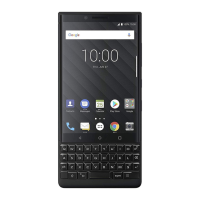
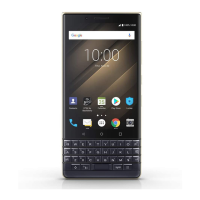
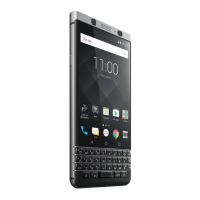
The BlackBerry KEYone is a smartphone designed with both touch and physical keyboard input. Its front features a camera, a notification LED, and a large display. The right side of the device houses the power key, which controls the device's on/off state and screen lock. On the left side, there are volume up and down keys for adjusting audio levels, a convenience key that can be programmed for quick access to specific functions or applications, and a fingerprint sensor integrated for secure authentication. The bottom of the device includes a USB Type-C port for charging and data transfer.
The physical keyboard is a prominent feature, offering a tactile typing experience. It includes standard QWERTY keys, along with dedicated keys for symbols, shift functions, and an alt key for accessing alternative characters. Below the main keyboard, there are three capacitive navigation buttons: a recents key to view recently opened applications, a home key to return to the home screen, and a back key to navigate back in applications or menus.
To begin using the BlackBerry KEYone, the first step is to insert a SIM card. This process involves using the included SIM tool to eject the SIM tray located on the side of the device. Once the tray is removed, the SIM card should be placed into the smaller section of the tray, ensuring that its notched corner aligns correctly with the tray's design. Optionally, a microSD card can be inserted into the larger section of the tray to expand the device's storage capacity. After placing the cards, the tray is then pushed back into the slot until it is flush with the device's body.
The physical keyboard offers a traditional typing experience, which can be beneficial for users who prefer tactile feedback over on-screen keyboards. The convenience key is a customizable feature, allowing users to assign a frequently used app, contact, or function for quick access, enhancing efficiency. The fingerprint sensor provides a secure and convenient method for unlocking the device and authenticating purchases or app access, eliminating the need to repeatedly enter passwords or PINs.
The USB Type-C port supports fast charging and reversible connection, meaning the cable can be inserted either way up. This port is also used for connecting the device to a computer for data transfer, such as moving photos, videos, or documents.
It is crucial to consult the Safety and Product Information Booklet that comes with the BlackBerry KEYone. This booklet contains essential safety information, including guidelines for safe operation, battery care, and proper disposal. Adhering to these guidelines is vital for ensuring the longevity of the device and the safety of the user.
The device's design, including the physical keyboard and robust build, suggests a focus on durability. However, like all electronic devices, it requires careful handling to prevent damage. Regular cleaning of the screen and keyboard with appropriate materials can help maintain its appearance and functionality. Protecting the USB Type-C port from dust and debris is also important to ensure reliable charging and data connectivity.
The software updates provided by the manufacturer are important for maintaining the device's security and performance. Users should regularly check for and install these updates to benefit from the latest features and security patches.
The BlackBerry KEYone is a product of BlackBerry Limited, with trademarks used under license by TCL Communication Ltd. Android™ and Google Play™ are trademarks of Google Inc., and USB Type-C™ is a trademark of USB Implementers Forum, Inc. All other trademarks mentioned are the property of their respective owners. This information is provided for the English version of the device, identified by model numbers BBB100-1, BBB100-2, and BBB100-3, with the document reference CJB61YOALAAB.
 General
| Screen shape | Flat |
|---|---|
| Pixel density | 433 ppi |
| Second display | No |
| Display diagonal | 4.5 \ |
| Touch technology | Multi-touch |
| Touchscreen type | Capacitive |
| Display resolution | 1620 x 1080 pixels |
| Native aspect ratio | 3:2 |
| Orientation sensor | Yes |
| Platform | Android |
| Google applications | Gmail, Google Calendar, Google Chrome, Google Drive, Google Maps, Google Music, Google Play, Google Voice Search, YouTube |
| App distribution platform | Google Play |
| Operating system installed | Android 7.1 |
| Processor cores | 8 |
| Processor family | Qualcomm Snapdragon |
| Processor frequency | 2 GHz |
| Themes | Wallpapers |
| Graphics card | Adreno 506 |
| Personalization | Icons, Menu, Ringtones, Shortcuts |
| Personal info management (PIM) | Alarm clock, Calculator, Calendar |
| RAM capacity | 3 GB |
| Compatible memory cards | MicroSD (TransFlash), MicroSDHC, MicroSDXC |
| Maximum memory card size | 2000 GB |
| Internal storage capacity | 32 GB |
| USB version | 3.2 Gen 1 (3.1 Gen 1) |
| USB connector type | USB Type-C |
| HDMI ports quantity | 0 |
| Battery type | QC3.0 |
| Talk time (3G) | - h |
| Battery voltage | 4.4 V |
| Battery capacity | 3205 mAh |
| Flash type | LED |
| Rear camera type | Single camera |
| Maximum frame rate | 30 fps |
| Video recording modes | 1080p |
| Rear camera aperture number | 2 |
| Front camera aperture number | 2.2 |
| Rear camera resolution (numeric) | 12 MP |
| Front camera resolution (numeric) | 8 MP |
| Audio formats supported | AAC, AAC+, ADTS, AMR-NB, AMR-WB, AWB, FLAC, MIDI, MP3, PCM, Vorbis, WAV |
| Image formats supported | BMP, GIF, JPG, PNG, WEBP |
| Video formats supported | 3G2, 3GP, AVI, DIVX, H.263, H.264, H.265, MKV, MPEG4, VP8, VP9, WEBM, XVID |
| 4G standard | LTE |
| 2G standards | GSM |
| 3G standards | CDMA |
| Wi-Fi standards | 802.11a, Wi-Fi 5 (802.11ac), 802.11b, 802.11g, Wi-Fi 4 (802.11n) |
| Bluetooth version | 4.2 |
| 3G bands supported | 800, 850, 900, 1700, 1900, 2100 MHz |
| SIM card capability | - |
| Security algorithms | HTTPS |
| 2G bands (primary SIM) | 850, 900, 1800, 1900 MHz |
| Mobile network generation | 4G |
| Form factor | Bar |
| Product color | Black, Silver |
| Keyboard layout | QWERTZ |
| Multimedia Messaging Service (MMS) | Multimedia Messaging Service (MMS) is a standard way to send messages that include multimedia content to and from a mobile phone over a cellular network |
 Weight and Dimensions
| Depth | 9.4 mm |
|---|---|
| Width | 72.5 mm |
| Height | 149.3 mm |
| Weight | 180 g |


 To Next Page

