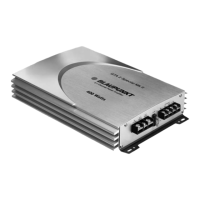
The provided document is an instruction manual for a Blaupunkt High Power Amplifier, specifically covering models AMP1504, AMP1501, and AMP7502. The manual details system planning, speaker requirements, connection diagrams, system configurations, technical specifications, and troubleshooting.
Function Description
The Blaupunkt High Power Amplifier is designed to enhance the audio system in a car by providing amplified sound output to speakers. It supports various configurations, including 2-channel mode, bridge connection for subwoofers, and 4-channel mode, catering to different audio system setups and user preferences. The amplifier is equipped with controls for gain, bass boost, high-pass filter (HPF), and low-pass filter (LPF) to allow for precise tuning of the audio output. It also includes protection circuitry to prevent damage from overheating and short-circuits.
Important Technical Specifications
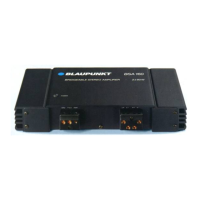
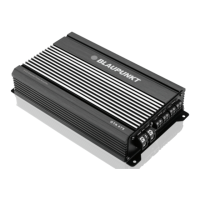
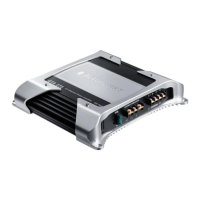
The manual provides detailed specifications for three models: AMP7502, AMP1504, and AMP1501.
AMP7502 (2-Channel Mode / Bridge Connection Subwoofer)
- RMS Output Power 2Ω (Watts): 325W x 2 CH
- RMS Output Power 4Ω (Watts): 160W x 2 CH
- THD: <=0.05%
- Frequency Response (±2dB): 10Hz ~ 45KHz
- Signal to Noise Ratio: =>90dB
- Sensitivity: 150mV ~ 6V
- Recommended Fuse Type: 30A x 1
- Dimensions: 8.6 × 7.5 × 2.1 inches
AMP1504 (4-Channel Mode / Bridge Connection Subwoofer)
- RMS Output Power 2Ω (Watts): 300W x 4 CH
- RMS Output Power 4Ω (Watts): 150W x 4 CH
- THD: <=0.05%
- Frequency Response (±2dB): 10Hz ~ 45KHz
- Signal to Noise Ratio: =>90dB
- Sensitivity: 150mV ~ 6V
- Recommended Fuse Type: 30A x 2
- Dimensions: 11.8 × 7.5 × 2.1 inches
AMP1501 (Connection Subwoofer)
- RMS Output Power 2Ω (Watts): 1125W x 1 CH
- RMS Output Power 4Ω (Watts): 563W x 1 CH
- THD: <=0.05%
- Frequency Response (±2dB): 10Hz ~ 180Hz
- Signal to Noise Ratio: =>90dB
- Sensitivity: 100mV ~ 6V
- Recommended Fuse Type: 20A x 2
- Dimensions: 7.1 × 7.5 × 2.1 inches
Usage Features
The amplifier offers flexible usage options to suit various car audio setups:
- Speaker Load Handling: Each channel can handle 4Ω loads in Stereo Mode. When a channel-pair is bridged, the recommended minimum load impedance is 3Ω for subwoofer use and 4Ω for full-range operation. Operating with lower impedances is not recommended as it can cause overheating and trigger thermal protection.
- Input/Output Controls:
- Gain Control: Allows adjustment of the input sensitivity to match the output of the source unit.
- Bass Boost: Provides an adjustable bass enhancement, typically with settings like 0dB, 6dB, and 12dB.
- Crossover Settings:
- HPF (High-Pass Filter): Adjustable from 60Hz to 1.2kHz, allowing higher frequencies to pass through to the speakers, useful for full-range speakers to prevent distortion from low bass.
- LPF (Low-Pass Filter): Adjustable from 50Hz to 400Hz (for AMP7502/AMP1504) or 40Hz to 180Hz (for AMP1501), allowing lower frequencies to pass through, ideal for subwoofers.
- Mode Selector (FULL/HPF/LPF): Enables selection of full-range output or activation of either the high-pass or low-pass filter.
- Connection Modes:
- 2-Channel Mode: Standard stereo connection for two speakers.
- 4-Channel Mode: For connecting four speakers, allowing for front and rear speaker setups.
- Bridge Connection Subwoofer: Combines two channels to power a single subwoofer, providing higher power output.
- Remote Control: Some models (e.g., AMP1501) feature a wired remote control for bass boost adjustment, offering convenient control from the driver's seat.
- Protection Circuitry: The amplifier includes thermal protection, which shuts down the unit if the heat sink temperature exceeds 90°C, preventing damage. Normal operation resumes once the chassis cools down. It also has protection against short-circuits and incorrect wiring.
Maintenance Features
The manual emphasizes proper installation and troubleshooting to ensure the longevity and optimal performance of the amplifier:
- System Planning: Proper planning is crucial to maximize performance and reliability. Consulting an authorized dealer for installation is recommended to optimize sound quality and system design.
- Wiring Guidelines:
- Power Connection: Connects directly to the car battery (positive pole) with an appropriate fuse.
- Grounding: Connects to the frame of the car for proper grounding.
- Remote Turn-on: Connects to the head unit's remote output to turn the amplifier on/off with the car's audio system.
- Speaker Connections: Detailed diagrams show how to connect speakers in series, parallel, or bridged configurations, depending on the desired impedance and power distribution.
- Troubleshooting Guide: A comprehensive table helps diagnose common issues:
- No Output: Addresses problems like low/no remote turn-on input, blown fuses, disconnected power/audio/speaker wires. Solutions include checking voltages, replacing fuses, and repairing connections.
- Audio Cycles On and Off: Often due to blown speakers or thermal protection engagement. Solutions involve checking speakers, ensuring proper ventilation, and checking input connections.
- Distorted Output: Can be caused by high amplifier level sensitivity, low impedance load, shorted speaker wires, or incorrect speaker connections. Solutions include resetting gain, rewiring speakers for higher impedance, and repairing connections.
- Poor Bass Response: May result from speakers wired with wrong polarity or incorrect crossover settings. Solutions include checking speaker polarity and resetting crossover.
- Battery Fuse Blowing / Amplifier Fuse Blowing: Indicates impedance load too low, short in power wires, or incorrect power connections. Solutions involve checking impedance, repairing connections, and replacing fuses with the correct size.
- FCC Compliance: The device complies with part 15 of the FCC Rules, ensuring it does not cause harmful interference and accepts any interference received.
- Safety Warning: A warning advises against connecting the car battery's negative poles to the positive poles before beginning installation, as short-circuitry can damage the amplifier and other electrical parts. A general warning about cancer and reproductive harm is also present, typical for electronic devices.

 Need help?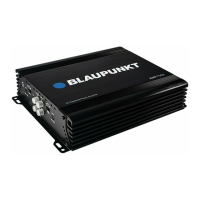



 To Next Page
 General