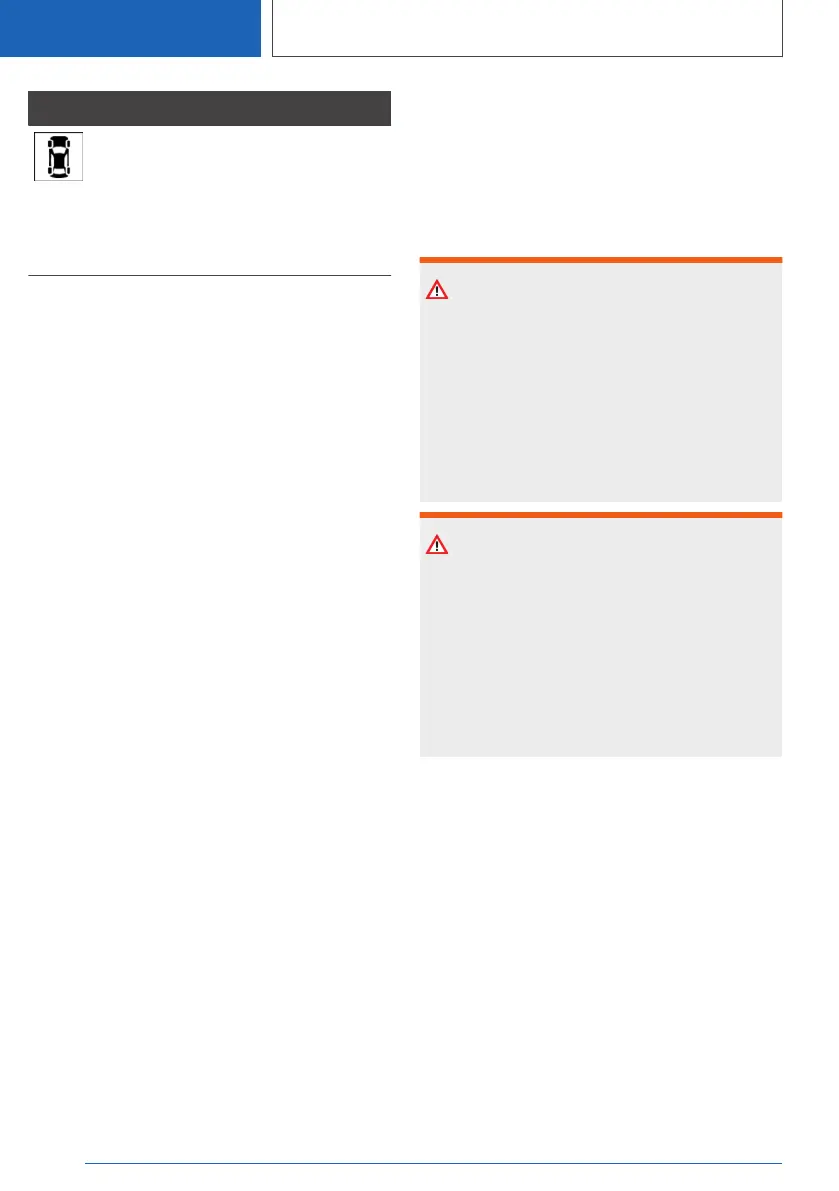
Symbol Possible cause
There is a flat tyre or substantial loss
of tyre inflation pressure.
No reset has been performed on the
system. The system is using the tyre
inflation pressures saved during the
last reset for the warning.
Action
1. Reduce your speed and carefully stop the ve‐
hicle. Avoid heavy braking and sudden steer‐
ing manoeuvres.
2. Check whether the vehicle is equipped with
standard tyres or run-flat tyres.
The symbol identifying run-flat tyres is a cir‐
cle with the letters RSC on the tyre sidewall.
Run-flat tyres, see page 373.
3. Follow the description of what to do when the
vehicle gets a flat tyre.
What to do in the event of a flat tyre, see
page 384.
What to do in the event of a flat
tyre
Standard tyres
1.
Identify the damaged tyre.
Check the tyre inflation pressure in all four
tyres, for example using the tyre pressure in‐
dicator of a flat tyre kit.
In the case of tyres with special approval: if all
four tyres are inflated to the correct tyre infla‐
tion pressures, the Tyre Pressure Monitor
might not have been reset. Perform a reset.
If no tyre damage can be found, contact a
Service Partner of the manufacturer or an‐
other qualified Service Partner or a specialist
workshop.
2.
Repair the flat tyre, for example using a flat
tyre kit or by changing the wheel.
The use of sealant, for example a flat tyre kit, can
damage the wheel electronics. Have the elec‐
tronics replaced at the next opportunity.
Run-flat tyres
Safety notes
WARNING
A run-flat tyre with too little or no tyre inflation
pressure will change the vehicle's handling
characteristics, for example there may be re‐
duced directional stability when braking, longer
stopping distances and different self-steering
characteristics. There is a risk of accident. Drive
with care and do not exceed a speed of
80 km/h, 50 mph.
WARNING
Continuing to drive with a flat tyre can result in
heavy trailers starting to slalom. There is a risk
of accident or material damage. When driving
with a trailer and a flat tyre, do not exceed the
speed of 60 km/h, 35 mph. If the trailer starts to
snake, brake immediately and make the neces‐
sary steering corrections as carefully as possi‐
ble.
Maximum speed
If a tyre is damaged you can continue your jour‐
ney, but do not exceed a maximum speed of
80 km/h, 50 mph.
Continuing a journey with a flat tyre
Note the following if you continue a journey with
a flat tyre:
1.
Avoid heavy braking and sudden steering
manoeuvres.
2. Do not exceed a speed of 80 km/h, 50 mph.
3. As soon as there is an opportunity, check the
tyre inflation pressure in all four tyres.
Seite 384
MOBILITY
Wheels and tyres
384
Online Edition for Part no. 01405A1EA53 - X/20


 To Next Page