Need help?
Do you have a question about the Bogner SHIVA and is the answer not in the manual?
Explains how Master Volume and Presence affect amp tone and loudness.
Details the Boost function bypass and the effect of the Bright switch.
Describes the series FX-Loop, send/return levels, and older version specifics.
Explains the reverb circuit, level loss, and individual controls.
Details the 90W KT88 amp, new boost circuit, and tone shaping switches.
Guides on connecting speaker cabinets and matching impedance for safe use.
Explains the 3-button footswitch, jacks, and alternative operation without a footswitch.
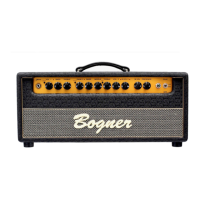
The Bogner Shiva is an all-tube amplifier designed for versatile tonal shaping and robust performance. It features a two-channel design, each with distinct characteristics and controls, allowing players to achieve a wide range of sounds from pristine cleans to aggressive high-gain tones.
The amplifier's core is its two-channel architecture. Channel 1 is dedicated to clean and slightly overdriven sounds, offering Bass, Treble, and Volume controls, along with a Bright switch to add sparkle. Engaging the Boost on Channel 1 bypasses the tone stack, meaning the Bass and Treble controls become inactive, preserving the original un-boosted tone while adding a significant gain increase. The Bright switch on Channel 1, when pushed in, provides a brighter, more open sound, though its effect diminishes as the Volume 1 control is set higher.
Channel 2 is designed for higher-gain sounds, featuring Bass, Middle, Treble, Gain, and Volume controls. It also includes a Bright and a Shift switch for further tonal sculpting. The Boost function on Channel 2 is variable via an independent Volume control (B.Vol.2), allowing for precise adjustment of the boosted level. The Bright switch on Channel 2, similar to Channel 1, adds a brighter, more open sound, becoming less effective at higher Gain settings but still noticeable when turned all the way up.
Both channels share a Common Master Volume and Presence control, which affect the overall output level and high-frequency contour of the amplifier. These controls allow for fine-tuning the amp's feel and sound, as different combinations of individual channel volumes and master volume can achieve the same loudness but with varying tonal characteristics.
The Shiva incorporates a tube-buffered series FX-Loop, designed to integrate external effects pedals and rack units seamlessly. This loop features separate sends and returns for optimal signal integrity. The footswitch provides control over channel switching (Ch.1 or Ch.2), engaging the boost, and activating the reverb (if applicable).
For models equipped with reverb, independent reverb level controls are provided for each channel, located on the back panel. When the reverb is switched in, a slight level loss may be perceived due to the reverb circuit loading the amp. This design choice prioritizes the open sound of the amp when reverb is not in use, as many amps keep the reverb circuit loaded at all times.
The 20th Anniversary model introduces several enhancements. It features a new boost circuit for the clean channel that, unlike the tone stack bypass boost of other Shiva models, incorporates a separate gain stage to push the channel into "Plexi" territory while keeping the tone controls active. The gain channel on this model offers higher gain and a more refined character. Two push-button switches are added to further shape the tone: the Shift button provides a more Fender- or Dumble-like tone with less mids and a softer feel, while the Mode button delivers a more aggressive, in-your-face sound. A power amp dampening control, labeled "Excursion," is also included on the back panel, allowing players to dial in a full sound at lower volumes or adjust the bass response to match a cabinet.
To properly use the Shiva, it's crucial to connect a load or speaker cabinet to the amplifier's speaker outputs before powering it on to prevent damage to the output transformer and power tubes. The impedance switch should be set correctly to match the cabinet's impedance (4, 8, or 16 ohms). When adding a second speaker cabinet, ensure both cabinets have matching impedances and adjust the impedance selector to "half" the impedance rating of one cabinet (e.g., two 16-ohm cabinets require an 8-ohm setting). Mismatched speaker impedances should always be avoided.
Before playing, flick the power switch to the "standby" position for several minutes to allow the amp to warm up and stabilize its circuits, preventing sudden surges. Once ready, flick the power switch to the "play" position.
The Effects Loop's send signal level is controlled by the individual channel volume levels. If external effects units overload, lowering the channel volumes and increasing the Global Master Volume can help. Current Shiva models feature two effects loop sends: a low-level Pedal/Instrument level and a hotter Rack/Line effects level, allowing users to choose the appropriate send for their effects units. Only one loop send should be used at a time. If using the Shiva as a "Power Amp" only, external preamps can be connected to the "Power Amp In" input on the back panel, bypassing the Shiva's preamp while still utilizing the Master Volume and Presence controls.
For older Shiva models (prior to 12/1/05), a special built-in Boost Amp and a level ducking cable may be necessary for instrument-level effects units or sensitive rack units to prevent signal distortion. The Loop circuit is always in the sound chain, even when nothing is connected. If bypassing effects, it must be done on the effects unit itself. The send can also be used to tap the preamp signal for recording or other power amps without needing to return the signal to the Shiva. Plugging into the return alone disconnects the Shiva's preamp, allowing it to function solely as a power amp.
The footswitch provides convenient control over the amplifier's functions. Current Shiva models come with a 3-button footswitch for channel switching, boost engagement, and reverb activation. A 4-position rotary switch on the right-side back panel allows activation of channels and boost functions when the footswitch is not plugged in. For older non-reverb models, a 2-button footswitch was used. Older Shiva versions without the footswitch connected default to Clean Channel 1. To access High Gain Channel 2 without a footswitch, a "shorted" mono 1/4" instrument plug can be used to engage High Gain with Boost, or a "shorted" stereo 1/4" instrument plug for High Gain without Boost.
Regular maintenance, particularly regarding tubes, is essential for optimal performance and longevity. The Shiva uses six preamp tubes (seven in reverb models) and power tubes (EL34, 6L6, or KT88 depending on the model). The first three preamp tubes (closest to the input jack) are the most noticeable in terms of sound and can be a source of noise if faulty. Experimenting with different tubes can alter the sound, with less gain tubes and those earlier in the signal chain generally resulting in less noise.
When switching tubes, always ensure the amplifier is turned off and unplugged from the power outlet. Tubes can be very hot, so exercise caution. Even after unplugging, capacitors can store lethal voltages, so avoid touching tube sockets with fingers.
Fuses protect the amplifier's circuits. The Main fuse (3A for 100/117V, 2A for 230V) and HT fuse (1/2A on all models) should be "3AG Slow Blow" types. A blown HT fuse often indicates bad power tubes, protecting the power amp. A blown Main fuse could be due to a voltage peak. If a fuse blows, replace it with the correct type. If it blows again, further inspection by a qualified technician is recommended.
For troubleshooting, always ensure cables, guitars, effects, and extension cabinets are working correctly. If an issue arises, play straight into the amp with only a guitar connected to isolate the problem. If using a combo, unplug the internal speaker and connect an external cabinet to determine if the amp itself is faulty. Preamp tube failure is a common source of sound and noise problems, as tubes are delicate and have a limited lifespan.
The speaker configuration varies by model and production date. Older 1x12" combos (prior to June 2002) used a Celestion Classic 80 8-ohm speaker, while newer ones (June 2002 and later) use a 16-ohm version. For a more open vintage sound, a Celestion Vintage 30 can be used, but be mindful of its 60-watt power handling limit.
 General
| Type | Tube Amplifier |
|---|---|
| Channels | 2 |
| Power | 80 Watts |
| Reverb | Yes |
| Effects Loop | Yes |
| Power Output | 80 Watts |
| EQ | 3-Band EQ |
| Tubes | 5 x 12AX7 |
| Controls | Reverb |
| Speaker Outputs | 4 ohm, 8 ohm, 16 ohm |
| Footswitch | Channel Select |

 To Next Page