EasyManua.ls Logo

Bosch ACS 251 - User Manual

Bosch ACS 251
24 pages
Print Icon
To Next Page IconTo Next Page
Loading...
ACS 251
en
Original instructions
A/C service unit

Table of Contents

Question and Answer IconNeed help?

Do you have a question about the Bosch ACS 251 and is the answer not in the manual?

Summary

Symbols Used

In the Documentation

Explains the meaning and structure of warning notices and symbols within the manual.

On the Product

Details warning notices and symbols displayed directly on the A/C service unit itself.

User Information

User Group

Defines the skilled and instructed personnel authorized to use the A/C service unit.

Agreement

Outlines copyright, liability, and warranty conditions for using the product.

Obligation of Contractor

Details the contractor's responsibility for safety measures and proper equipment setup.

Safety Instructions

Provides critical safety guidelines for handling refrigerants, vapors, and connecting the unit.

Safety Devices

Explains the function of safety devices like pressure switches, safety valves, and fuses.

Product Description

Application

Outlines the basic services the ACS 251 performs for passenger car A/C systems.

Delivery Specification

Lists all components and items included with the ACS 251 unit.

Description of Unit

Details the physical components and parts of the ACS 251 unit.

Description of Function

Explains the core functions performed by the ACS 251, such as recovery, vacuuming, and recharging.

Commissioning

Removing the Transport Packaging

Steps to safely unpack and prepare the ACS 251 unit for initial use.

Before Turning on for the First Time

Procedures to follow before powering on the ACS 251 for the initial operation.

Powering on the ACS 251

Instructions for connecting power and starting the ACS 251 unit.

ACS Settings

Configuration options for the ACS 251, including automode service parameters.

Filling the Internal Refrigerant Tank

Procedure for filling the internal refrigerant tank with R134a before operation.

Viewing System Information

How to access and view system information, software version, and serial numbers.

Troubleshooting

Program Description

ACS 251 Operating Modes

Explains the automatic and manual modes for performing A/C service.

Preparations for A;C Service

Outlines essential preparatory steps before servicing a vehicle's A/C system.

Configuring the Custom Database

Details how to manage a custom database of vehicles for the ACS 251.

Accessing the Custom Database

Steps to access and select vehicles from the custom database for service.

Automatic Mode

Explains how to perform A/C service in automatic mode using custom or preset parameters.

Setting Custom Parameters

Describes how to set specific parameters for a single automatic mode service.

Manual Mode

Explains how to perform A/C service by selecting individual phases in manual mode.

Performing Service in Manual Mode

Step-by-step guide for executing service phases using the manual mode.

Refrigerant Top Up

Procedure for adding refrigerant when the level is low.

Hose Drain

Instructions for draining residual refrigerant from hoses after service.

A;C Performance Test

Guide for testing the performance of the vehicle's A/C system.

Maintenance

Spare and Wearing Parts

Lists necessary spare parts and wearing parts for the ACS 251.

Refilling the Refrigerant Tank

Refers to chapter 4.5 for instructions on refilling the internal refrigerant tank.

Service Record

How to view records of past services, self-tests, and errors.

Vacuum Pump Oil Change

Procedure for changing the vacuum pump oil based on operating hours.

Replacing the Filter Drier

Step-by-step guide for replacing the filter drier unit.

Replacing the Inline Filters

Instructions for changing the inline filter inserts within the unit.

Self Test

How to initiate and interpret the automatic and manual self-test results.

Firmware Update

Procedure for updating the ACS 251 firmware using a USB disk.

Decommissioning

Disposal of Electronic Items

Guidelines for the proper disposal of electronic components according to WEEE.

Disposal of LCD Display, Refrigerants, Lubricants and Oils

Instructions for disposing of specific materials like LCDs, refrigerants, and oils.

Disposal of Filter Drier

How to dispose of the filter drier according to local regulations.

Electromagnetic Compatibility (EMC)

Information on the unit's compliance with EMC standards.

Technical Data

Overview

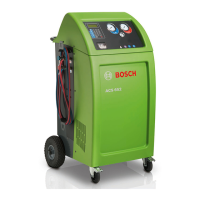
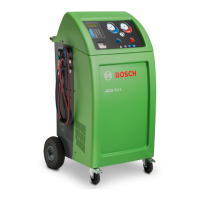
The Bosch ACS 251 is an A/C service unit designed for performing basic services on passenger car air conditioning systems that use R134a refrigerant. It supports both manual and automatic operating modes for various A/C service phases.

Function Description

The ACS 251 performs several key functions for vehicle A/C systems:

  • Refrigerant Recovery and Recycling: It recovers refrigerant from the car's A/C system, then recycles it to remove suspended particles and moisture. The cleaned refrigerant is stored in an internal refrigerant tank.
  • Vacuuming and Leak Detection: The unit creates a deep vacuum in the car's A/C system and performs leak checks to ensure system integrity.
  • Refrigerant Recharge: It recharges the vehicle A/C system with refrigerant from its internal tank.
  • Oil Replenishment: The unit replenishes vehicle compressor oil along with the refrigerant, as specified by the vehicle manufacturer.

The device operates in two main modes:

  • Automatic Mode: All phases of the A/C service (recovery, oil recharge, vacuuming, leak tests, and refrigerant recharge) are executed automatically in sequence.
  • Manual Mode: Only selected phases of the A/C service can be executed. For example, selecting "Recovery" will only perform the recovery phase.

Additional services include:

  • Refrigerant Top Up: Allows adding an additional quantity of refrigerant if there is a decrease in the vehicle A/C system. This should only be done after ascertaining the quantity already present to avoid overcharging.
  • Hose Drain: Drains any remaining refrigerant from the service hoses after a recharge or top-up.
  • A/C Performance Test: Monitors the health of the vehicle A/C system by checking pressure and temperature at specific locations, as recommended by the vehicle manufacturer.

Important Technical Specifications

  • Operating Voltage: 230 V ± 10%
  • Frequency: 50/60 Hz
  • Refrigerant: R134a
  • R134a Scale: 50 kg
  • LP Manometer: -1 bar – 15 bar ± 1.6% of final value
  • HP Manometer: -1 bar – 34 bar ± 1.6% of final value
  • Refrigerant Tank Capacity: 12 L
  • Maximum System Pressure PS: 20 bar
  • Pset: 18 bar
  • Medium Group: Group 2
  • Power: 700 W
  • Permissible Ambient Temperature TS: 10 °C – 50 °C
  • Optimum Filling Weight of R134a for Operation: 4 kg - 7 kg
  • Dimensions (H x W x D): 1188 x 638 x 762 mm
  • Weight: 90 kg

The unit is compliant with EN 61000-6-2 and EN61000-6-4 standards for electromagnetic compatibility (EMC).

Usage Features

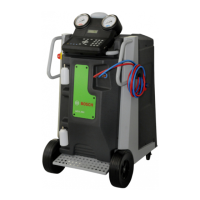
The ACS 251 features a Human Machine Interface (HMI) consisting of:

  • Pressure Gauges: Display the pressure during service.
  • Status and Warning Lights: Indicate the status of service and disruptions (Red for Error/Warning, Blinking Green for Service in progress, Static Green for Service complete).
  • LCD Display: Shows menu options and service status.
  • Keypad: Used for selecting service menu options, setting parameters, and alphanumeric input. Dedicated keys include AUTO (automode menu), MANUAL (manual mode menu), MENU (additional services, ACS maintenance, ACS settings), ABORT (abort service), arrow keys (navigate), ENTER, RETURN, SELECT/DESELECT, CLEAR, and ABC/123 (numeric/alphabetical entry). An 'i' key displays system information.
  • USB Port: Allows for firmware updates by plugging in a USB disk.

The unit includes a programmable custom database that can store details for up to 50 vehicles, including model name and R134a quantity. This database can be added to, edited, deleted from, viewed, and even transferred between ACS 251 units.

Safety features include:

  • Pressure Switch: Switches off the compressor if normal operating pressure is exceeded.
  • Safety Valve: Operates when the design pressure is exceeded.
  • Fuse: Interrupts excessive current flow.
  • Brakes: On the rear wheels to prevent the unit from rolling away.

The unit must be operated on a flat, vibration-free surface and transported in a vertical position. It is crucial to use only new oil to replace the amount removed during recovery and to discard used oil as per regulations. Only R134a refrigerant should be used, and mixing with other refrigerants is prohibited.

Maintenance Features

The ACS 251 requires specific maintenance procedures:

  • Vacuum Pump Oil Change: Recommended after every 60 hours of operation. The unit displays a "Replace Vacuum Pump Oil" message when due. The procedure involves draining old oil and filling with VPO46 High vacuum pump oil (max 400 ml).
  • Filter Drier Replacement: Recommended after every 75 kg of refrigerant is recovered. A "Filter Drier Replacement Due" message is displayed when due. This ensures the purity level of the refrigerant.
  • Inline Filter Replacement: These filters must be changed every time the filter drier is replaced.
  • Self Test: An automatic self-test is initiated upon powering on the unit, but it can also be triggered manually.
  • Firmware Update: Can be performed via the USB port using USB disks supplied by Bosch.
  • Resetting Factory Settings: Allows reverting all system settings to their default factory values.
  • Service Record: Provides access to reports of the last vehicle A/C system service, last self-test, and the latest error during vehicle A/C service.

Regular calibration of load sensors (at least once a year) and inspections by service personnel or approved authorities are recommended to ensure safety and correct operation. Users are warned against disconnecting electrical connections or tampering with internal components, and to contact customer service for any damage or oil spillage.

Bosch ACS 251 Specifications

General IconGeneral
BrandBosch
ModelACS 251
CategoryService Equipment
LanguageEnglish

Related product manuals