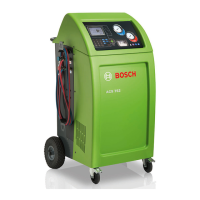
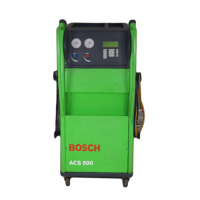
The Bosch ACS 500 is an AC Service Unit designed for the maintenance and repair of vehicle air conditioning systems. This document provides repair instructions, covering calibration, troubleshooting, and component replacement.
Function Description:
The ACS 500 is a comprehensive unit for handling refrigerant (R134a), used oil, fresh oil, and UV contrast medium. Its primary functions include:
- Refrigerant Recovery and Recycling: The unit recovers refrigerant from the vehicle's AC system, separates oil and moisture, and recycles the clean refrigerant for reuse.
- Vacuum Phase: It performs a vacuum phase to evacuate the AC system, removing non-condensable gases and moisture, which is crucial for efficient AC operation.
- Leak Testing: The unit can perform pressure loss measurements during the vacuum phase to detect leaks in the vehicle's AC system.
- Refrigerant Filling: It accurately fills the AC system with the specified amount of R134a refrigerant.
- Oil and UV Contrast Medium Injection: The ACS 500 can inject fresh oil and UV contrast medium into the AC system, essential for lubrication and leak detection.
- Pressure and Force Sensor Calibration: The unit features internal force sensors for scales (refrigerant, used oil, fresh oil, UV contrast medium) and a pressure sensor, all of which can be calibrated to ensure accuracy.
- Firmware Updates: The device's firmware can be updated via a PC connection, allowing for software enhancements and new features.
- Self-Diagnosis and Troubleshooting: The ACS 500 provides error messages and symptoms to assist in troubleshooting, guiding users to identify and resolve issues.
Important Technical Specifications:
While specific numerical values for all technical specifications are not explicitly detailed in the provided excerpts, the manual highlights several key components and their roles:
- Refrigerant: R134a.
- Scales: Dedicated force sensors for refrigerant, used oil, fresh oil, and UV contrast medium tanks, ensuring precise measurement of quantities.
- Pressure Sensor: Measures pressure within the AC system, with calibration procedures to ensure accuracy (e.g., target values of approx. 1000 mbar and < 50 mbar).
- Vacuum Pump: Essential for evacuating the AC system, with a specified operating time counter.
- Compressor: Drives the refrigerant recovery and recycling process.
- Filter and Drier Cartridge: Removes moisture and contaminants from the refrigerant.
- Valve Block: Contains solenoid valves that control the flow of refrigerant, oil, and UV contrast medium during different operational phases (e.g., recovery, recycling, filling, vacuum, oil injection, UV contrast medium injection).
- Control/Display Unit: The primary interface for operating the device, displaying information, and entering commands.
- Actuation Circuit Board: The main electronic control board that manages the unit's operations, including power supply to components like the printer, control/display unit, pressure switch, and other ACS components. It includes fuses (F1: 200 mAT for 12 Volt supply, F2 & F3: 10 AT for mains connection) for protection.
- Refrigerant Flask (Reservoir): Internal tank for storing refrigerant, with a maximum permissible filling weight of 10 kg. It includes safety valves for overpressure and non-compressible gases.
- Hose System: Connects the ACS 500 to the vehicle's AC system, with specified offset values for filling hoses (recommended 55 g).
Usage Features:
The ACS 500 is designed for user-friendly operation with a clear control/display unit and a structured menu system:
- Calibration and Customer Service Menu: Provides access to various sub-menus for configuration, repair, and function tests. This menu is password-protected to prevent unauthorized changes.
- Language Selection: Users can change the national language of the display.
- Time and Date Setting: Allows for adjustment of the internal clock.
- Workshop Address Entry: Enables input of workshop details for documentation.
- Offset Setting for Filling Hoses: Allows compensation for the weight of the filling hoses to ensure accurate refrigerant charging.
- Display Test: A function to check the legibility of all alphanumeric characters on the control/display unit.
- Firmware Update Interface: A 9-pole Sub-D cable connects the ACS 500 to a PC for updating the firmware and language database.
Maintenance Features:
The manual emphasizes several maintenance aspects to ensure the longevity and accurate operation of the ACS 500:
- Maintenance Intervals: The unit prompts users to "Change filter" and "Change vacuum pump" when maintenance intervals are reached, requiring a reset of internal counters.
- System Parameter Reset: A function to reset all calibration values, internal counters, and workshop address to default settings. This requires recalibration of all force and pressure sensors and re-entry of the workshop address.
- Counter Display: Users can view various internal counters, such as R134 emptied, R134a external, pump operating time, and R134 filled.
- Component Replacement Procedures: Detailed instructions are provided for replacing key components, including:
- Actuation circuit board
- Control/display unit
- Force sensor for refrigerant scale
- Valve block
- Pressure sensor
- Vacuum pump
- Processing unit
- Force sensors for used oil, fresh oil, and UV contrast medium scales
- Cleaning and Sealing: Instructions for cleaning pipe sealant residue and applying new pipe sealant with PTFE (e.g., RODI-DOS PTFE from Würth) are provided for connections to ensure leak-free operation. Cleaning mediums like brake cleaner are recommended.
- Safety Precautions: The manual highlights critical safety warnings, including:
- Danger - Electric shock hazard: Emphasizes disconnecting mains power and securing the master switch with a padlock before working on live parts.
- Warning - Danger of frostbite: Advises closing refrigerant flask valves and wearing protective goggles and gloves when handling refrigerant.
- Warning - Danger of burns: Cautions about hot surfaces on the valve block and vacuum pump, recommending allowing them to cool down and wearing protective gloves.
- Calibration after Repair: After replacing certain components (e.g., force sensors, pressure sensor, or after a system parameter reset), recalibration is mandatory to ensure accuracy.
- Oil Drain and Fill: Procedures for draining and filling oil in the vacuum pump are included.
The ACS 500 is designed for use by trained and instructed Robert Bosch GmbH customer service staff or authorized organizations to ensure proper installation, repair, and maintenance, thereby preserving warranty entitlements.

 Need help?
 General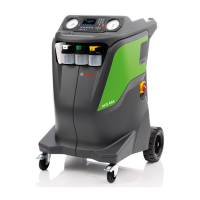



 To Next Page