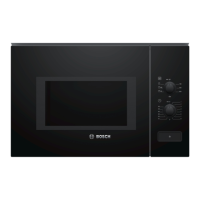
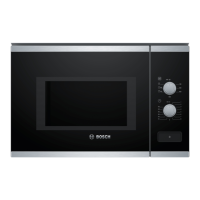
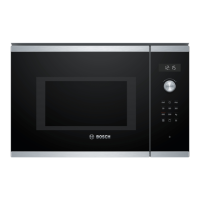
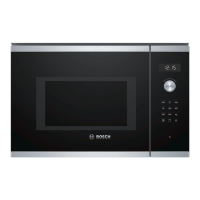
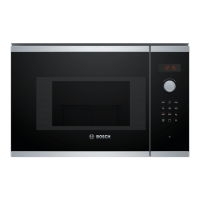
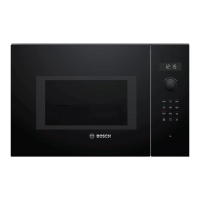
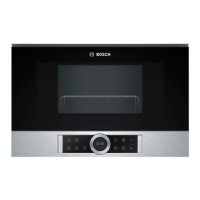
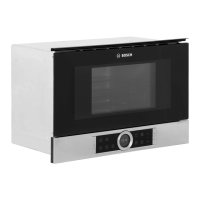
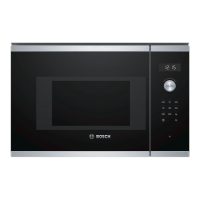
This document serves as a comprehensive user manual and installation guide for a Bosch Microwave Oven, covering models BEL553MS0B, BEL554MS0A, and BEL554MS0B. It provides essential information for safe operation, optimal use, and maintenance of the appliance.
The microwave oven is designed for preparing meals and drinks in household and similar applications, such as staff kitchens, farmhouses, hotels, and bed and breakfasts. It is suitable for use up to an altitude of 4000 meters above sea level. The appliance operates as a group 2, class B product, meaning it produces microwaves for heating food and is suitable for private households.
Function Description
The appliance features a control panel that allows users to configure all functions and obtain information about the operating status. Key controls include:
- Automatic door opener: Opens the appliance door automatically.
- Touch fields: Sensitive surfaces for selecting functions, such as microwave power settings (90-900 watts), automatic programs, and weight for programs.
- Rotary selector: Used to set time, cooking time, or automatic programs. It can be pushed in to engage or release.
- Display: Shows the clock or cooking time.
The microwave oven offers various heating types:
- Microwave (90-900 watts): Ideal for defrosting, cooking, or heating food and liquids. Different power settings are available for specific tasks:
- 90 W: Defrost delicate foods.
- 180 W: Defrost food and continue cooking.
- 360 W: Cook meat and fish, or heat delicate foods.
- 600 W: Heat and cook food.
- 900 W: Heat liquids.
- Grill: Used for gratinating and browning food.
- Microwave combined operation (MicroCombi): Combines microwave and grill functions to bake bakes and gratins, and brown dishes, reducing overall cooking time.
The appliance also includes a memory function, allowing users to save settings for frequently prepared dishes and recall them easily. Automatic programs are available for defrosting and cooking various foods, simplifying the cooking process by automatically selecting optimum settings. These programs cover defrosting meat, poultry, and bread, as well as cooking rice, potatoes, and vegetables. A combi-cooking program is also available for frozen bakes.
A cooling fan operates as needed, even during microwave operation when the cooking compartment remains cold, and may continue to run after the oven is switched off. Condensation may occur in the cooking compartment and on the appliance door, which is normal and does not affect operation.
Usage Features
- Initial Configuration: Upon first use or after a power cut, the appliance requires initial setup, including setting the clock.
- Heating up the cooking compartment: Before first use, the cooking compartment should be heated up and then cleaned.
- Fitting the turntable: The appliance must always be used with the turntable correctly engaged in the recess and drive in the cooking compartment floor.
- Cookware suitability: Only microwave-safe cookware made from heat-resistant materials like glass, glass ceramic, porcelain, temperature-resistant plastic, and fully glazed ceramic without cracks should be used. Metal cutlery can be used to prevent delayed boiling in liquids, but metal containers or cookware with metal edging should be avoided during microwave-only operation to prevent sparks and damage. A cookware test is provided to determine suitability.
- Setting cooking time: The cooking time can be adjusted at any point during operation using the rotary selector.
- Pausing and cancelling operation: Operations can be paused by pressing the stop button or opening the door, and resumed by closing the door and pressing start. Operations can be cancelled by pressing stop twice or opening the door and pressing stop once.
- Basic settings: Users can customize settings such as button tone and demo mode. The signal duration for audible signals can also be adjusted. The clock can be hidden to reduce standby power consumption.
- Defrosting food: Frozen food should be placed in an open container on the turntable. Delicate parts can be covered with small pieces of aluminum foil, ensuring it does not touch the cooking compartment sides. Food should be redistributed or turned during defrosting, and allowed to stand afterwards to even out the temperature.
- Heating food: Ready meals should be placed in microwave-safe cookware, distributed flat, and covered with a suitable lid, plate, or special microwave foil. Food should be turned or stirred several times during cooking, and allowed to stand afterwards to even out the temperature.
- Cooking food: Cookware should fit in the compartment and allow the turntable to turn freely. Food should be distributed flat and covered with a suitable lid, plate, or special microwave foil when cooking with microwave. When grilling, food should not be covered.
Maintenance Features
- Cleaning products: Only suitable cleaning agents should be used. Harsh or abrasive cleaners, high-alcohol content products, hard scouring pads, cleaning sponges, and steam/high-pressure cleaners should be avoided. Glass cleaners, glass scrapers, or stainless steel care products should only be used as recommended for specific parts. New sponge cloths should be thoroughly washed before use.
- Cleaning the appliance: Regular cleaning is crucial to prevent damage and maintain service life. The appliance components should be cleaned with hot soapy water and a soft dish cloth, then dried.
- Cleaning the cooking compartment: Oven spray, abrasive materials, or aggressive oven cleaners should not be used. The compartment can be cleaned with hot soapy water or a vinegar solution. For heavy soiling, oven cleaner can be used when the compartment is cold. Unpleasant odors can be eliminated by heating a cup of water with lemon juice. The compartment should be wiped with a soft cloth and left to dry with the door open.
- Cleaning the turntable: The turntable should be removed, cleaned with hot soapy water and a dish cloth, dried, and then reinserted, ensuring it engages correctly.
- Cleaning the front of the appliance: Glass cleaner, metal scrapers, or glass scrapers should not be used. Limescale, grease, starch, and albumin stains should be removed immediately from stainless steel fronts to prevent corrosion. Special stainless steel cleaning products are recommended for stainless steel surfaces. The front should be cleaned with hot soapy water and a dish cloth, then dried with a soft cloth.
- Cleaning the control panel: The control panel should not be wiped with a wet cloth. It should be cleaned with a microfibre cloth or a soft, damp cloth, then dried.
- Cleaning accessories: Baked-on food remnants should be softened with a damp dish cloth and hot soapy water, then cleaned with hot soapy water and a soft dish cloth or scrubbing brush. The wire rack can be cleaned with stainless steel cleaner or in a dishwasher.
- Cleaning aid: A cleaning aid function softens dirt by vaporizing soapy water, making it easier to wipe away. This involves heating a cup of water with washing-up liquid for 3 minutes at maximum microwave power, then leaving the door closed for 3 minutes, wiping the compartment, and leaving the door open to dry.

 Need help?
 General

 To Next Page