How it works en
13
4.
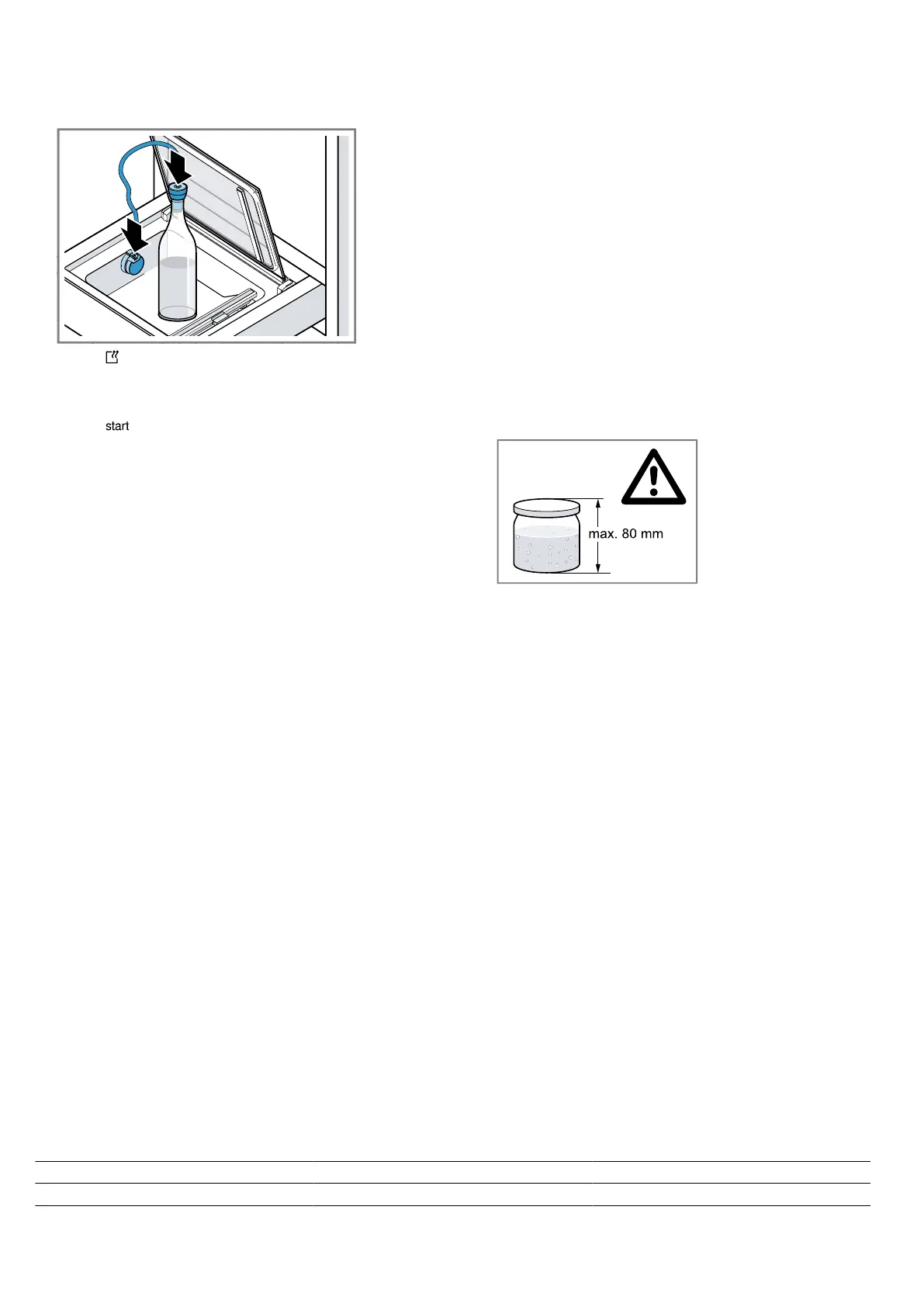
Disconnect the hose from the vacuum-sealing ad-
apter and secure the bottle adapter.
5.
Touch to select the vacuum-sealing level.
‒ Always vacuum-seal bottles at the lowest level.
‒ Do not vacuum-seal any carbonated liquids, such
as sparkling wine.
6.
Touch to start the vacuum-sealing process.
a The vacuum-sealing level that has been reached
lights up and an audible signal sounds.
7.
Detach the hose from the bottle adapter and the ex-
ternal vacuuming adaptor.
8.
Undo the bottle adapter from the bottle cap.
12.3 Fast marinating and flavouring
You can use your vacuum-sealing bag to quickly add
flavour to or marinate food such as meat, fruit and ve-
getables.
Marinating your food in the traditional way usually takes
a long time and is not particularly intensive. When you
vacuum-seal in a bag, the food's cell pores open. The
marinade that is added can be absorbed quickly. This
produces a more intensive taste in a much shorter
time.
12.4 Storing and transporting food
You can use the vacuum-sealing process to store your
food for longer and can benefit from additional advant-
ages.
¡ Due to the low-oxygen environment in the vacuum,
freshly vacuum-sealed food remains edible for
longer when it is stored correctly.
¡ The freezer burn is lower when the food has been
frozen and vacuum-sealed.
¡ You can re-seal food, such as jams and sauces, in
glass containers.
¡ The vacuum-sealing significantly increases the stor-
age time.
¡ Store food such as cheese, fish or garlic without any
unpleasant odours. The hermetic sealing that takes
place during vacuum-sealing means that no un-
wanted odours can get out and the flavour cannot
be absorbed by the other food.
¡ Sealed vacuum-sealing bags or vacuum-sealing
containers are the ideal means of transport for liquid
foods. They are easy to handle, leak-proof and
space-saving.
ATTENTION!
Glass containers that are too tall may damage the ap-
pliance's glass lid.
▶ Do not use glass containers that are taller than 80
cm.
Notes
¡ Only use screw-top jars that are robust and intact.
¡ Only tighten the container by hand. The container is
automatically sealed by the vacuum-sealing pro-
cess.
¡ Not all jars or lids are suitable for being re-sealed
under a vacuum. After vacuum-sealing, check
whether there a vacuum has been formed. A lid that
is curving inwards and can only be opened with a
lot of force is an indication that the vacuuming pro-
cess has worked. If the lid makes a clicking sound
when it is pushed in and released and if it is easy to
open, no vacuum has occurred. Repeat the vacu-
uming process or use more suitable screw-top jars.
12.5 Recommended settings
This section provides you with recommendations for
the vacuum-sealing levels for different foods. Observe
the specific information on the recommended vacuum-
sealing levels and on preparing the food.
When stored appropriately, vacuum-sealed food re-
mains fresh for significantly longer. Higher vacuum-
sealing levels retain the quality, appearance and in-
gredients of the food.
Notes
¡ Only use fresh food.
¡ Check the quality of the food before vacuum-sealing
it.
¡ Only vacuum-seal cold food – within a temperature
range of 1–8°C is best.
¡ Start at the lowest of the recommended vacuum-
sealing levels.
¡ Check the quality of the food after you remove it
from storage. Do not use any food that is of dubious
quality.
Food that is stored at room temperature (20°Cto23°C)
Food Vacuum-sealing level Recommendation
Baked goods 1, 2, 3


 To Next Page
 Loading...