
 To Next Page
L
Luis MooreSep 9, 2025
How to prevent damage from condensate returning to my Bosch Ventilation Hood?
- Ssteven38Sep 9, 2025
Install the exhaust duct in such a way that it falls away from the appliance slightly (1° slope).

How to prevent damage from condensate returning to my Bosch Ventilation Hood?
Install the exhaust duct in such a way that it falls away from the appliance slightly (1° slope).
Why won't the displays light up on my Bosch DWB97CM50B/03?
If no displays light up on your Bosch Hob, it could be due to a disconnected power supply. Check other electrical appliances to see if there's a power failure. Also, ensure the appliance is connected according to the circuit diagram. If these steps don't resolve the issue, it may be an electronics fault, and you should contact technical after-sales service.
What to do if the displays are flashing on my Bosch DWB97CM50B/03 Hob?
If the displays on your Bosch Hob are flashing, it means that the control panel is wet or something is covering it. You should dry the control panel or remove the object.
How to prevent surface damage when cleaning my Bosch Ventilation Hood?
To prevent surface damage when cleaning, clean stainless steel surfaces in the direction of the grain only. Do not use any stainless steel cleaners for operator controls.
Why did my Bosch DWB97CM50B/03 cooking zone switch off?
If your Bosch Hob cooking zone switched off to protect the electronics, it is likely due to hot cookware being near the control panel. Remove the cookware, wait a few seconds, and touch any button. Once the fault display disappears, you can continue cooking.
How to prevent hot oil and fat from igniting in my Bosch Ventilation Hood?
To prevent hot oil and fat from igniting, never leave hot fat or oil unattended. Switch off the hotplate. Extinguish flames carefully using a lid, fire blanket or something similar.
Why is my Bosch Wine Cooler making noises?
No action is required. The noises your Bosch Wine Cooler is making are normal.
What to do if my Bosch Wine Cooler electronics have detected a fault?
If the electronics in your Bosch Wine Cooler have detected a fault: disconnect the appliance from the mains, reconnect it after five minutes. If the message still appears on the display, call customer service.
How to avoid corrosion damage to my Bosch Ventilation Hood?
To avoid damage due to corrosion, always switch on the appliance while cooking to avoid condensation.
How to prevent poisoning from flue gases with my Bosch Ventilation Hood?
Always ensure adequate fresh air in the room if the appliance is being operated in exhaust air mode at the same time as a room air-dependent heat-producing appliance.
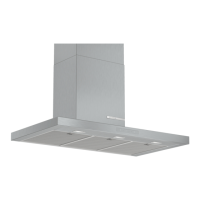
This document describes an extractor hood, a kitchen appliance designed to remove smoke, steam, heat, and airborne grease from the cooking area. It can operate in two main modes: exhaust air mode and circulating-air mode, each with specific installation and operational considerations.
The primary function of the extractor hood is to maintain a clean and comfortable kitchen environment by extracting cooking fumes. In exhaust air mode, the appliance draws in air from the cooking area, filters it, and then expels it outside the building through a duct system. This mode is highly effective at removing odors and moisture. For optimal performance in this mode, the exhaust air duct should be as short and straight as possible, with a large diameter to minimize resistance and noise. It is crucial to ensure adequate fresh air supply in the room, especially if other room air-dependent heat-producing appliances (like gas or wood heaters) are operating simultaneously, to prevent the risk of flue gases being drawn back into the living space. A safety switch for the electricity supply to the hood is recommended in such cases.
In circulating-air mode, the appliance filters the extracted air through both a grease filter and an activated carbon filter, and then returns the cleaned air back into the kitchen. This mode is suitable when external venting is not possible or desired. While it effectively removes grease and odors, it does not remove moisture from the air. Different options for the activated carbon filter are available, and it's important to replace or regenerate these filters regularly to maintain effectiveness.
The extractor hood also features integrated lighting to illuminate the cooking surface, enhancing visibility during food preparation.
The appliance offers several operational modes and settings to suit different cooking needs:
To operate the appliance, users typically interact with a control panel that includes symbols for fan on/off, fan settings, intensive mode, and light on/off.
Regular maintenance is crucial for the efficient and safe operation of the extractor hood. Key maintenance tasks include:
The manual also emphasizes safety precautions during maintenance, such as disconnecting the appliance from the power supply before cleaning or repairs, and wearing protective gloves when handling components with sharp edges.
 General
| Width | 90 cm |
|---|---|
| Lighting type | LED |
| Energy Efficiency Class | A |
| Power Supply | 220-240 V |
| Control Type | Touch control |