Need help?
Do you have a question about the Bosch FR5CPCCF and is the answer not in the manual?
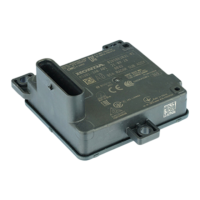
This document describes the FR5CPCCF, a radar sensor and control unit (SCU) developed by Robert Bosch GmbH. It operates as a Frequency Modulated Continuous Wave (FMCW) radar transceiver within the globally harmonized frequency range of 76.0 – 77.0 GHz. The sensor functions by emitting short frequency modulated waves that are reflected by targets and received by the sensor's antennas. Distance and relative speed are determined by measuring the beat frequency (due to the travelling time of the waves) and phase difference between ramps (due to the change of distance in short time). The antenna diagram allows for the departure and arrival of radar waves to be determined.
The FR5CPCCF utilizes a Bosch chirp sequence radar modulation, which enables unambiguous determination of relative speed in a single measurement cycle. This eliminates the need for complex object models and reduces ambiguity resolution. The radar reflections (strength, distance, and relative speed, angular direction, and derived values) form the basis for a comprehensive model of the sensed environment.
The FR5CPCCF sensor is built on a single printed circuit board with integrated components:
The FR5CPCCF is designed to be mounted in or around the sensor, like a painted bumper, unpainted cover, or emblem/radome, regarding RF integration at 77 GHz with FR5Plus radar sensors. Values are marked with t.b.c. or t.b.d., indicating that they are to be confirmed or defined during the development process. Product development is an ongoing process, with amendments made in line with technical progress.
The radar cone describes the zone where the fascia has to be optimized. Any parts of the vehicle inside the radar cone may influence the radar performance. Cables, brackets, bars, etc., should not touch the radar cone. The fascia in this zone must not have bends and edges, as well as changes in thickness or material or painting. The footprint on the top side of the radar PCB is characterized by a vertical and a horizontal opening angle. The footprint is considered regarding to the sensor housing. The CAD model of the radar cone is available. The footprint for the radar cone has the following dimensions: (W x H) 55 mm x 55 mm.
The horizontal opening angle depends on the angle range that is evaluated by the sensor in azimuth and elevation, whereby the opening angle of the radar cone has to be larger than the angle range that is evaluated by the sensor. For covered integration, the radar cone is 10° larger than the used angle range that is evaluated by the sensor.
Material with low dielectric constant (εr) and low dielectric loss factor tanδ at 77 GHz should be used. Recommended materials are based on polypropylene (PP) and polymethyl methacrylate (PMMA), while materials like polycarbonate (PC) and acrylonitrile butadiene styrene (ABS) are still acceptable. The material should be homogenous, with compounds including glass fiber, carbon fiber, or metal particles not recommended.
The fascia is designed for radar transparency. The thickness shall be a multiple of the half wavelength (in the material) to minimize the influence of the fascia. The quality criteria of radar transparency is the reflection coefficient of the radome/fascia. Tolerances of the overall thickness and the dielectric constant of the used material influence the amount of reflection at the radome/fascia. Additional influence occurs due to curvature of the fascia. Therefore, the radius has to be as large as possible. With sharp edges, the negative influence will increase significantly. Not allowed are ribs, structures, and steps changing the thickness of the radome/fascia.
The layer structure of the painting, typically made of three painting layers consisting of primer, base coating, and clear coating, will increase the effective permittivity value εr,eff and dielectric loss factor tanδ of the painted plate used as fascia.
The two-way radar loss caused by fascia should be as low as possible. High losses decrease the sensor performance regarding range and angle estimation. Therefore, it is recommended to achieve a two-way radar loss below 3 dB.
The surfaces of the fascia shall not exceed an average roughness height of 20 µm (corresponding to ISO 1302 class N10; VDI 3400 class 45).
To enable full performance of the radar sensor, it is recommended to use the following installation hints and guidelines for the RF integration of the sensor.
The sensor shall not be rotated more than 1.5° around the normal of the radome surface.
The angle α between the radar beam inside the radar cone and the fascia may not be larger than 70° anywhere inside the radar cone.
The minimum distance between the sensor radome and the fascia or any other part of the vehicle may not be smaller than 5 mm. This is valid for fascia parts fulfilling the following requirements.
The vertical tilt angle between the sensor normal and the surface normal of the fascia shall be in the range according to the following table:
| Minimum vertical tilt coefficient | max. tolerance thickness | tolerance εr | tanδ | application |
|---|---|---|---|---|
| <-15 dB | ±0.1 mm | ±0.02 | <0.01 | unpainted, (black) painting, embleme |
| >8° <-10 dB | ±0.2 mm | ±0.02 | <0.03 | unpainted, (black) painting, embleme |
| ±0.1 mm | ±0.2 | <0.03 | painted bumper | |
| >18° <-6 dB | ±0.2 mm | ±0.2 | <0.05 | painted bumper |
Curvature of the fascia may influence the radar performance, especially with low vertical tilt angles. The minimum radius of the curvature shall be according to the following rules:
It is highly recommended to use a cone made of absorber material around the radar cone of the sensor to prevent ghost targets. The design of the absorber cone must fulfill the following design guidelines (reflection from outside the radar cone, multipath reflection).
Reflections from structures located outside the radar cone have to be avoided. Furthermore, interference signals picked up by the sensor antennas should be avoided by keeping a minimum distance (d) of 5 mm to 10 mm for parts in front of the sensor. Even with compliance to the radar cone, reflections at parts outside the radar cone may disturb the received signal. Reflections at parts causing an interference signal to the receiving antenna and reflections at parts getting to the receiving antenna after a second reflection at the fascia (multipath reflection).
Closed surfaces of brackets and masks made of metal or high reflecting material need a tilt angle arranged such that the reflection is not received by the receiving antennas of the sensor. For closed surfaces (masks) in azimuth, the angle γ between the mask surface and the normal vector n of the sensor shall be above 75° for parts outside of the radar cone. For closed surfaces (masks) in elevation, the angle γ between the mask surface and the normal vector n of the sensor shall be above 20° for parts outside of the radar cone.
Reflections of incoming signals at a bracket or shielding absorber will return to the sensor if reflection at the bumper occurs. The worst case happens if the combination of the vertical tilt angles of shielding and bumper is γ1 = γ2 / 2. For a low interference signal, the condition shall be: γ1 > γ2 / 2 +10° or γ1 < γ2 / 2 -10°.
Repair and maintenance of the product are not allowed. The sensor cannot be opened without damaging it. In case of service, the sensor needs to be replaced.
All materials are released regarding the following regulations:

 To Next Page
 General