Need help?
Do you have a question about the Bosch KIR81VSF0G and is the answer not in the manual?
Basic instructions for manual use, intended purpose, and limitations.
Outlines age and ability restrictions for appliance use.
Instructions and warnings for moving and safely installing the appliance.
Important guidelines for operating the appliance safely.
Safety measures and actions if the appliance or power cord is damaged.
Guidance on recycling and disposing of packaging materials.
Methods and tips to reduce the appliance's energy consumption.
Lists items included in delivery and procedures for checking.
Guidelines for selecting a suitable installation spot.
Step-by-step instructions for physically installing the appliance.
Steps to take before initial use after installation.
How to safely connect the appliance to the power source.
Overview of the different parts of the appliance.
Explanation of the appliance's control panel functions.
Information on shelf adjustment and usage.
Guidelines for storing produce in the dedicated container.
How to adjust or remove the door racks.
Details on optional or included accessories.
Step-by-step guide to turning the appliance on.
Advice for efficient and correct use of the appliance.
Instructions for safely turning the appliance off.
How to adjust the internal temperature settings.
Explanation and usage of the Super Cooling feature.
Best practices for storing food to maintain freshness.
Understanding temperature variations within the compartment.
How to use the OK sticker to check temperature settings.
Information on automatic defrosting in the refrigerator section.
Specific advice for cleaning stainless steel parts.
Steps to take before starting the cleaning process.
General instructions and warnings for cleaning the appliance.
How to maintain the drainage system to prevent issues.
Instructions for removing the internal shelves.
Instructions for removing the door racks.
Instructions for removing the fruit and vegetable drawer.
Addresses issues with cooling and display.
Troubleshooting steps for non-functional LED lights.
Resolving temperature inconsistencies.
Diagnosing and fixing moisture at the compartment base.
Explains normal operating noises like humming and bubbling.
Identifying and resolving unusual appliance noises from fittings.
Resolving noises caused by bottles or containers touching.
Steps for preparing the appliance for storage or decommissioning.
Guidelines for environmentally friendly disposal of the appliance.
How to find and use product identification numbers.
This document is a user manual for a Bosch refrigerator, providing comprehensive instructions for its safe operation, installation, maintenance, and troubleshooting.
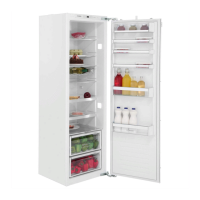
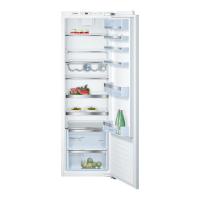
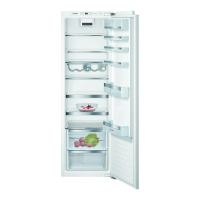
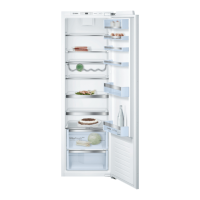
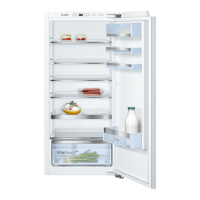
The Bosch refrigerator is designed for chilling food in private households and enclosed domestic environments, suitable for altitudes up to 2000 m above sea level. It is intended to be fully fitted into a kitchen. The appliance features a refrigerator compartment where the temperature can be set between 2 °C and 8 °C, allowing for the storage of various foods such as meat, sausage, fish, dairy products, eggs, prepared meals, and pastries. The refrigerator compartment also includes chill zones, with the coldest zone ideal for highly perishable foods like fish and meat, and the warmest zone (at the very top of the door) suitable for items like hard cheese and butter. An "OK" sticker, if present, helps verify that the refrigerator compartment has reached the recommended safe temperature range of +4 °C or colder. The appliance also features a Super cooling function, which rapidly cools the refrigerator compartment to its coldest possible temperature, useful for quickly chilling large quantities of food.
The refrigerator is operated via a control panel that allows users to switch the appliance on or off and set the desired temperature. The recommended temperature for the refrigerator compartment is 4 °C. To switch on the appliance, the user presses the power button, and the appliance begins to cool. The set temperature is typically reached after several hours, and it is advised not to place food inside until this temperature is achieved. To switch off the appliance, the user simply presses the power button again. The temperature can be adjusted by repeatedly pressing the °C button until the desired temperature is displayed.
The Super cooling function can be activated by repeatedly pressing the °C button until "super" lights up. This function automatically switches back to normal operation after approximately 15 hours. Users are advised to activate Super cooling before placing large quantities of food into the refrigerator.
The internal layout of the refrigerator is flexible, with shelves that can be removed and re-inserted to vary the storage space as needed. Door racks are also adjustable and removable. A fruit and vegetable container is provided for storing fresh produce in its packaging. To maintain the quality and aroma of cold-sensitive fruits and vegetables (e.g., pineapple, bananas, citrus fruits, cucumbers, courgettes, peppers, tomatoes, and potatoes), it is recommended to store them outside the appliance at temperatures between 8 °C and 12 °C. Condensation may form in the fruit and vegetable container, which should be removed with a dry cloth.
Operating tips include: allowing warm food and drinks to cool down before storing them, thawing frozen food in the refrigerator compartment to utilize its low temperature, and ensuring some space is left between food and the back panel to prevent freezing and ensure air circulation. When closing the door, a vacuum may be created, making it temporarily difficult to open; waiting a moment allows the vacuum to equalize.
Regular cleaning and servicing are crucial for the appliance's long-term efficiency. Before cleaning, the appliance must be switched off and disconnected from the power supply by unplugging it or switching off the circuit breaker. All food should be removed and stored in a cool place, preferably with ice packs. Any hoarfrost should be allowed to defrost. All fittings and accessories, such as shelves and door racks, should be removed for thorough cleaning.
The appliance, its fittings, accessories, and door seals should be cleaned with a dishcloth, lukewarm water, and a pH-neutral washing-up liquid. After cleaning, all surfaces should be thoroughly dried with a soft, dry cloth. It is important not to use steam or high-pressure cleaners, hard scouring pads, cleaning sponges, or harsh/abrasive detergents, as these can damage the appliance surfaces. Cleaning products with a high alcohol content should also be avoided. Fittings and accessories should never be cleaned in a dishwasher, as this can cause deformation or discolouration.
The condensation channel and drainage hole on the rear panel of the refrigerator compartment should be regularly cleaned to ensure proper drainage and prevent odours. This can be done using a moistened cotton bud. It is important to ensure that rinsing water does not drip into the lighting or controls.
For stainless steel surfaces, only suitable cleaning cloths and agents should be used. To prevent visible scratches, wipe the surface in the direction of the grain. After cleaning, the fittings should be re-inserted, the appliance reconnected to the electricity supply, switched on, and then the food can be returned.
The manual also outlines a self-test procedure for the appliance, which can help diagnose minor faults before contacting customer service. If the self-test indicates an issue (e.g., "super" flashes for 10 seconds), customer service should be informed.
For disposal, the appliance should be unplugged, the power cord cut, and then disposed of in an environmentally friendly manner, following local authority guidelines. Shelves and containers should be left inside to prevent children from climbing in and getting trapped. The tubes of the refrigerant circuit or insulation should not be damaged during disposal.
 General
| Door hinge | Right |
|---|---|
| Control type | Buttons |
| Product color | White |
| Built-in display | No |
| Reversible doors | Yes |
| Shelves material | Glass |
| Appliance placement | Built-in |
| Fridge door balconies | 6 |
| Number of egg balconies | 3 |
| Number of vegetable drawers | 2 |
| Fridge number of shelves/baskets | 7 |
| Current | 13 A |
| Connected load | 90 W |
| AC input voltage | 220/240 V |
| Power source type | AC |
| AC input frequency | 50 Hz |
| Energy efficiency scale | A to G |
| Annual energy consumption | 144 kWh |
| Noise level | 37 dB |
| Climate class | SN-ST |
| Fridge net capacity | 319 L |
| Multi-airflow system | - |
| Minimum operating temperature | 10 °C |
| Lamp type | LED |
 Weight and Dimensions
| Depth | 545 mm |
|---|---|
| Width | 541 mm |
| Height | 1772 mm |
| Weight | 58800 g |
| Installation compartment depth | 550 mm |
| Installation compartment width | 560 mm |
| Installation compartment height | 1775 mm |


 To Next Page