Need help?
Do you have a question about the Bosch KIR41 series and is the answer not in the manual?
Provides essential guidelines and information for safe and effective use of the appliance.
Details the specific applications and environments for which the appliance is designed.
Outlines limitations and conditions for use by children and individuals with reduced capabilities.
Provides warnings and instructions regarding safe handling and movement of the appliance.
Details crucial safety instructions for the proper and secure installation of the appliance.
Covers essential safety precautions to be followed during the operation of the appliance.
Provides safety guidelines for operating or handling an appliance that may be damaged.
Instructions for sorting and disposing of packaging materials in an environmentally friendly manner.
Provides tips and guidance on how to use the appliance efficiently to reduce power consumption.
Lists the components included in the delivery and instructions for checking for damage.
Specifies requirements for the installation site, including space and environmental conditions.
Provides instructions for the physical installation of the appliance according to guidelines.
Details the steps required to prepare the appliance before its initial use.
Instructions for safely connecting the appliance to the electrical power source.
Overview of the appliance's main parts and features with reference to diagrams.
Explanation of the control panel functions, buttons, and display indicators.
Information on adjusting and using the shelves within the appliance.
Guidance on storing fruits and vegetables for optimal freshness and preservation.
Instructions for adjusting and utilizing the racks located in the appliance door.
Details about optional accessories available for enhancing appliance functionality.
Step-by-step guide on how to start and power on the appliance.
Provides practical advice for optimal use and performance of the appliance.
Instructions on how to safely turn off and power down the appliance.
Guide on how to adjust and set the desired temperature for the refrigerator compartment.
Information on the Super Cooling function for rapid temperature reduction.
Advice on proper food storage to maintain quality and freshness within the compartment.
Explanation of different temperature zones within the compartment and optimal food placement.
Information about the 'OK' sticker for checking the correct temperature setting.
Details on the automatic defrosting process in the refrigerator compartment.
Steps to take before cleaning the appliance, including power disconnection.
Instructions and precautions for cleaning the interior and exterior of the appliance.
Guidance on cleaning the channel and hole to ensure proper condensation drainage.
Instructions on how to remove shelves and racks for cleaning or adjustment.
Steps for safely decommissioning and preparing the appliance for storage.
Information and safety warnings regarding the environmentally friendly disposal of old appliances.
Guidance on locating and using the product and production numbers for service inquiries.
This document describes a Bosch refrigerator, providing comprehensive information on its function, usage, and maintenance.
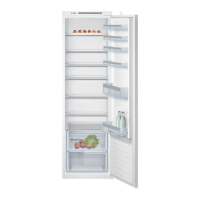
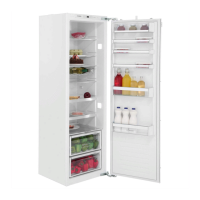
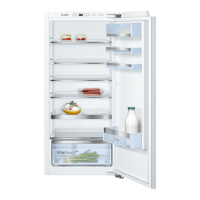
The Bosch refrigerator is designed for chilling food in private households and enclosed domestic environments, at altitudes up to 2000 m above sea level. It is intended to be fully fitted in a kitchen. The appliance operates by circulating air to create different chill zones within the refrigerator compartment. It uses a refrigerant circuit to cool the interior, with condensation droplets or frost forming on the rear panel due to functional reasons, which then defrosts automatically. The condensation runs through a channel into a drainage hole and an evaporation pan, eliminating the need for manual wiping.
The refrigerator compartment allows for temperature settings between 2 °C and 8 °C, with 4 °C being the recommended temperature for optimal food preservation. A "Super cooling" function is available to rapidly cool the compartment to its coldest possible setting, useful before introducing large quantities of food. This function automatically switches off after approximately 15 hours. The appliance also features a "Showroom mode" for display purposes, which can be exited by performing an appliance self-test.
Basic Operation: To switch on the appliance, connect it to the electricity supply. If previously switched off via the control panel, press and hold the designated button for three seconds. The appliance will then begin to cool. The desired temperature can be set by repeatedly pressing the temperature adjustment button until the display shows the required value. For optimal food safety, it is recommended to wait several hours for the set temperature to be reached before placing food inside.
Food Storage: The refrigerator compartment is suitable for storing meat, sausage, fish, dairy products, eggs, prepared meals, and pastries. Food should be stored fresh, undamaged, covered, or in air-tight packaging to prevent contamination and maintain quality. It is crucial to avoid placing food directly against the back wall to ensure proper air circulation and prevent freezing. Warm food and drinks should be allowed to cool down before being placed in the appliance. Users should always observe the best-before or use-by dates provided by manufacturers.
Chill Zones: The refrigerator compartment has distinct chill zones due to air circulation. The coldest zone is located between an arrow stamped on the side and the shelf underneath, ideal for highly perishable items like fish, sausages, and meat. The warmest zone is at the very top of the door, suitable for foods that do not spoil easily, such as hard cheese and butter, allowing cheese to release its aroma and butter to remain spreadable.
"OK" Sticker: Some models include an "OK" sticker, which serves as a visual indicator to confirm if the refrigerator compartment has reached the safe temperature range of +4 °C or colder. If the sticker does not indicate "OK," the temperature should be gradually reduced.
Fittings: The appliance includes shelves, fruit and vegetable containers, and door racks. These fittings can be removed and re-inserted elsewhere to customize storage space as needed. The fruit and vegetable container is designed for storing fresh produce in its packaging. Chopped fruit and vegetables should be covered or stored in air-tight packaging within this container. Condensation may form in the fruit and vegetable container, which should be removed with a dry cloth. Certain fruits and vegetables sensitive to cold, such as pineapple, bananas, citrus fruits, cucumbers, courgettes, peppers, tomatoes, and potatoes, should be stored outside the appliance at temperatures between 8 °C and 12 °C to retain quality and aroma.
Troubleshooting: The manual provides guidance for rectifying minor faults, such as the appliance not cooling, LED lighting not working, temperature discrepancies, a wet refrigerator compartment base, or unusual noises. Users are advised to perform an appliance self-test if the appliance is in "Showroom mode" or to check and clean the condensation channel and drainage hole if the base is wet. For persistent issues or damaged components, contacting customer service is recommended.
Cleaning and Servicing: Regular cleaning and maintenance are essential for the appliance's long-term efficiency. Before cleaning, the appliance must be switched off and disconnected from the power supply. All food should be removed and stored in a cool place, ideally with ice packs. Any hoarfrost layer should be allowed to defrost. All fittings and accessories should be removed for thorough cleaning.
Cleaning Procedure: The appliance, its fittings, accessories, and door seals should be cleaned with a dish cloth, lukewarm water, and a pH-neutral washing-up liquid. After cleaning, all surfaces should be dried thoroughly with a soft, dry cloth. It is crucial not to use steam or high-pressure cleaners, hard scouring pads, abrasive detergents, or cleaning products with a high alcohol content, as these can damage the appliance's surfaces or cause electric shock. Rinsing water must not drip into the lighting or controls. Fittings and accessories should never be cleaned in a dishwasher, as this may cause deformation or discolouration.
Condensation Channel and Drainage Hole: The condensation channel and drainage hole require regular cleaning to ensure proper drainage and prevent odours. This can be done carefully using a moistened cotton bud. It is important to ensure that rinsing water does not get into the drainage hole.
Removing Fittings: For thorough cleaning, shelves can be removed by lifting them at the front and pulling them out. Door racks can be removed by lifting them. The fruit and vegetable container can be removed by pulling it out as far as it will go and then lifting it at the front.
Storage and Disposal: If the appliance is to be taken out of operation for an extended period, it should be switched off, disconnected from the power supply, and all food removed. The appliance should then be defrosted and cleaned. To ensure ventilation and prevent mould formation, the appliance door should be left open. For disposal of an old appliance, it should be unplugged, the power cord cut, and then disposed of in an environmentally friendly manner. Shelves and containers should be left inside to prevent children from climbing in and getting trapped. The refrigerant circuit tubes and insulation should not be damaged during disposal.
 General
| Category | Refrigerator |
|---|---|
| Energy efficiency class | A+ |
| Door hinge | Right |
| Reversible doors | Yes |
| Number of vegetable drawers | 1 |
| Interior light | Yes |
| Climate Class | SN-T |
| Number of shelves/baskets | 4 |

 To Next Page