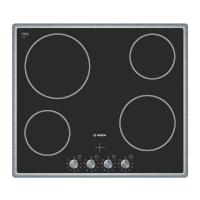
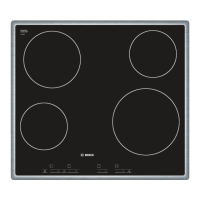
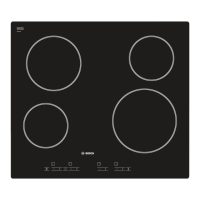
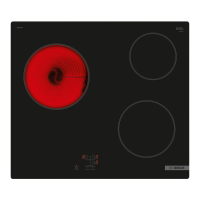
This document serves as a comprehensive user manual and installation guide for Bosch hob models PKE6..CA. and PKF6..CA. It covers essential safety information, operational instructions, maintenance tips, and installation guidelines to ensure safe and efficient use of the appliance.
The hob is designed for preparing meals and drinks in private households and enclosed domestic environments. It is intended for use under supervision, meaning it should not be left unattended, especially when cooking for short periods. The appliance is suitable for altitudes up to a maximum of 2000 meters above sea level. It should not be used with an external timer or a separate remote control, unless operation with appliances included in EN 50615 is specifically switched off.
The manual emphasizes reading all instructions carefully and keeping them for future reference. It warns against connecting a damaged appliance and highlights that only licensed professionals should connect appliances without plugs, as incorrect connection voids the warranty.
Restriction on User Group: The appliance can be used by children aged 8 and over, and by individuals with reduced physical, sensory, or mental abilities, or lack of experience/knowledge, provided they are supervised and instructed on safe use, understanding the associated dangers. Children must not play with the appliance or perform cleaning/user maintenance unless they are at least 15 years old and supervised. Children under 8 years old must be kept away from the appliance and its power cable.
Safe Use: Several warnings are provided to prevent fire, burns, electric shock, injury, and suffocation.
- Risk of fire: Leaving fat or oil cooking unattended is dangerous. Never attempt to extinguish a fire with water; instead, switch off the appliance and cover it with a lid or fire blanket. Flammable objects should not be placed on or near the cooking surface. Combustible objects or aerosol cans should not be stored in drawers directly underneath the hob. Hob covers are explicitly discouraged due to overheating and fire risks.
- Risk of burns: The cooking surface and surrounding parts become hot during use. Caution is advised to avoid touching heating elements. Young children must be kept away. Hob protective grilles should never be used. The appliance must be allowed to cool down before cleaning.
- Risk of electric shock: Improper repairs are dangerous and should only be carried out by trained specialists using genuine spare parts. A damaged power cord or appliance power cable must be replaced by the manufacturer or customer service. A damaged appliance should never be operated; if the surface is cracked, the appliance must be switched off at the fuse box, the hotplate control set to zero, and customer service contacted. Steam or high-pressure cleaners should not be used for cleaning. Electrical appliance cables should not come into contact with hot parts of the appliance.
- Risk of injury: Saucepans may jump due to liquid between the base and hotplate. Hotplates and saucepan bases must always be kept dry.
- Risk of suffocation: Packaging material should be kept away from children to prevent suffocation. Small parts should also be kept away from children to prevent choking.
Preventing Material Damage:
The manual provides warnings to prevent damage to the appliance and cookware.
- Cookware: Rough pot and pan bases can scratch the ceramic surface. Cookware should be checked. Empty pans should not be placed on a heated hotplate or allowed to boil dry, as this can damage cookware or the appliance. Hot pots or pans should not be placed on the controls or the hob surround.
- Falling objects: Hard or pointed objects falling onto the hob can cause damage.
- Heat-resistant materials: Non-heat-resistant materials will melt on heated hotplates. Oven protective foil, aluminum foil, or plastic containers should not be used.
Overview of Common Damage and Prevention:
A table outlines common types of damage and how to avoid them:
- Scratches: Caused by salt, sugar, sand, or rough pot/pan bases. Prevent by not using the hob as a work surface/storage space and checking cookware.
- Stains: Caused by food boiling over or unsuitable cleaning products. Remove boiled-over food immediately with a glass scraper. Use only cleaning products suitable for glass ceramic.
- Discoloration: Caused by pan abrasion (e.g., aluminum) or unsuitable cleaning products. Lift pots and pans to move them on the hob. Use only suitable cleaning products.
- Blisters: Caused by sugar or high-sugar content food. Remove boiled-over food immediately with a glass scraper.
Environmental Protection and Saving Energy:
- Disposing of packaging: Packaging materials are environmentally compatible and recyclable. Users are instructed to sort components by type for separate disposal.
- Saving energy: Tips include selecting the correct cooking zone size for the pan, centering cookware, using cookware with a base diameter matching the hotplate, covering saucepans with lids, lifting lids infrequently, using glass lids, using flat-based pots/pans, matching cookware size to food quantity, cooking with minimal water, turning down power early, and utilizing residual heat by switching off the hotplate 5-10 minutes before cooking ends.
Familiarizing Yourself with Your Appliance:
The manual describes the control panel and hotplates.
- Control Panel: Used to configure functions and obtain operating status information.
- Hotplate Controls: Permanently fixed and should not be removed forcibly, as this will destroy them.
- Hotplates: An overview of hotplate activations is provided. Single-circuit cooking zones are activated by turning the switch to the right until the desired heat setting is selected. Dual-circuit hotplates are activated similarly. Switching off involves turning the switch to 0. The hotplate regulates temperature by switching heat on and off, even at the highest setting, to protect components from overheating and prevent electrical overload.
- Hotplate Display and Residual Heat Indicator: The display lights up during operation or shortly after switching on. After cooking, it remains lit if the hotplate is still warm, indicating residual heat that can be used to keep small dishes warm or melt chocolate.
Basic Operation:
- Switching the hob on/off: Done with the hotplate switch.
- Setting the hotplates: The hotplate control adjusts heat output from 1 (lowest) to 9 (highest). The display symbol indicates which hotplate the display refers to.
- Recommended cooking settings: A table provides recommended power levels and cooking times for various foods (e.g., stew, dumplings, fish, rice, potatoes, pasta, vegetables, roulades, pot roast, goulash, escalope, chops, steak, stir-fry, pancakes). Cooking tips include using heat setting 9 for boiling, stirring thick liquids, searing food in small portions, and energy-saving practices.
Cleaning and Servicing:
Proper cleaning and maintenance are crucial for long-term efficiency.
- Cleaning products: Suitable cleaning products and glass scrapers are available from customer service, online shop, or retailers.
- Unsuitable cleaning products: Users are warned against using unsuitable products such as undiluted detergent, dishwasher detergent, abrasive cleaners, aggressive cleaning products (oven spray, stain remover), abrasive sponges, or high-pressure/steam jet cleaners, as they can damage appliance surfaces.
- Cleaning the glass ceramic: The hob should be cleaned after every use to prevent cooking residues from burning on. After the hob has cooled down, heavy soiling should be removed with a glass scraper, followed by cleaning with a glass ceramic cleaning product according to product packaging instructions. A special sponge for glass ceramic is recommended for good results.
Disposal:
- Disposing of old appliance: Valuable raw materials can be recycled. The appliance should be disposed of in an environmentally friendly manner, with information on current disposal methods available from specialist dealers or local authorities. The appliance is labeled according to European Directive 2012/19/EU (WEEE) for the return and recycling of used electrical and electronic appliances.
Customer Service:
Function-relevant genuine spare parts are available from Customer Service for at least 10 years from the market placement date, in accordance with the Ecodesign Order. Under warranty terms, Customer Service is free of charge. Detailed warranty information is available from after-sales service, retailers, or the website. When contacting Customer Service, the product number (E-Nr.) and production number (FD) are required, found on the appliance's rating plate (on the appliance certificate or lower section of the hob).
Installation Instructions:
- Safe installation: Electrical connection must only be carried out by licensed specialist staff, as incorrect connection invalidates the warranty. Safe operation is guaranteed only if installed professionally according to instructions. The installer is liable for damage from incorrect installation.
- Built-under: Refrigerators, dishwashers, non-ventilated ovens, or washing machines should not be installed underneath the appliance. If an oven is fitted below, the worktop must be at least 20 mm thick (or thicker as per oven instructions). Projecting parts like mains housing or cable should not collide with drawers.
- Intermediate floor: If the underside of the hob can be touched, an intermediate floor must be fitted. This can be purchased as an accessory or custom-made, ensuring a minimum 10 mm distance to the appliance's mains connection.
- Preparing the units: The worktop must be level, horizontal, and stable. Fitted units and wall finishing strips must be heat-resistant to at least 90 °C. Niche cladding within 50 mm of the back wall must be non-combustible. Cut surfaces should be sealed to prevent moisture-induced swelling.
- Installing fixing rails: For stone work surfaces, fixing rails should be bonded. The hob can also be installed in existing cut-outs with a depth of 500 mm.
- Electrical connection: To protect the appliance, it should not be removed from polystyrene trays until pressed into the cut-out. The appliance should never be laid flat on its side. Household wiring must be checked before connection. The appliance fulfills protection class I and requires an earth conductor. A partition must be provided in the phases for permanent electrical installation. If "1400" appears on the display, it indicates incorrect connection; the appliance should be disconnected, and the connection checked.
- Connecting without a pre-installed cable: Connect according to the diagram, install copper bridges if needed. The power cable must be type H05 VV-F or higher, with a cross-section of at least 1.5 mm².
- Connecting with a pre-installed 5-wire power cable: This cable should only be replaced by trained customer service personnel.
- Installing the hob: Do not trap the power cable or route it over sharp edges. If the oven is a built-under type, route the cable along the rear corners of the oven to the mains socket. Push the hob in until it locks into place.
- Removing the hob: Disconnect the appliance from the power supply, then push it out from below.

 Need help?
 General

 To Next Page