30
GeneralOverviewWiringAdjustment
Operation
Error AnalysisAppendix
5.2 Activation and request of control station
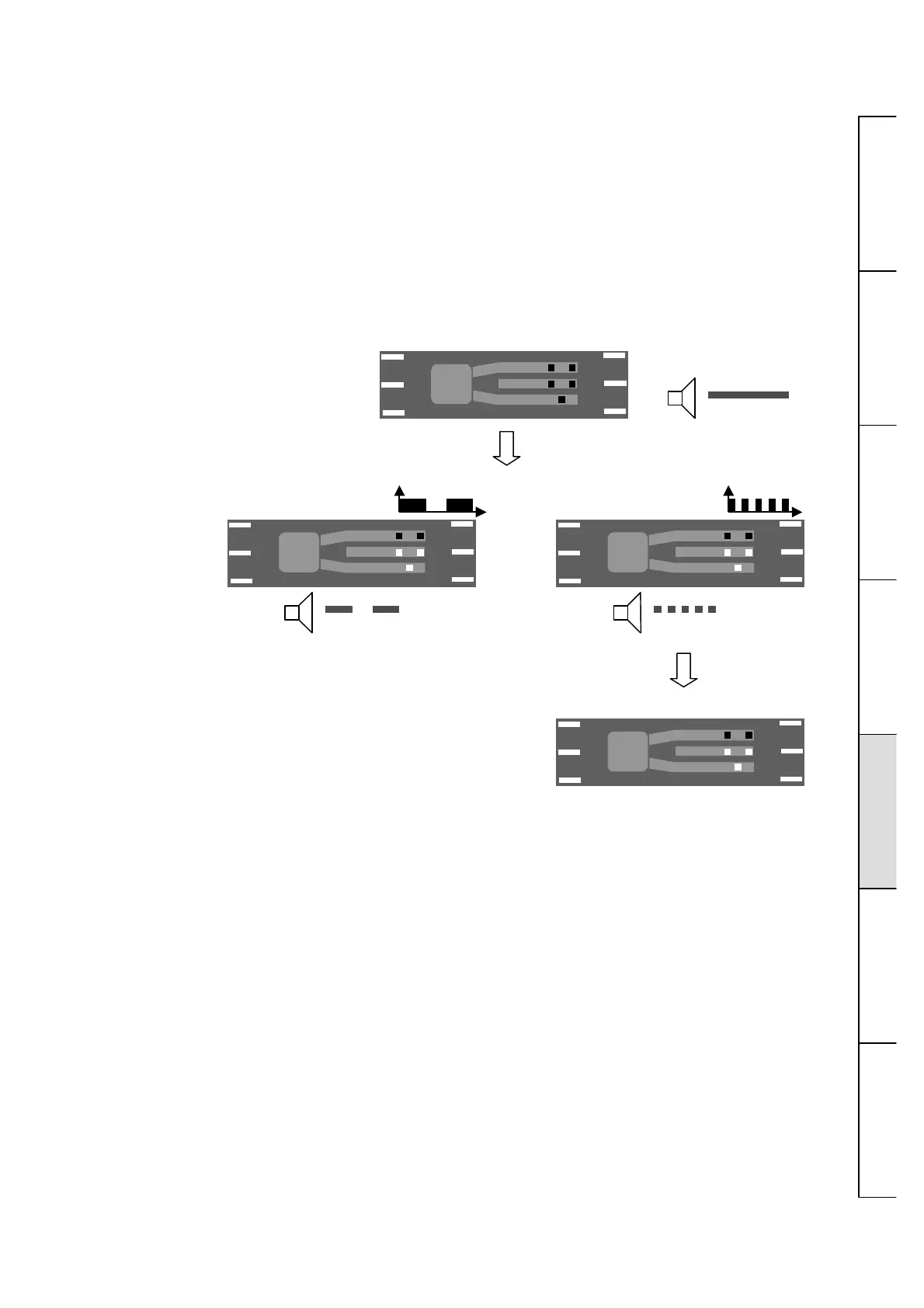
After switching on the power supply, all control heads which work correctly are in condition "lamp test"
(all lamps and buzzer on). The command can be requested from every control station by pressing the
key once. After the key has been pressed, the condition "lamp test" will end for all control heads.
On the control head on which the key has been pushed, the command lamps will flash and the buzzer
sound. The lamps flash slowly and the buzzer sounds at slow intervals when the control head lever is
not in neutral position.
By a slow flashing of the command lamp, the control head signals that the lever must be moved in
neutral position first. If the levers are already in neutral, the command lamp will flash quickly and the
buzzer sounds at high repetition. The command can be taken over by pressing the key again.
condition:
lamp test
permanent sound
all lamps on permanently
push key
condition:
requesting
station
slow bleeping
fast bleeping
lever not in neutral lever in neutral
lever in neutral
push key
condition:
active
station
Command lamp on permanently
command lamp flashes slowly Command lamp flashes quickly
all lamps on
As soon as a control station has been activated, gear position neutral and idle speed will be selected.
The command can then be set from the active control station (see chapter 5.1).
Note for control heads twin engine:
In this case, both levers must be moved in neutral. The function of the command lamps is assigned to
the respective lever (port, starboard).
Note for possible error:
If, on a control head, the command lamps do not glow after the activation, it failed to contact the
control unit. Wiring and ID (see chapter 3.2.) need to be controlled. If necessary, the procedure of
entering the control heads into the system (see chapter 4.2) must be repeated.
If there is no functioning control head, the alarm relay will be activated.


 To Next Page