
 Need help?
Do you have a question about the Bose AMM112 and is the answer not in the manual?
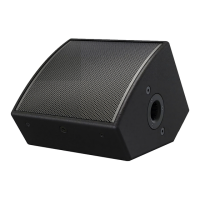
The Bose AMM112 Multipurpose Loudspeaker is a sophisticated audio device designed for a wide array of sound reinforcement and monitoring applications. This loudspeaker integrates a coaxially mounted 3.0-inch compression driver with a 12-inch low-frequency transducer, all housed within a compact, heavyweight enclosure. Its design is optimized for short-throw scenarios, making it suitable for various professional audio environments. The AMM112 operates across a broad frequency range, ensuring comprehensive sound reproduction.
A key feature of the AMM112 is its internal passive crossover network. This network works in conjunction with Bose loudspeaker presets to deliver optimal performance, whether the unit is used in permanent installations or portable setups. The combination of advanced transducer technology and a carefully designed crossover system allows the loudspeaker to produce clear, balanced, and powerful audio.
For maintenance and service, the manual outlines a detailed disassembly procedure. The first step involves the removal of the grille. This process begins by unscrewing four M6 screws that secure the grille to the enclosure. Once the screws are removed, a spudger is used to carefully lift the grille at its edge, releasing it from its snaps. When reassembling the grille, it is crucial to ensure it is properly inserted into the grille guides. The manual specifies an installation torque of approximately 20 +/-1 kgf*cm for the grille screws, highlighting the importance of precise reassembly to maintain the unit's integrity and acoustic performance.
Following the grille removal, the woofer can be accessed. This involves several steps, starting with the removal of twelve screws that secure the waveguide. After these screws are taken out, four waveguide labels need to be peeled off. These labels are intended for reuse during reassembly. Subsequently, four screws securing the waveguide cover are removed, allowing the waveguide cover to be lifted out of the enclosure. Further disassembly of the waveguide involves removing two additional screws. Once these are out, the entire waveguide assembly can be lifted from the enclosure.
The next stage of woofer removal requires unscrewing eight screws that secure the woofer itself. Similar to the grille, the reassembly of the woofer also has a specified installation torque of around 20 +/-1 kgf*cm. A critical note for woofer removal is to exercise caution due to its significant weight. After the woofer screws are removed, four cable harnesses connected to the woofer must be detached. This is done by pressing the white fastener on each harness. During reassembly, it is important to align the waveguide mounting holes correctly, as indicated by red arrows in the manual, and to screw the woofer onto a flat surface.
The manual also includes a section on functional test procedures, which are essential for verifying the loudspeaker's performance after any service or repair. These tests require specific equipment, including an audio sweep generator and an L2400 power amplifier. The first test is an "Air Leak Test," where a 50 Hz, 10 Vrms tone signal is applied to the unit's PARALLEL (left) input. Technicians then listen for any air leaks from sealed areas, such as the grille assembly and cup pole, indicating potential issues with the enclosure's sealing.
The "Buzz and Sweep Test" is another crucial diagnostic. For this test, a 20 Vrms signal is applied to the PARALLEL (left) input. The generator is then swept from 50 Hz to 10 KHz, using a sine wave with a -6dB slope, low-pass, 100Hz cut-off filter. This sweep lasts for 5-10 seconds, with listening conducted at a distance of 60cm. The purpose is to detect any buzz, rub, or extraneous sounds. If such sounds are identified, their source must be localized and repaired. Any woofer producing these extraneous sounds should be replaced.
Two additional functional tests focus on the "Switch and Biamp" functions for both low frequency (LF) and high frequency (HF) components. For the "Switch and Biamp LF Function Test," a 20 Vrms signal is applied to the PARALLEL (left) input. The generator sweeps from 50 Hz to 3 KHz, again with a -6dB slope, low-pass, 100Hz cut-off filter. This test also lasts 5-10 seconds, with listening at 60cm to identify any buzz, rub, or extraneous sounds in the LF range. Similarly, the "Switch and Biamp HF Function Test" applies a 20 Vrms signal to the PARALLEL (left) input, but the generator sweeps from 400 Hz to 10 KHz, with the same filter settings and duration. This allows for the detection of similar issues in the HF range. In both biamp tests, any identified issues require localization, repair, or replacement of the woofer if it is the source of the unwanted sounds.
The manual emphasizes safety information, particularly regarding Electrostatic Discharge Sensitive (ESDS) devices. It recommends performing work at an electrically grounded workstation, wearing wrist or heel straps connected to conductive mats, and avoiding direct contact with leads or contacts of ESDS devices or PC boards. Boards should only be handled by their edges. For storage and transport, ESDS devices must be kept in ESD protective bags, bins, or totes, and never in materials like plastic, polystyrene foam, or bubble wrap, which can generate static electricity.
A critical safety note highlights that certain parts are identified with a special symbol on schematics or in the parts list. For these critical parts, only manufacturer-recommended replacements with identical safety characteristics should be used to prevent potential shock, fire, or other hazards. The manual also states that the Bose AMM112 Multipurpose Loudspeaker contains no user-serviceable parts, and any servicing should be referred to authorized warranty service stations or factory service to avoid warranty infractions. This underscores the complexity and specialized nature of the loudspeaker's internal components.
The product is covered by a limited 5-year transferable warranty. Units that fail within 90 days of sale are eligible for replacement. The parts list notes clarify that individual parts on PCBs are listed in the Electrical Part List, and some parts are for informational purposes only, not stocked as repair parts, requiring reference to the next higher assembly for replacement. The proprietary information section further restricts the use of the document to authorized Bose service centers for servicing the identified product, prohibiting reproduction or use for any other purpose.
 General
| Nominal Impedance | 8 ohms |
|---|---|
| Crossover Frequency | 1.6 kHz |
| Weight | 19.3 kg |
| Sensitivity (SPL / 1W @ 1 m) | 95 dB |
| LF Transducer | 12-inch woofer |
| HF Transducer | 1.4-inch compression driver |
| Input Connections | 2 x NL4 Neutrik Speakon |
| Connectors | 2 x NL4 Neutrik Speakon |
| Long-Term Power Handling | 300 W continuous |



 To Next Page