Need help?
Do you have a question about the Boss Acoustic Singer Live and is the answer not in the manual?
Detailed overview of the amplifier's front panel layout and primary controls.
Explanation of the controls for the microphone input, including effects and EQ.
Description of the harmony, delay/echo, and reverb effect controls.
Details on guitar input jack, volume, EQ, anti-feedback, and chorus effect.
Explanation of the looper, tweeter attenuator, mute, power, and master volume.
Description of the AC IN jack and DI/LINE OUT connections for PA systems or recorders.
Details on PHONES/REC OUT jack and REC OUT jack for computer connectivity.
Instructions for using footswitches (FS-6, FS-7, FS-5U) for looper, chorus, and harmony.
Guidance on using expression pedals and the GA-FC controller for effect and volume control.
Instructions for connecting external audio devices via the AUX input.
Step-by-step guide for safely turning the Acoustic Singer on and off.
How to specify the reference pitch for harmony effects based on guitar tuning.
Instructions for recording, playback, and overdubbing loops using the looper.
Methods for operating the looper functions using external footswitches.
Details on rated power output and nominal input levels for various jacks.
Information on the woofer and tweeter specifications for each model.
List of all available connectors and power consumption details.
Physical specifications and included accessories for the amplifier.
Visual representation of the audio signal path through the amplifier's circuits.
Diagram illustrating connections for foot control, GA-FC, and various output jacks.
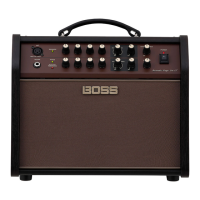
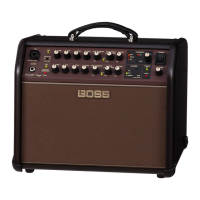
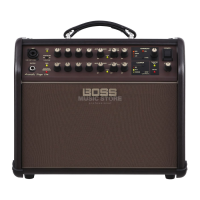
The BOSS Acoustic Singer is an amplifier series designed for singer-instrumentalists, allowing them to perform powerfully with both acoustic guitar and vocals. This series includes two models: the Acoustic Singer Live and the Acoustic Singer Pro.
The core function of the Acoustic Singer is to amplify and process both vocal and acoustic guitar signals simultaneously. It features independent channels for a microphone and a guitar, which can be mixed together to create a balanced sound. A key innovation is its newly developed two-way speaker system, which is bi-amped to deliver clear and powerful sound across the frequency spectrum.
For vocalists, the amplifier offers a range of effects including anti-feedback, delay/echo, and reverb, allowing for enhanced vocal performance. A unique harmony function can automatically add natural harmony to the vocal, tracking the guitar performance for accurate pitch. The harmony can be set to add notes above (HIGH), below (LOW), or simulate a doubling effect (UNISON) for a richer sound. The reference pitch for the harmony can be precisely specified to match the tuning of the guitar or other accompaniment.
The guitar channel is equipped with acoustic resonance, anti-feedback, chorus, and reverb effects. The acoustic resonance feature adds natural resonance to an acoustic guitar, with settings for emphasized body resonance, boosted mid-range resonance, or brilliant high-range sound. The anti-feedback system includes both a phase button and a notch knob to effectively suppress acoustic feedback. The chorus effect offers natural or emphasized modulation, while the reverb adds depth to the guitar sound.
Both channels feature a 3-band equalizer (BASS, MIDDLE, TREBLE) for detailed tone shaping. Input pads are available on both mic and guitar channels to prevent distortion when using high-output sources. Phantom power is supplied for condenser microphones.
A built-in looper allows users to record up to 40 seconds of mono performance, play it back, and overdub additional layers, enabling real-time backing performances. The mix of vocal and guitar sound can be recorded and used for these loop performances.
The amplifier also includes an AUX input for connecting external audio players or other audio sources, allowing users to play along with their favorite tracks. A line output provides connectivity to a PA system or recorder, offering options for direct line recording or external amplification. A REC OUT jack allows for direct recording to a computer via USB, and the unit can also play back audio from a computer.
The Acoustic Singer is designed for ease of use in live performance and practice settings. The front panel provides intuitive controls for each channel, with dedicated knobs and buttons for volume, EQ, effects, and anti-feedback.
For the microphone channel, the [PAD] button attenuates the input level by 15 dB, useful for preventing distortion from loud mics. The [PHANTOM] switch activates phantom power for condenser microphones. The [DELAY/ECHO] knob adjusts the depth of the selected delay or echo effect, while the [REVERB] knob controls reverb depth. The HARMONY section includes a [LEVEL] knob for volume, an [ON] button to activate/deactivate, and a [TYPE] button to cycle through harmony types (HIGH, UNISON, LOW).
On the guitar channel, the [PAD] button attenuates input by 10 dB. The [ACOUSTIC RESONANCE] button cycles through different resonance settings. The [CHORUS] knob adjusts the chorus effect depth, with TYPE1 for natural modulation and TYPE2 for emphasized modulation. The [REVERB] knob controls reverb depth.
Both channels feature anti-feedback controls: a [PHASE] button to switch phase and a [NOTCH] knob to target and suppress specific feedback frequencies.
Common controls include a [TWEETER ATT] button, which applies a filter to the high-frequency region for a milder, softer sound, particularly useful for guitar strings. A [MUTE] button allows users to mute the amp's sound without changing volume or other settings, convenient for breaks during performances. The [MASTER] knob adjusts the overall output volume.
Foot control options enhance live usability. Footswitches (BOSS FS-6, FS-7, or FS-5U, sold separately) can be connected to control looper operations, or to turn CHORUS, HARMONY, and MUTE on/off. An expression pedal (Roland EV-5, BOSS FV-500L, BOSS FV-500H, sold separately) can be used to vary the guitar channel volume or control the HARMONY effect volume. The GA-FC Foot Controller (sold separately) provides comprehensive control over REVERB, DELAY/ECHO, CHORUS, HARMONY, and MUTE for both channels.
The looper is operated via dedicated buttons: the [LOOPER] button for record-standby, playback, and overdubbing, and the [STOP] button to stop recording/playback or clear the phrase. An indicator shows the looper's status (REC, PLAY, OVERDUB).
Power management involves a specific sequence: ensuring all volumes are at zero, turning on the Acoustic Singer, then turning on connected devices. The reverse sequence is used for powering off.
The manual emphasizes proper power on/off procedures to prevent malfunction and equipment failure. It advises always turning down the volume before switching the unit on or off to avoid sudden loud sounds. For complete power shutdown, it instructs users to turn off the unit first, then unplug the power cord from the outlet.
The device is designed with robust connectivity options, including XLR and 1/4-inch TRS phone types for MIC, GUITAR, DI/LINE OUT, and FOOT CONTROL jacks, ensuring reliable connections for various audio equipment. The USB port is a standard USB 2.0 B type.
The manual also highlights the importance of installing the correct USB driver when connecting the unit to a computer for recording or playback, directing users to the BOSS website for downloads. It specifies setting the computer's sample rate and bit depth to 44.1 kHz and 24-bit respectively for optimal recording.
While the manual does not detail internal maintenance, it implies that the device is designed for user-friendly operation and external connectivity, with internal components requiring professional service if issues arise. The anti-feedback features can be considered a form of "performance maintenance," helping users maintain optimal sound quality in various acoustic environments.
 General
| Type | Acoustic Amplifier |
|---|---|
| Feedback Control | Yes |
| Bluetooth | No |
| Power Output | 60 W |
| Speaker | 6.5-inch |
| Channels | 2 |
| Effects | Reverb, Chorus, Delay |
| Outputs | Line Out |
| EQ | 3-band EQ |
| USB | USB B type (Audio) |
| Inputs | Mic/Instrument, Aux In |

 To Next Page