Need help?
Do you have a question about the Boss GM-800 and is the answer not in the manual?
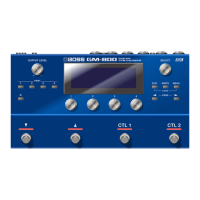
Details the controls and indicators on the front of the GM-800 unit.
Explains the rear panel connections for audio, MIDI, and external control devices.
Ensures your guitar or bass has a divided pickup for optimal GM-800 connection.
Guides on connecting guitars, amps, headphones, and other devices to the unit.
Step-by-step instructions for turning on the GM-800 and connected equipment.
Configures the GM-800 to recognize devices connected to the OUTPUT jacks.
Configures settings for the divided pickup (GK pickup) type for optimal performance.
Sets the GK PU Pos based on the divided pickup installation location on a bass guitar.
Selects the correct type of pickup installed on your guitar or bass.
Balances the volume of individual strings from the divided pickup for consistency.
Controls the overall output volume of the GM-800 using the dedicated knob.
Accesses and utilizes the built-in chromatic tuner for tuning your instrument.
How to choose and switch between different preset or saved scenes for performance.
Explains the different display modes available on the main play screen.
Alerts about the automatic power-off feature and how to disable it.
Emphasizes using only the supplied AC adaptor and correct voltage.
Stresses using only the supplied power cord with the unit.
Warning to keep small parts away from children to prevent ingestion.
Precautions for handling the ground terminal screw safely.
Details on AC adaptor placement and potential surface discoloration.
Advice on backing up data before repairs and Roland's liability.
Warnings about data loss from equipment failure or incorrect operation.
Precautions for using external memory devices safely.
Information on copyright and usage of product content.
The BOSS GM-800 is a guitar synthesizer designed to expand the sonic possibilities for guitar and bass players. It functions by processing the independent signals from a divided pickup (such as the BOSS GK-5 or GK-5B) installed on a guitar or bass, allowing users to access a wide range of synthesized sounds and control them with their instrument.
The core function of the GM-800 is to convert guitar/bass input into MIDI data and synthesized sounds. It features multiple "parts," each capable of hosting different synthesized tones, which can be layered or assigned to individual strings. This allows for complex sound design, from realistic instrument emulations to unique, otherworldly textures. The unit includes a comprehensive sound engine with a "Sound List" detailing the built-in sounds.
The GM-800 offers extensive control over its sounds and effects. Users can adjust parameters for each part, including volume, tone, and effects. The "Scene" system allows for saving and recalling complete setups, encompassing all part settings, Guitar to MIDI settings, scene effect settings, and control function/assign settings. This makes it easy to switch between complex sound configurations during performance or practice.
Connectivity options are robust, enabling integration into various setups. The GK IN jack is specifically for connecting a guitar or bass equipped with a BOSS Divided Pickup, ensuring optimal signal separation for the synthesizer engine. A GK OUT jack allows for connecting multiple GM-800s or other compatible GK devices. Standard OUTPUT jacks (L/MONO, R/PHONES) facilitate connection to guitar amps, PA systems, or headphones. MIDI OUT/IN connectors enable communication with external MIDI devices, expanding control and sound generation possibilities.
For computer integration, the GM-800 features a USB (COMPUTER) port for dedicated editor software, USB MIDI, and USB audio data transfer. A separate USB (MEMORY) port is provided for connecting USB flash drives, likely for data backup, firmware updates, or loading/saving scenes.
The unit also includes a built-in tuner, accessible via the MENU screen, which helps ensure accurate pitch for the connected instrument. Pickup settings, referred to as "GK SETTING," are crucial for optimal performance, allowing users to specify the type of divided pickup used and adjust sensitivity for each string to compensate for volume discrepancies. These settings are saved automatically and do not need to be reconfigured each time the unit is powered on.
Operating the GM-800 involves a combination of knobs, buttons, and a central display. The [OUTPUT LEVEL] knob controls the overall volume. Part [1]-[4] and [R] buttons allow users to switch between part settings screens and toggle parts on/off. Four [1]-[4] knobs and [SELECT] knobs are used for selecting and editing parameters displayed on the screen.
Navigation through menus and screens is managed by the [EXIT] button (for returning to previous screens and undoing operations), the [WRITE] button (for saving scene settings), and the [MENU] button (for accessing the main menu). The PAGE [][] buttons facilitate switching between different display pages, particularly on the "Play screen" which offers various views of the current scene.
Two dedicated CTL1 and CTL2 switches provide assignable control over various functions within each scene, offering real-time performance flexibility. Further control can be added via external footswitches or expression pedals connected to the CTL3, 4/EXP1 and CTL5, 6/EXP2 jacks. These external controllers can be assigned to manipulate a wide array of parameters, enhancing expressive control during live performance.
The "OUTPUT SELECT" feature allows users to optimize the GM-800's output for different destinations, such as headphones, a keyboard amp, mixer, digital recorder (LINE/PHONES setting), or a guitar amp (GUITAR AMP setting). This ensures the best possible sound quality regardless of the connected audio system.
The "Play screen" is the primary interface during performance, offering different views including a large scene number, scene name, selected tones for each part, and assigned functions for the unit's switches. Knobs [1]-[4] can be customized to adjust specific parameters directly from the play screen, providing quick access to essential controls.
The GM-800 is designed with user convenience in mind, including several features related to maintenance and safe operation. Rubber feet are included to protect the unit and the surface it rests on, preventing damage and ensuring stability. Users are advised to attach these feet to the designated locations.
The unit incorporates an "Auto Off" function to conserve power, automatically turning off after a predetermined period of inactivity. While this is a useful energy-saving feature, users are cautioned that any unsaved edits will be lost if the power turns off automatically. Therefore, it is recommended to save settings regularly. The Auto Off function can be disengaged if desired.
For power management, the GM-800 uses an included AC adaptor. The DC IN jack also doubles as the power switch; inserting the plug turns the unit on, and unplugging it turns it off. Users are specifically warned to use only the supplied AC adaptor and to ensure the line voltage matches the adaptor's specifications to prevent damage or electric shock.
When handling external memory devices via the USB (MEMORY) port, users are advised to observe precautions such as not removing the device while data is being read/written and discharging static electricity from their person before handling. This helps prevent data corruption and damage to the unit.
In terms of data integrity, the manual emphasizes the importance of backing up data, especially before sending the unit for repairs. While Roland strives to preserve stored data, in cases of physical damage to the memory section, restoration may be impossible. This highlights the user's responsibility in maintaining backups of their custom settings and scenes.
The display, a critical component for interaction, should be handled with care, avoiding strong pressure or impacts. This helps ensure the longevity and functionality of the user interface.
 General
| Power Supply | AC Adapter |
|---|---|
| Sound Generator | ZEN-Core |
| Effects | Multi-effects, EQ, Delay, Reverb |
| Display | 128 x 64 dots LCD |
| Connectivity | MIDI, USB |
| Weight | 1.2 kg |

 To Next Page