Need help?
Do you have a question about the Boss JamStation JS-5 and is the answer not in the manual?
Explains the meaning of warning symbols used throughout the manual for user safety and equipment protection.
Creates high-quality four-part backing data by selecting and combining preset songs and styles.
Allows recording of approximately two minutes of guitar play, vocals, or other sounds.
Enables users to compose original songs by specifying styles and recording forms and chord progressions.
Guidelines on power circuit usage, heat generation, interference, and unit placement for safety.
Recommends periodic backup of important data to a memory card to prevent loss due to malfunction.
Covers careful use of controls, display protection, cable handling, volume levels, and transportation.
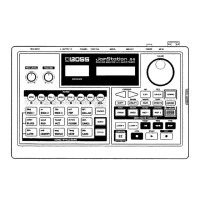
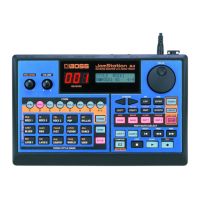
Detailed descriptions of knobs, buttons, and display elements on the front of the JS-5 unit.
Identification and function of all input/output jacks, power switch, and MIDI connectors on the rear panel.
Explains typographical conventions like button names in brackets and key combinations used in the manual.
Illustrates necessary external equipment connections like amps, speakers, headphones, and foot switches.
Step-by-step guide for safely powering on the JS-5 and connected audio devices in the correct order.
Procedure for safely powering down the JS-5 and connected audio devices in the correct order.
Guide on selecting and playing the 200 onboard preset songs categorized by genre.
Instructions on how to adjust the tempo of a song that is currently being played.
Procedure for changing the musical style of a preset song to alter its accompaniment patterns.
Guide on how to input custom chords for playing preset songs, deactivating original chord progressions.
Explanation of the components of a song: Style, Form track, Chord track, and Audio track.
Step-by-step guide to creating original songs using the interactive EZ Compose feature.
Instructions for erasing forms and chords within specified measure ranges.
Procedures for copying forms and chords within specified measure ranges to other locations.
Methods for deleting existing measures or inserting empty measures into songs.
Process for copying entire preset or user songs, including audio data, to other locations.
How to adjust the volume level for individual parts (Inst 1, Inst 2, Drum, Bass) and the audio track.
Controlling the amount of chorus and reverb applied to parts, and adjusting direct sound volume.
Guide to modifying parameters for Reverb, Chorus, and Insert Effects to customize sound.
Procedure for selecting different drum kits, which are groupings of percussion instrument sounds.
Instructions for changing the instrument sounds used for Bass, INST 1, and INST 2 parts.
Important notes before recording, including available time, input selection, and audio quality options.
Step-by-step process for new audio recordings, including tempo adjustment and track selection.
Methods for rerecording performances over existing audio data or deleting recorded audio data.
Guidance on using the JS-5 for practicing difficult musical passages by adjusting tempo and playback.
How to set and play specified measure ranges repeatedly within a song.
Instructions on connecting foot switches and setting their functions for performance control.
Important considerations for creating user styles, including chord progression and arrange mode.
Procedure for recording performance patterns from a MIDI keyboard to create user styles.
Instructions for inserting, handling, and protecting memory cards (SmartMedia) for the JS-5.
Procedure for formatting memory cards to ensure compatibility and proper function with the JS-5.
How to save all JS-5 settings as a backup file to a memory card and restore them later.
Instructions for deleting backup files or other unneeded data from the memory card.
Guide to adjusting the LCD contrast for better visibility of the display.
Procedure for tuning the JS-5's internal sound generator to a specific frequency.
How to adjust metronome sound levels or turn it off during user style recording.
Restores all JS-5 settings to their original factory values, erasing all user data.
Information on checking available memory in User Memory, Memory Card, and Temporary Area.
Explanation of MIDI basics, connectors, channels, and messages used for controlling the JS-5.
Details on transmitted and recognized MIDI messages, including channel voice and system messages.
Guide on connecting external MIDI instruments to use the JS-5 as a sound module.
Instructions for synchronizing JS-5 playback with external MIDI devices using various Sync modes.
Procedures for sending (bulk dump) and receiving (bulk load) data to/from external MIDI devices.
Solutions for common problems related to no sound output, including volume, muting, and effect levels.
Troubleshooting steps for when the [START] button does not initiate playback, checking sync modes and song data.
Solutions for issues preventing recording, such as memory limits, card insertion, protect stickers, and song selection.
List of error messages displayed by the JS-5 and recommended solutions for each.
A comprehensive list of all 200 preset songs, categorized by genre.
A list of all 200 preset styles, categorized by genre, indicating ideal melody types.
An index of all 128 available instruments, including bass sounds, with their corresponding numbers.
A detailed chart showing drum kit contents and corresponding note numbers for each percussion instrument.
Visual representation of chord types and their note structures, with the root C as a reference.
Details on channel voice messages, system messages, and control changes transmitted and recognized by the JS-5.
Information on universal non-realtime system exclusive messages and data transmission protocols.
Overview of JS-5 features including polyphony, instruments, effects, styles, songs, resolution, and tempo.
Details on input/output connectors, power supply requirements, and current draw.
Information on available recording times for internal memory and memory cards, and memory usage.
 General
| Sampling Rate | 44.1 kHz |
|---|---|
| Bit Depth | 16-bit |
| Phrase Trainer | Yes |
| Built-in Effects | Chorus, Reverb |
| Power Supply | AC adapter |

 To Next Page