This document is a user manual for the Bowers & Wilkins 700 Series 3 loudspeakers. It provides comprehensive instructions for installation, positioning, connection, fine-tuning, running-in, and aftercare of the speakers.
Function Description:
The Bowers & Wilkins 700 Series 3 are high-performance loudspeakers designed to deliver an immersive audio experience in home stereo and home theatre systems. They are engineered with imaginative design, innovative engineering, and advanced technology to unlock the enjoyment of audio. The series includes various models: 702 S3, 703 S3, 704 S3, 705 S3, 706 S3, 707 S3, HTM71 S3, and HTM72 S3, each with specific installation and positioning guidelines. The speakers are designed to be floor-mounted (702 S3, 703 S3, 704 S3) or placed on dedicated floor stands or shelves (705 S3, 706 S3, 707 S3, HTM71 S3, HTM72 S3). They support both conventional and bi-wired connections to an amplifier, allowing for flexibility in system setup and potential improvements in sound resolution. The speakers feature port tubes that can be fine-tuned with foam plugs or rings to adjust bass performance according to room acoustics and personal preference.
Important Technical Specifications (derived from the manual's content):
- Speaker Models: 702 S3, 703 S3, 704 S3, 705 S3, 706 S3, 707 S3, HTM71 S3, HTM72 S3.
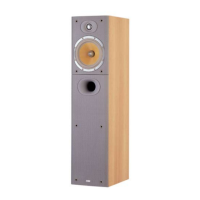
- Floor-standing Models: 702 S3, 703 S3, 704 S3. These models require the installation of a plinth for stability and can use either spike feet (for carpeted floors) or rubber feet (for hard surfaces).
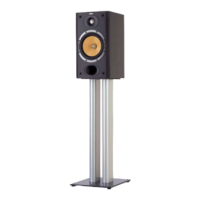
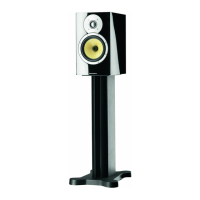
- Shelf/Stand-mounted Models: 705 S3, 706 S3, 707 S3. These are primarily designed for dedicated floor stands (FS-700 S3) but can be placed on a strong shelf. They should use self-adhesive rubber feet if placed on a shelf.
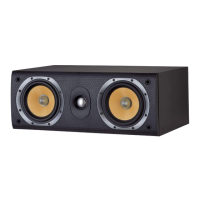
- Centre Channel Models: HTM71 S3, HTM72 S3. These can be positioned behind an acoustically transparent screen, or directly below/above a screen on a floor stand, furniture unit, or wall shelf. They also use self-adhesive rubber feet for vibration isolation.
- Tweeter Assembly: Decoupled component, mechanically isolated from the main cabinet, ensuring optimum performance. This design feature means the tweeter may appear loose when unboxed, which is normal.
- Speaker Terminals: Accept 4mm banana plugs, 6mm and 8mm (1/4 in and 5/16 in) spades, or bare wires up to 4mm (5/32 in) diameter.
- Connection Types: Supports Conventional Connection (using terminal links) and Bi-Wired Connection (removing terminal links).
- Environmental Compliance: Complies with international directives including Restriction of Hazardous Substances (RoHS), Registration, Evaluation, Authorisation and restriction of Chemicals (REACH), and Waste Electrical and Electronic Equipment (WEEE).
- Magnetic Fields: Drive units create stray magnetic fields. Magnetically sensitive articles (CRT televisions, computer screens, computer discs, audio/video tapes, swipe cards) should be kept at least 0.5m away. LCD, OLED, and plasma screens are not affected.
Usage Features:
- Plinth Installation (702 S3, 703 S3, 704 S3): The plinth is essential for stability and must always be used. Spike feet are designed to pierce carpet and rest on the floor, with lock nuts for adjustment. Rubber feet are provided for hard floors. A tommy bar and spanner are included for spike/rubber feet installation on the 702 S3 model.
- Speaker Positioning:
- Conventional Stereo Systems: Speakers should be 1.5m to 3m apart, forming an equilateral triangle with the listening area. They should be at least 0.5m away from back and side walls. Tweeters should be approximately at ear height.
- Home Theatre Systems: Front channels should be placed closer together than for 2-channel audio, ideally within 0.5m of the screen sides to match the visual image. They should also be at least 0.5m from any side walls.
- Acoustic Environment: Ensure similar acoustic character around each speaker (e.g., avoid one speaker near bare walls and another near soft furnishings) to prevent compromised sound quality and stereo imaging.
- Fine-Tuning:
- Bass Adjustment: Moving speakers further from walls reduces bass; moving them closer increases bass. Foam plugs (two-piece, allowing for partial or full insertion) or foam rings can be inserted into port tubes to reduce bass volume.
- Resonance Modes: Uneven bass with frequency may indicate room resonance modes. Adjusting speaker or listening position, or relocating speakers to a different wall, can help. Large furniture pieces can also influence resonance.
- Central Image Focus: If the central image lacks focus, move speakers closer together or angle them inward.
- Sound Brightness/Dullness: Increase soft furnishings (e.g., heavier curtains) to balance a bright sound; reduce soft furnishings to brighten a dull sound.
- Grilles: For optimal listening, grilles can be removed by gently pulling them away from the cabinet edges.
- Running In: The speaker's performance will subtly change during an initial listening period. This includes damping compounds and suspension materials recovering mechanical properties and drive unit suspensions loosening. Allow up to a week for temperature effects to stabilize and 15 hours of average use for mechanical parts to attain intended design characteristics.
Maintenance Features:
- Cabinet Cleaning: Use a soft microfibre cloth for dusting. If using an aerosol or cleaner, apply it to the cloth first, not directly to the product. Test on a small area. Avoid abrasive, acidic, alkaline, or anti-bacterial cleaning agents.
- Drive Unit Care: Avoid touching the drive units as damage may result. Do not use cleaning agents on them.
- Wood Veneer Care: Bowers & Wilkins speakers with real wood veneers are treated with ultra-violet resistant lacquer to minimize colour changes. However, some colour change is natural. Exposing all veneer surfaces equally and evenly to sunlight can help unify colour. Keep wood veneered surfaces away from direct heat sources (radiators, warm air vents) to prevent cracking.
- Tweeter Housing Cleaning: The textured tweeter housing can be cleaned by wiping a soft microfibre cloth around it, following the surface texture.
- Disposal: Consult local waste disposal authority for guidance on proper recycling or disposal of the product in accordance with WEEE directives.

 Need help?
 General





 To Next Page