The AMPTS® III (Automatic Methane Potential Test System III) is a next-generation analytical platform developed by BPC Instruments for conducting anaerobic batch fermentation tests. It builds upon the features of its predecessor, AMPTS II, with significant improvements and further developments across all components.
Function Description:
The AMPTS III is designed to cover a broad range of applications related to anaerobic digestion and fermentation processes. Its primary function is to continuously collect and measure gas produced during the degradation of organic material under anaerobic conditions, allowing for the determination of dynamic degradation profiles for various biomass substrates.
Key applications include:
- Biochemical Methane Potential (BMP) tests: Quantifying the maximum methane yield from a substrate.
- Biogas production analysis: Determining gas composition based on methane and carbon dioxide.
- Specific Methanogenic Activity (SMA) assays: Assessing the activity of methanogenic microorganisms.
- Residual Gas Potential (RGP) assays: Measuring the remaining gas potential of a substrate.
- Biological Hydrogen Potential (BHP) tests: Evaluating hydrogen production from fermentation.
The instrument is also valuable for optimizing parameters in the Anaerobic Digestion (AD) process, such as identifying optimal substrate mixes for co-digestion, evaluating pre-treatment methods, and assessing the need for additives.
A significant enhancement over the previous AMPTS II is the capability to perform both single gas (e.g., methane) and total gas (e.g., biogas) measurements within the same batch test, enabling the estimation of gas composition. The measured gas can also be easily collected for further off-line composition analysis.
The system operates in three main stages:
- Gas Generation (Incubation Unit - Unit A): The anaerobic digestion or dark fermentation process occurs here, generating accumulated gas volume and flow rate (CH₄ + CO₂ or H₂ + CO₂). This gas is continuously measured by the first BPC Core AMPTS Unit in a DUO configuration.
- Gas Absorption (CO₂-absorption Unit - Unit B): For methane or hydrogen measurements, acid gases like carbon dioxide and hydrogen sulfide are removed through a chemical reaction with a 3 mol/L NaOH solution. This ensures that only the target gas reaches the detection unit. If total biogas measurement is desired, this unit is bypassed.
- Gas Detection (Detection Unit - Unit C): The processed gas (CH₄ or H₂) is collected and measured. The system automatically compensates for atmospheric pressure, environmental temperature, and moisture content changes to normalize data to standard conditions.
The AMPTS III DUO configuration further enhances testing capacity by allowing simultaneous measurement of total gas and a specific gas component (e.g., CH₄) from 18 samples. This involves two BPC Core AMPTS Units.
Important Technical Specifications:
The AMPTS III system comprises three main units:
-
Incubation Unit (Unit A):
- Reactor Capacity: 18 channels for AMPTS III (0.5 L or 1 L reactors as standard/option) and 9 channels for AMPTS III Light (2 L reactors).
- Temperature Control: Thermostatic water bath (68 x 56 x 33 cm) with a temperature range up to 60°C and a precision of 0.2°C. A lid minimizes water loss and ensures rapid temperature set point achievement.
- Agitation System: Each reactor is connected to a brushless DC motor for well-mixed content. Remote speed control up to 220 rpm, adjustable rotation directions, and a timer function for motor reversal are available.
- Motor Controller Unit (MCU): Provides power to the motors. It must be turned off and unplugged when connecting/disconnecting cables.
-
CO₂-absorption Unit (Unit B):
- Bottle Holders: AMPTS III comes with two bottle holder units, each for nine 250 mL bottles. AMPTS III Light has one bottle holder for nine 250 mL bottles.
- Absorption Efficiency: Higher than 98% even at high flow rates, using 3 mol/L NaOH solution.
- pH Indicator: Thymolphthalein is used to monitor the NaOH solution's capacity to retain CO₂, changing from blue to colorless around pH 9.
-
Detection Unit (BPC Core AMPTS Unit - Unit C):
- Flow Cell Units (FCUs): 18 or 9 independently operating flow cell units for simultaneous gas volume detection.
- Measurement Resolutions: Two possible resolutions: 2 mL and 9 mL, for low and ultra-low gas measurements.
- Operational Principle: Based on liquid displacement and buoyancy. The system counts each flow cell opening and registers temperature and pressure for automatic data normalization.
- Electronics: New electronics for faster and more stable operation.
- Storage Capacity: 150 times higher storage capacity compared to AMPTS II (130,000 L of gas can be recorded compared to 900 mL for a 9 mL FCU).
- Connectivity: USB port for software upgrades, Ethernet port for network connection.
- Display: OLED screen displaying IP address, software version, environmental parameters (temperature and pressure), and alignment indicator.
- Leveling: Built-in accelerometer for leveling the unit C, adjustable feet for instrument leveling.
Usage Features:
- Standalone Operation: Embedded data acquisition and web server for remote access, eliminating the need for software installation on a dedicated computer.
- Web-based Software (Aurora™): Accessible locally or remotely via a web browser (preferably Google Chrome) from any device.
- User-friendly Interface: Organized topics for experimental setup, execution, monitoring, and reporting.
- Experiment Setup: Allows for calculated or manual parameter entry for each reactor, including inoculum and substrate concentrations, ISR, and organic matter content.
- Real-time Control: Direct interaction with channels and motors. Users can start/stop all or selected channels, pause/resume data registration, and clear data.
- Agitation Control: Motors can be controlled in continuous (single) or two-phase (double) modes, with adjustable speeds and ON/OFF intervals.
- Data Visualization: Provides graphs for accumulated gas volume and flow rate as a function of time. Data can be normalized (dry/wet) and displayed in different units (NmL/min, NmL/h, NmL/day). Zoom functionality for detailed real-time data visualization.
- Reporting: Generates and downloads reports in CSV or Microsoft Excel (XLSX) format, with various settings for gas normalization, flow units, and interpolation intervals.
- System Log: Records events for operational diagnosis and troubleshooting.
- Easy Setup: Step-by-step instructions for instrument installation, including reactor fixation, water bath filling, agitation system connection, and CO₂-absorption solution preparation.
- Tubing Management: New tubing markers for easy channel identification and soft binders for grouping tubing. A bottle/tube opening tool is provided to simplify removal of lids and tubing.
- Anaerobic Environment Creation: Push-in valves simplify the flushing step of the reactor headspace.
- Pre-calibrated Measuring Cells: The measuring cells are factory-calibrated.
Maintenance Features:
- Easy Maintenance: Most components are easily exchangeable without special requirements.
- Consumables: Flow cell units are considered consumables and cannot be opened. Reactors and stirrers are autoclavable.
- Cleaning: The detection unit should be wiped with a damp cloth and mild detergent; water must not enter the machine.
- Water Bath: Use deionized water in the thermostatic water bath to prevent calcification or corrosion.
- Chemical Disposal: Used NaOH solution must be disposed of as hazardous waste, not poured into the sink.
- Spare Parts & Support: Spare parts and a Maintenance Package (including recommended consumables) are available through the BPC Instruments webshop or direct contact.
- Operational Diagnosis: System log for troubleshooting and support contact.

 Need help?
 General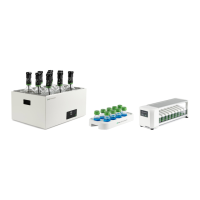

 To Next Page