8
HOIST INSTALLATION
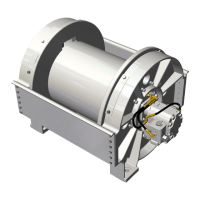
1. The hoist should be mounted with the centerline of
the cable drum in a horizontal position. The mount-
ing plane of the hoist may be rotated in any position
around this centerline providing the vent in the motor
adapter is above the centerline of the cable drum. The
vent should be as close to top dead center as pos-
sible.
2. When mounting the hoist, use all four mounting holes
and Grade 8 bolts and nuts. Evenly tighten the nuts
to the torque in the Recommended Fastener Torque
chart in this manual. Make certain the hoist drum is
centered behind the rst sheave and the eet angle
does not exceed 1-1/2 degrees. The hoist should also
be mounted perpendicular to an imaginary line from
the center of the drum to the rst sheave to ensure
even spooling.
Refer to dimensional drawing in this manual and in sales
brochure for bolt hole size and pattern.
It is important that the hoist is mounted on a surface that
will not ex when the hoist is in use, and cause binding of
the gear train. Binding in the gear train will result in accel-
erated wear and heat. Also, the mounting surface should
be at with +/- 0.020 inch. If necessary, install shims un-
der the hoist mounting pads to achieve even mounting.
3. The hydraulic lines and components that operate the
hoist should be of sufcient size to assure minimum
back pressure at the hoist. The back pressure at the
motor must not exceed 100 PSI (690 kPa) to maintain
full brake system design factor and optimum motor
seal life for gear motors, 30 PSI (207 kPa) for piston
motors. On all piston motors and on gear motors with
backpressures above 50 PSI, an external line should
be plumbed directly to tank from the motor case drain.
On tandem motors (two inlet and two outlet ports on
the motor) that have two case drain ports, the larger
center case drain should be plumbed to tank.
The hoist directional control valve must be a three-posi-
tion four-way valve with a motor spool such that when the
valve is in the center position both work ports are open
to tank (open center, open port), and must be spring-
centered and without detents.
4. High-quality hydraulic oil is essential for satisfactory per-
formance and long hydraulic system component life.
Oil having 150 to 330 SUS viscosity at 100°F (38°C) and
viscosity index of 100 or greater will give good results un-
der normal temperature conditions. The use of an oil hav-
ing a high viscosity index will minimize cold start trouble
and reduce the length of warm-up periods. A high vis-
cosity index will minimize changes in viscosity with cor-
responding changes in temperature.
Maximum cold weather start-up viscosity should not ex-
ceed 5,000 SUS with a pour point at least 20°F (11°C)
lower than the minimum ambient temperature.
Under continuous operating conditions the temperature of
the oil at any point in the system must not exceed 180°F
(82°C). 120°F (49°C) to 140°F (60°C) is generally consid-
ered optimum.
In general terms:
For continuous operation at ambient temperatures be-
tween 50°F (10°C) and 110°F (43°C) use SAE 20W; for
continuous operation between 10°F (-12°C) and 90°F
(32°C) use SAE 10W; for applications colder than 10°F
(-12°C), contact the BRADEN Service Department. The
use of multiviscosity oils is generally not recommended.
For hoist gear oil, refer to lubricant specications in the
Preventive Maintenance and Specications section of this
manual.
5. The hydraulic oil lter should have a 10-micron nomi-
nal rating and be full-ow type.
6. The vent plug in the motor adapter (and auxiliary brake
end if equipped) must be located as close to top dead
center as possible. If the hoist is mounted on a pivot-
ing surface, the vent plug must remain above the cen-
terline of the cable drum to prevent gear oil leakage.
7. Refer to dimensional drawing for relationship between
drum rotation and which port is pressurized.
Recommended Control-
valve Schematic
DO NOT use a control valve with any detents or latch-
ing mechanism that would hold the control valve in an
actuated or running position when the operator releas-
es the control handle. Use of the wrong type of control
valve could lead to unintentional operation of the hoist,
which could result in property damage, personal injury,
or death.
THE CABLE ANCHORS ALONE ON HOISTS ARE
NOT DESIGNED TO HOLD RATED LOADS. Loads
applied directly to the wire rope anchor may cause the
wire rope to pull free and result in the sudden loss of
load control and cause property damage, personal inju-
ry, or death. A minimum of ve wraps of wire rope must
be left on the drum barrel to achieve rated load.


 To Next Page