GB
55
General Warning
Risk of bodily injury!
Never use this device to look directly at the sun or in the direct proximity of the sun.
This will result in a risk of blindness.
• Children should only use the device under adult supervision. Keep packaging material, like plastic bags and
rubber bands, out of the reach of children, as they pose a choking hazard.
• Never subject the device, especially the optics, to direct sunlight. The concentration of light can cause res
or burns.
• Do not disassemble the device. In the event of a defect, please contact your dealer. The dealer will contact the
Service Centre and can send the device in to be repaired, if necessary.
• Do not expose the device to high temperatures.
Privacy protection!
This device is intended only for private use. Please heed the privacy of other people. Do not use
it to look into apartments, for example.
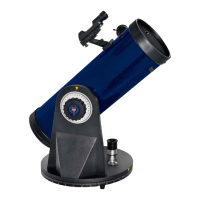
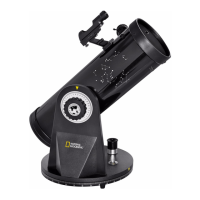
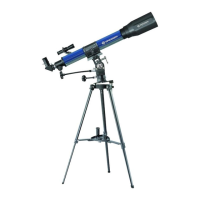
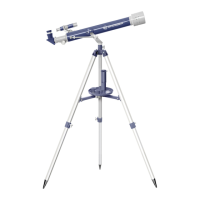
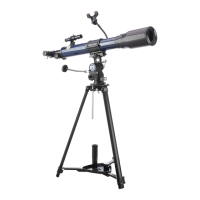
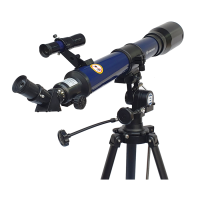
Your telescope consists of these parts:
1. Focus wheel
2. Telescope (Telescope tube)
3. Compass
4. Alt-azimuth mount
5. Azimuth scale
6. Scale with 90° steps
7. Height adjustment wheel
8. LED Viewnder
Additional equipment:
9. Two Eyepieces (6 mm, 20 mm)
10. Barlow lens 2X
11. Moon lter
Please look for a suitable location to set up your telescope before you begin. Use a stable surface like a table
or countertop.
Pointing your telescope
An Azimuthal mounting means that you can move your telescope up and down, left and right.
With the height adjustment wheel (7) and the turnable azimuth mount, you can point the telescope at any ob-
ject you want. Use the wheel (7) to tilt the telescope up and down. By using the azimuth mount like a turntable
you can pan the telescope to the left and to the right.
Fine adjustment is done with the aid of the LED Viewnder (8). Look through the viewnder and try to align it
with the North Star in the centre of the crosshairs (No. 1).
Which eyepiece is right?
It is important that you always choose an eyepiece with the highest focal width for the beginning of your
observation. Afterwards, you can gradually move to eyepieces with smaller focal widths. The focal width is
indicated in millimeters, and it is written on each eyepiece. In general, the larger the focal width of an eyepiece,
the smaller the magnication.





 To Next Page