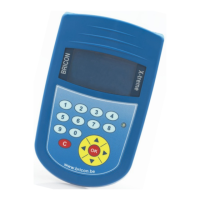
The BRICON electronic clock (EC).
Electronic clocking on the loft.
1. Introduction
1.1. Electronic clocking systems, the basic principles.
The basic principle of an electronic clocking device is the identification of a
pigeon from a distance or identification without direct contact. RFID (Radio
Frequency Identification) is one of the techniques used for this purpose.
This technology has become very popular since the eighties and is already
being frequently used. Electronic clocking systems for pigeons use RFID.
1.2. What is RFID?
RFID systems consist of three elements: an antenna, a decoder and a
transponder.
The antenna emits radio signals which activate the transponder. The data
can be read in the transponder and can be written on. The antenna is the
link between the transponder and the decoder. The contact between the
antenna and the transponder is wireless and consists of radio waves. The
transponder holds the identification data, the decoder interprets these data
and controls the antenna.
A transponder consists of the following components:
a spool used as an antenna,
a chip (IC) which has a radio transmitter / receiver and a computer with a
memory.
A transponder can only function if it is supplied by power. Depending on the
power source we talk about:
an active transponder or
a passive transponder
An active ID-transponder not only has a antenna spool and a chip, but also
a battery supplying everything with power. This built-in power source
increase the performances of the transponder, enabling it to be read and/or
be written on on larger distances.
Passive ID-transponders have no internal power source, they get their
power from the antenna. The advantage of these transponders is in their
smaller sizes, their smaller production costs and their almost infinite life
span. Since there is no power source their emitted signal is so weak they
can only be read on limited distances.
1.3. What are the advantages of RFID?
The most important advantages of an RFID system can be reduced to the
possibility to identify automatically without using pen and paper. It can be
used in almost all circumstances.
RFID is the obvious means in dusty, dirty, greasy, wet and even very
aggressive places.



 To Next Page